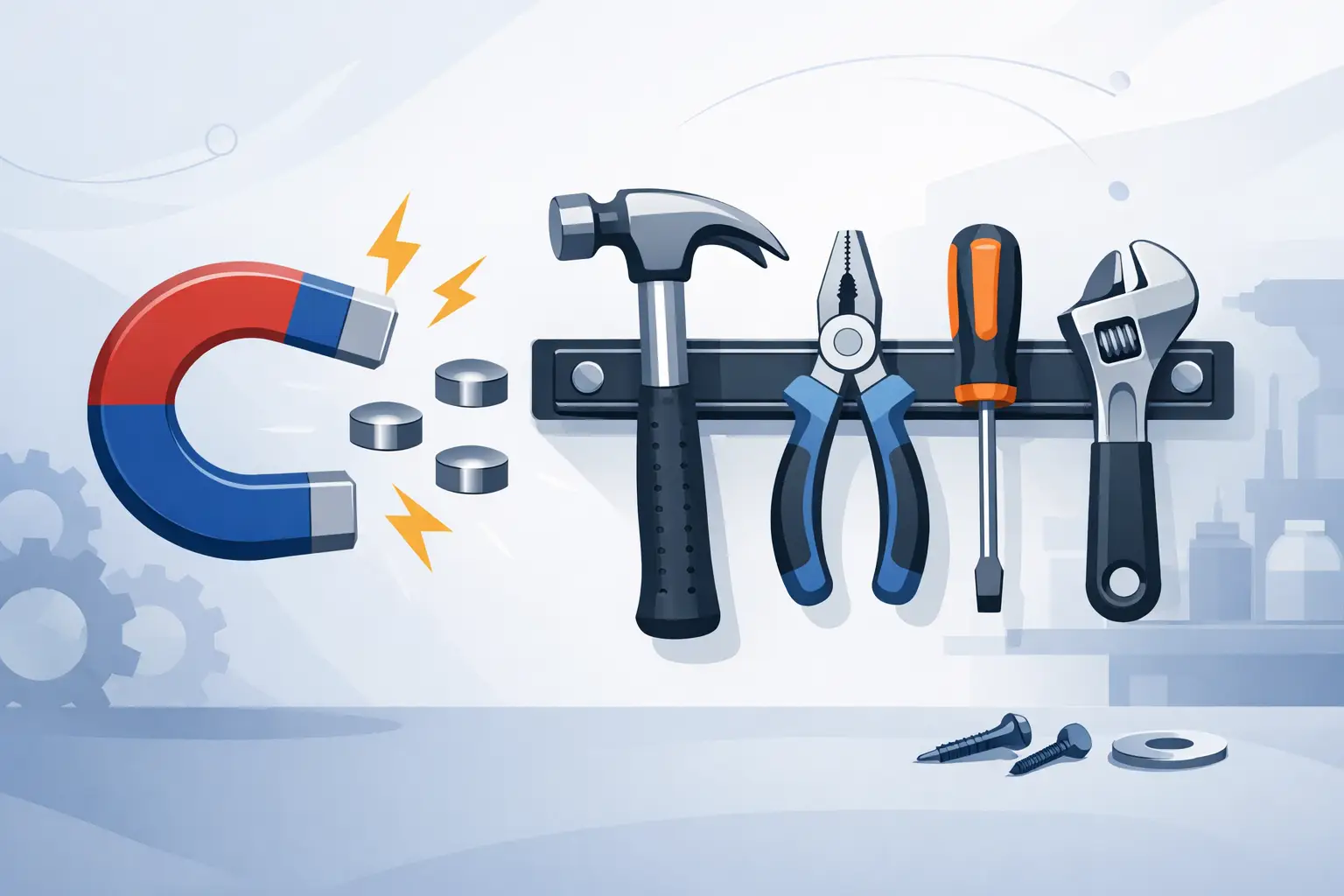
Best Magnets for Tool Holders
A tool holder only works if the magnet does. If spanners slide, drill bits rattle loose or heavier hand tools creep down the strip over time, the issue is rarely the holder itself. In most cases, it comes down to choosing the best magnets for tool holders for the weight, contact area and fixing method involved.
For workshop storage, retail fit-outs and custom van or garage organisation, strong neodymium magnets are usually the right place to start. They offer far more pull strength than standard ferrite magnets in a much smaller size, which makes them ideal when space is limited but reliable holding power matters.
What makes the best magnets for tool holders?
The short answer is pull strength, but that is only part of it. The best magnets for tool holders need to match the shape of the tools, the material of the holder and the way the magnet is mounted.
A magnet can be extremely strong on paper and still perform badly in use if the contact area is poor. A heavy screwdriver with a rounded shaft behaves differently from a flat spanner. A steel-backed holder also changes performance because the steel helps direct and strengthen the magnetic field. That is why magnet format matters just as much as grade.
For most practical builds, N52 neodymium magnets are the strongest and most versatile option. They provide superior pull performance for their size, which is exactly what you want in a compact tool holder. Whether you are fitting magnets into a timber rack, recessing them into a fabricated metal frame or screwing them into a custom panel, N52 gives you more usable strength without needing oversized components.
Choosing the right magnet format
Disc magnets for compact tool rails
Disc magnets are a strong choice when you want a clean, compact layout. They are easy to recess into timber, plastic or routed housings, and they suit holders designed for lighter to medium-weight tools such as screwdrivers, hex keys, drill bits and small pliers.
Their main advantage is flexibility. You can space them evenly across a rail, increase holding points where needed and keep the overall holder slim. For smaller hand tools, this often gives a neater and more controlled result than relying on one long magnet strip.
The trade-off is that individual disc magnets create localised holding points. If the spacing is wrong, some tools may sit securely while others feel less stable. That is usually solved by adding more magnets or using a steel face to spread magnetic attraction across the holder.
Block magnets for broader contact area
If the holder needs to support larger tools or give more even grip across the full width, block magnets are often the better option. Their larger surface area helps with tools that do not naturally sit on a small magnetic point, including wider spanners, chisels and heavier workshop items.
Block magnets also suit custom tool holders where the magnet is bonded behind a panel or embedded into a backing plate. Because the magnetic field is spread over a broader area, they can feel more secure in day-to-day use, especially when tools are frequently lifted off and replaced.
This format works well when consistency matters more than the smallest possible footprint. In a busy workshop, that extra contact area can make the holder feel more dependable.
Countersunk magnets for secure fixing
Countersunk magnets are often the best answer when the magnet itself needs to be mechanically fixed rather than glued in place. They are particularly useful in tool holders exposed to vibration, repeated impact or regular movement, such as mobile tool boards, van storage or fold-down workshop panels.
With a countersunk hole, the magnet can be screwed directly into position for a cleaner and more reliable installation. That reduces the risk of adhesive failure and gives you greater confidence over time. For heavier-duty holders, this can be the difference between a tidy long-term solution and a holder that slowly works loose.
The main point to watch is screw choice and fit. Over-tightening can damage the magnet, and poor alignment can reduce performance. Used properly, though, countersunk neodymium magnets are one of the most practical formats for fixed tool storage.
Strength matters, but so does the real working setup
When buyers look for strong magnets, they often focus only on the highest pull figure. That makes sense up to a point, but quoted pull strength is usually based on ideal conditions – direct contact with a thick, clean steel surface and a straight pull away from it.
A tool holder is rarely an ideal condition. Paint, powder coating, uneven tool shapes, timber covers and sideways movement all reduce effective holding force. That is why it is worth building in a safety margin rather than sizing the magnet to the bare minimum.
If a tool weighs enough to make you hesitate, move up in strength or increase the number of magnets. A holder that feels slightly over-specified is normally the right call in real workshop use. It gives better retention, better confidence and less chance of tools shifting when bumped.
Material and mounting choices affect performance
A strong magnet still needs a sensible mounting method. For timber holders, recessed fitting usually gives the cleanest result and helps prevent magnets being knocked directly. Adhesive can work well for lighter applications, but for higher loads or repeated use, mechanical fixing is more dependable where the magnet format allows it.
In steel tool holders, the surrounding metal can either help or hinder depending on the design. Used properly, a steel backing plate can improve magnetic efficiency by directing the field towards the tool. Poor placement, on the other hand, can create an awkward layout or reduce the practical holding face.
For custom fabricated holders, testing the setup before final fixing is worth the time. Even a very strong magnet behaves differently once it sits behind a cover material or inside a recessed channel.
Which magnets suit different tool holder jobs?
For a simple wall-mounted holder for screwdrivers and small hand tools, N52 disc magnets are usually the most efficient choice. They are compact, powerful and easy to install in a tidy row.
For heavier spanners, pliers or mixed-use workshop rails, N52 block magnets tend to offer a better balance of grip and contact area. They help tools sit more naturally and reduce the chance of uneven holding points.
For van fit-outs, mobile boards or holders that need a more secure installation, countersunk neodymium magnets are often the strongest practical option. They combine powerful hold with screw fixing, which makes them well suited to demanding environments.
If the holder needs to support unusually heavy items, there is no single best answer. In that case, a combination of larger magnets, closer spacing and a steel-backed design may be more effective than simply choosing one oversized magnet.
Common mistakes when choosing magnets for tool holders
The most common mistake is underestimating how much holding power is lost in everyday use. A magnet that feels strong in your hand can still be too weak once fitted behind wood, paint or a protective face.
The second is choosing the wrong shape. Disc magnets are excellent in many holders, but not every tool suits point contact. If the tools twist or sit awkwardly, a block format may immediately perform better.
The third is relying on adhesive alone in a higher-stress application. For fixed workshop rails this may be fine, but for portable storage or regular vibration, a mechanically fixed magnet is usually the safer option.
Buying for performance, not guesswork
If you are building or upgrading a tool holder, it pays to buy from a specialist rather than treating magnets as an afterthought. Product consistency, accurate sizing and dependable pull performance matter when the goal is a holder that works every day, not just for the first week.
A focused range of strong neodymium disc, block and countersunk magnets makes selection easier because you can choose around the job rather than compromise with whatever happens to be available. That is exactly why many UK trade and DIY buyers come to specialists such as Magman when they need powerful and versatile magnetic solutions with straightforward ordering.
The best tool holder magnet is the one that matches the real job – the weight of the tools, the holder design and how hard that setup will be worked. Get that right, and the result feels simple every time you reach for a tool and it stays exactly where it should.