Magnetic Catches Installation Guide
A cupboard door that will not stay shut usually comes down to one of two things – poor alignment or a catch that is simply not strong enough for the job. This magnetic catches installation guide is built for both DIY and trade users who want a neat, reliable closure without wasting time on trial and error.
Magnetic catches are simple in principle, but the result depends on choosing the right format, placing it accurately and fixing it to a stable surface. Get those three things right and you get a clean, dependable close. Get them wrong and even a super-strong catch can feel weak, noisy or inconsistent.
Before you start your magnetic catches installation guide
The first decision is not where to screw the catch. It is whether the catch you have chosen suits the door, panel or flap you are fitting. A lightweight kitchen unit door, a heavier wardrobe door and a retail display hatch do not all need the same pull performance.
If the door is light and well hung, a compact magnetic catch is often enough. If it is heavier, slightly warped or likely to be opened frequently, step up to a stronger unit with better holding force. The catch is only one part of the system, though. Loose hinges, bowed panels and uneven frames will all reduce performance.
Surface material matters too. Timber and MDF are straightforward. Thin sheet material, laminate-faced board and metal-framed units can need a bit more care, especially if screw bite is limited or the fixing area is narrow.
Before fitting anything, check the door closes square to the frame. If it does not, fit the hinges correctly first. A magnetic catch is there to hold a door shut, not to drag a badly aligned door into position every time.
What you need for a clean installation
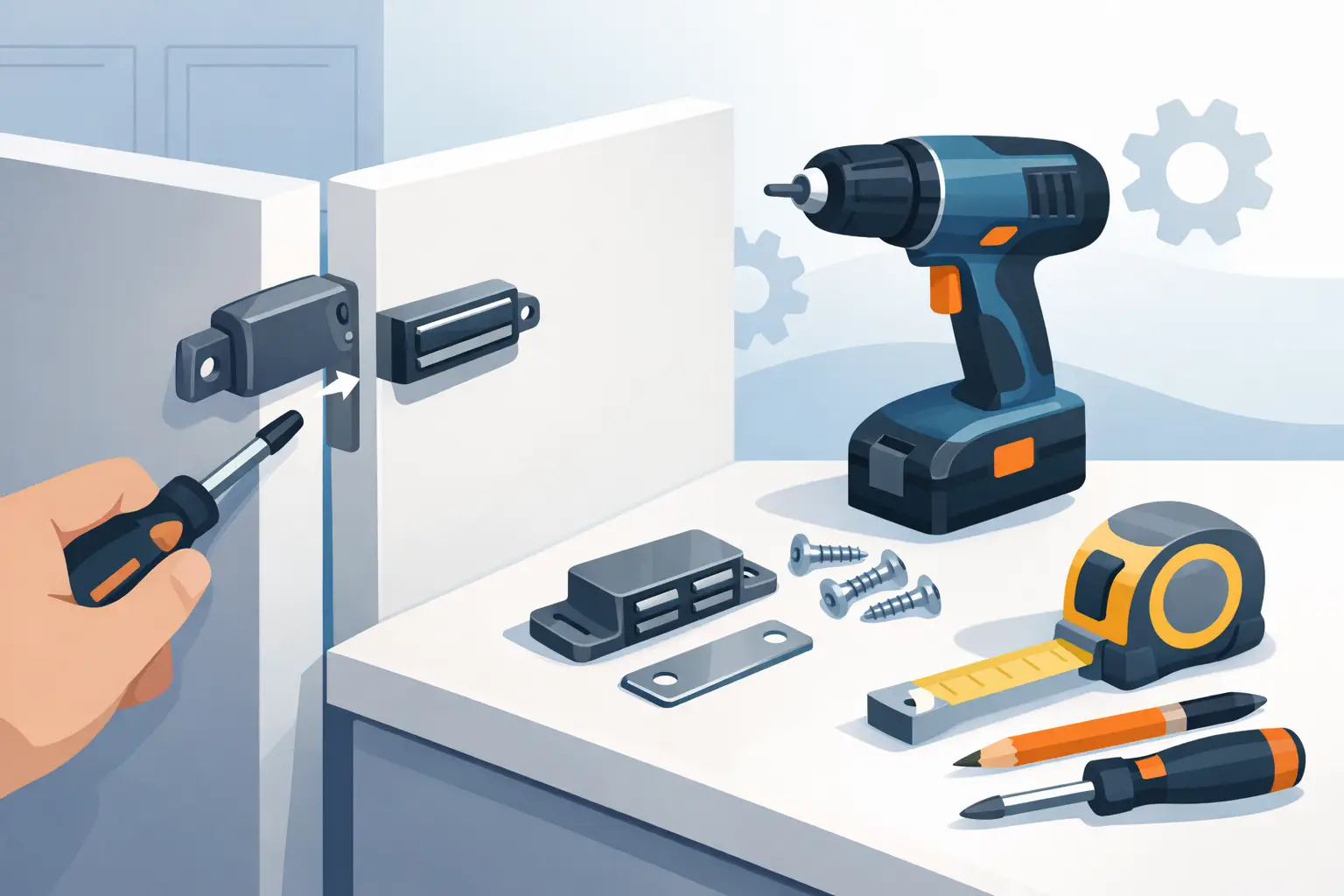
Most installations only need basic tools: a pencil, tape measure, drill, suitable pilot bit, screwdriver and screws matched to the material. A bradawl can help mark timber cleanly before drilling. If you are fitting several catches in joinery or shopfitting work, a simple marking jig saves time and keeps positions consistent.
Use fixings that suit the substrate. Short screws may be right for thinner cabinet sides, while deeper timber can take a more secure fixing. Overtightening is a common mistake, particularly on smaller catches. It can distort the housing slightly or strip the board, which weakens the installation from day one.
Choosing the best position
In most cabinet applications, the magnetic catch is fitted on the inside top corner of the carcass, with the strike plate fixed to the rear of the door. That position keeps the hardware discreet and gives reliable holding on a standard hinged door.
There are exceptions. A tall door may benefit from a lower fixing point if movement at the top is causing misalignment. Wider doors sometimes work better with two catches, especially if the panel has any twist or if an even close across the width matters. For flap doors or access panels, the best position depends on how the panel opens and where the load sits when closed.
The key point is simple: fit the catch where the door meets the frame cleanly and where the magnet and plate can meet flat. If the strike plate lands at an angle, the effective pull drops quickly.
How to fit a magnetic catch properly
Offer the catch into place inside the unit and check that the door can shut without fouling it. Mark the screw holes lightly with pencil or an awl. Drill pilot holes if you are fixing into timber or MDF. This helps prevent splitting and keeps the screws straight.
Fix the body of the catch first, but do not fully tighten the screws until you have checked position. A small amount of adjustment now can save repeated repositioning later.
Next, close the door gently and mark where the strike plate needs to sit. Some installers use a dab of pencil or masking tape to transfer the position. Others hold the plate against the magnet, close the door carefully, then mark around it. Either approach works as long as the plate ends up centred on the magnet face.
Fix the strike plate to the door and test the close. You want a firm pull in the final part of travel, not a hard slam. If the magnet grabs too late or not at all, the plate is likely off-centre or sitting too far away. If the door feels like it rebounds, the catch may be too strong for the hinge tension or the door may be meeting the frame unevenly.
Once the alignment is right, tighten all screws securely without forcing them.
Magnetic catches installation guide for different applications
Cabinet doors are the most common use, and they are usually the easiest. A single catch near the top corner is often enough for standard hinged doors. If the door is taller or heavier, a second catch can improve stability and reduce rattle.
Wardrobe and utility doors often need stronger holding force because the door size creates more leverage at the closing edge. In these cases, stronger magnetic hardware gives a more dependable shut, especially where the door is opened many times each day.
Retail units and display cabinets are slightly different. Appearance matters more, and the close often needs to feel precise rather than aggressive. Good alignment is everything here. A powerful magnetic catch is useful, but only if it closes neatly and does not pull the door off line.
Workshop enclosures, access panels and fabricated units can be more demanding. Vibration, heavier materials and repeated use all put more strain on the fixing. In that setting, strong catches paired with solid screw fixing points are usually a better choice than lighter-duty hardware.
Common fitting problems and how to fix them
If the door will not stay shut, do not assume the magnet is weak. The more common issue is a gap between magnet and strike plate, or poor contact caused by bad alignment. Even a small offset can reduce the effective holding force.
If the catch feels inconsistent, check whether the door is moving on its hinges. A loose hinge screw or sagging door changes the contact point every time it closes. Fix that first, then retest the catch.
If the catch is too strong, the problem is usually usability rather than performance. On a lightweight door, too much pull can make opening feel jerky or put unnecessary strain on the fixing screws. In that case, a smaller catch or a slightly different position can give a better result.
Rattling is another common complaint. That often points to a catch that is holding the door but not drawing it firmly against the frame. Better alignment, a stronger catch or a small buffer can solve it, depending on the door and material.
Getting better long-term performance
A good installation is not only about the first close. It is about how the catch performs after weeks and months of normal use. The strongest magnetic catch in the wrong material, or fixed with poor screws, will not stay dependable for long.
Aim for a flat mounting surface, secure pilot holes and a strike plate that meets the magnet squarely. On higher-use doors, check that repeated opening will not loosen the fixings over time. If the substrate is soft or worn, consider whether the fixing area needs reinforcing before you install the catch.
It also pays to think about the user. A workshop door, a kitchen cabinet and a retail display do not all need the same feel. Some jobs need stronger hold. Others need a lighter, quicker release. The right choice depends on weight, frequency of use and the standard of finish expected.
For buyers who want dependable pull performance without sorting through a general hardware catalogue, a specialist range makes selection easier. That is the value of a focused supplier such as Magman – strong, practical magnetic hardware built for real fixing and closure tasks rather than novelty use.
When one magnetic catch is not enough
There are times when adding more strength is better than trying to force a single catch to do everything. Double doors, tall panels and slightly twisted doors often benefit from two catches fitted evenly. This spreads the holding force and helps the door sit flatter against the frame.
That said, more is not always better. Two badly aligned catches are worse than one fitted correctly. If you use more than one, mark them carefully and test both contact points before final tightening.
A magnetic catch should make a door feel sorted – neat close, reliable hold, no fuss. If you take the time to match the strength to the job and fit it accurately, that is exactly what you get.