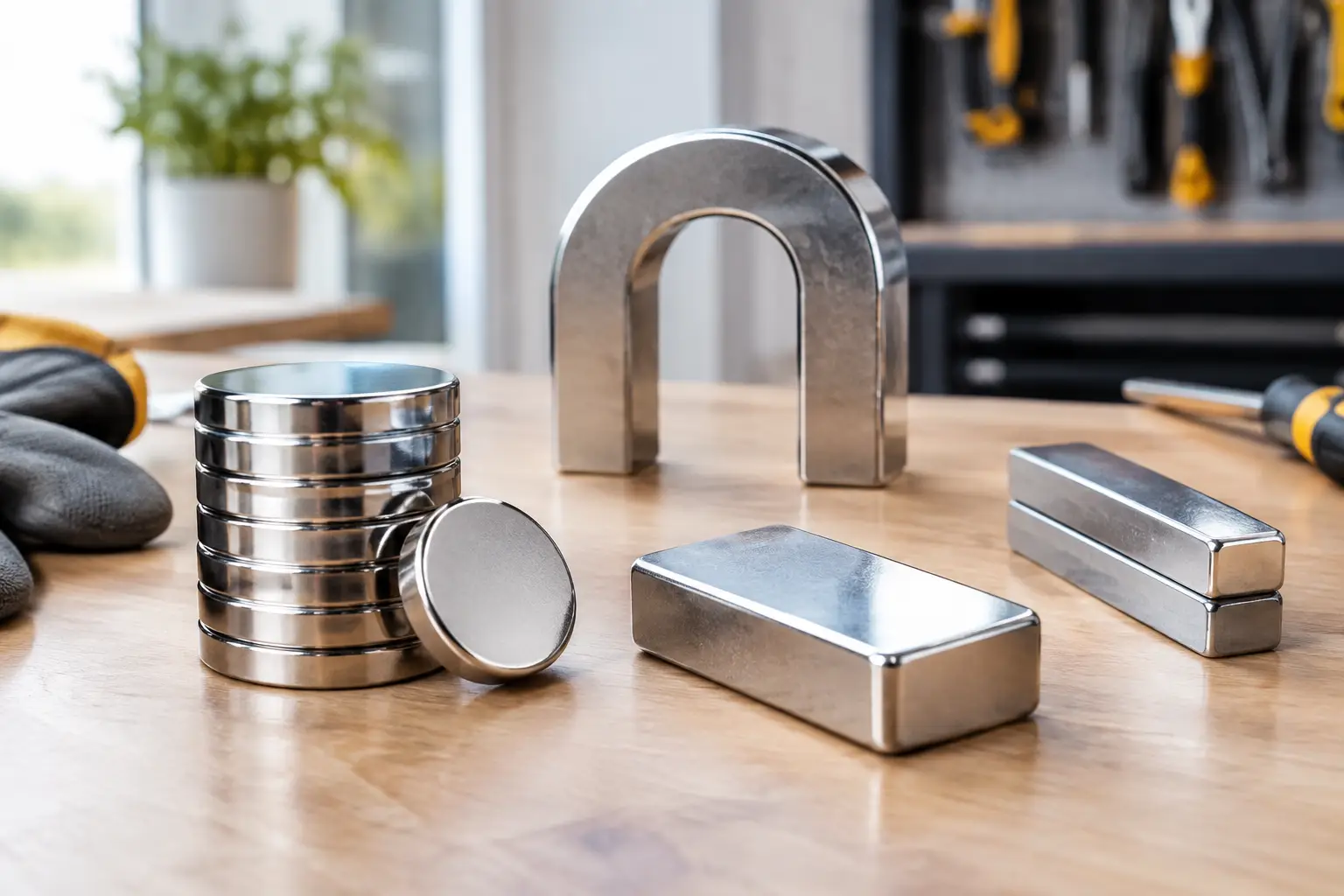
Strongest Magnets for Serious Fixing Jobs
A small magnet that cannot hold a cabinet door shut, secure a display panel or keep a tool fixture in place is not a saving. The strongest magnets earn their place by delivering serious holding power from a compact component, giving DIY users and trade professionals more options where screws, latches or bulky fittings are unsuitable.
For practical fixing work, N52 neodymium magnets are among the strongest commercially available permanent magnets. Their performance makes them a reliable choice for discreet closures, removable panels, jigs, retail displays and purpose-built workshop solutions. But maximum strength is only useful when the magnet’s shape, size and installation match the job.
What makes the strongest magnets so powerful?
Neodymium magnets are made from an alloy of neodymium, iron and boron. This material stores a much stronger magnetic field than ferrite magnets, the familiar dark grey magnets often found in basic catches and household items. The result is far greater pull strength for a given size.
N52 refers to a high magnetic grade. In simple terms, a higher grade can produce more magnetic force from the same volume of material. That matters when space is tight. A compact N52 disc or block can provide a firm hold without the oversized hardware that may spoil the finish of a cabinet, display unit or custom build.
Grade is not the whole story, however. A larger, lower-grade magnet can sometimes outperform a tiny high-grade magnet because it has more material and a greater contact area. The strongest choice is therefore not always the highest number on the label. It is the magnet that produces the required holding force in the actual installation.
Strongest magnets: pull strength depends on the setup
Published pull-force figures are useful for comparison, but they describe a best-case test. Typically, the magnet is pulled straight away from a thick, clean, flat piece of mild steel with full contact. Real jobs are often less favourable.
Paint, lacquer, plastic laminate, tape, uneven timber and even a small air gap can significantly reduce holding power. Pulling a magnet directly apart is also different from trying to slide it sideways. A magnetic catch holding a cupboard door closed uses force in one direction; a tool holder supporting weight on a vertical surface must resist sliding as well.
The steel target matters too. Mild steel is highly responsive to a magnet, while aluminium, brass, copper, stainless steel and many alloys are not. Some stainless steels are magnetic, but not all. If the receiving surface is non-magnetic, use a steel strike plate, a matching magnet with the correct pole orientation, or a mechanical fixing arrangement designed for the load.
Allow a sensible safety margin. If a panel weighs 2 kg, do not select magnets with a stated pull force of exactly 2 kg and expect dependable performance. Consider the gap, leverage, vibration, repeated use and how the item will be pulled open. For overhead, safety-critical or load-bearing applications, magnets should not be the sole means of support.
Choosing a magnet shape for the job
The format affects both installation and performance. Disc, block and countersunk magnets all have a clear role in practical work.
Disc magnets for clean, compact holds
N52 disc magnets suit slim doors, removable signs, packaging, craft fixtures and small locating tasks. Their round profile is easy to recess into timber with the correct drill bit, and they offer a neat solution where the magnet needs to sit flush or remain mostly hidden.
Diameter has a major effect on contact area. A wider disc generally provides a stronger hold against a steel plate than a very narrow disc of the same thickness. Thickness adds magnetic material and can improve performance, but it will not overcome a poor connection surface. Choose the largest diameter and thickness your design can accommodate rather than relying on grade alone.
Block magnets for directional strength
Block magnets are a practical option for cabinet catches, workshop jigs, mounting brackets, retail fittings and rectangular recesses. Their straight edges make alignment straightforward, while their larger faces can provide strong contact over a broad area.
They are particularly useful when a component needs to resist twisting or when a narrow, elongated fixing area is available. A block magnet can be bonded into a routed channel or mechanically retained within a purpose-made housing. Check the magnetisation direction before building it into a design, as the pole orientation affects how it works against a target surface or second magnet.
Countersunk magnets for secure screw fixing
Countersunk neodymium magnets are made for installations where adhesive alone is not enough. The recessed hole allows a suitable screw head to sit flush, giving a clean finish and a more reliable permanent fixing to timber, plastic or similar substrates.
This format works well for removable access panels, door catches, signage and fixtures likely to receive regular use. Do not overtighten the screw. Neodymium magnets are extremely strong but brittle, and excessive pressure can crack them. A pilot hole and a controlled hand fit are usually better than driving the screw hard with a power tool.
Adhesive, screws or a recessed fit?
Adhesive can be an effective choice when drilling is not possible, but it needs preparation. Both surfaces should be clean, dry and free from dust, grease and loose coatings. A quality adhesive needs time to cure, and the joint should be designed so it is not constantly peeled away from the surface.
For frequent use, higher loads or awkward surfaces, a countersunk magnet and screw usually provide more dependable results. Recessing a disc or block magnet into timber also protects the magnet from knocks and helps establish a controlled gap. The best method depends on whether the fitting needs to be removable, invisible, adjustable or permanently fixed.
Common jobs where high-strength magnets make sense
The practical advantage of high-strength neodymium magnets is flexibility. In a kitchen, workshop or retail unit, they can create a firm closure without a visible latch. In a fabrication setting, they can hold parts in position during marking, setup or light assembly. For displays, they make signs, graphic panels and product information easy to change while keeping the fixing discreet.
Magnetic catches are especially useful where a simple open-and-close action is needed. A correctly selected catch keeps a cupboard, wardrobe or access door shut, then releases without fuss when pulled. The aim is not always maximum force. On a light door, an overly powerful magnet can make opening frustrating or pull the fixing loose over time.
For custom projects, think about the user’s hand movement. A panel held by magnets may need a finger notch, a push-to-release point or a small gap at the edge. Good magnetic fixing is as much about easy release and accurate alignment as it is about raw pull strength.
Handle high-strength magnets with care
Powerful magnets deserve careful handling. Keep fingers clear when two magnets, or a magnet and steel surface, are close together. They can snap together quickly and cause a painful pinch. Their brittle material can also chip or shatter if allowed to collide.
Keep them away from children, pacemakers and other implanted medical devices. Swallowed magnets are a serious medical emergency. Strong magnetic fields can also affect magnetic strips, some electronic equipment and precision instruments, so store them responsibly and separate them with spacers where appropriate.
Most neodymium magnets have a protective coating, commonly nickel, to help resist corrosion. Avoid using standard coated magnets in wet outdoor environments or areas exposed to prolonged moisture unless the specification is suitable for those conditions. If the coating becomes damaged, corrosion can reduce the life of the magnet.
Buy strength with a clear purpose
The strongest magnets are not simply the biggest or highest grade available. They are the magnets selected for the material, gap, fixing method and real force the job demands. N52 neodymium discs, blocks and countersunk formats give you powerful, versatile options without adding unnecessary bulk.
Start with the space available and the way the finished item will be used, then choose enough pull strength to allow for real-world conditions. With a well-matched magnet and a sound fixing method, a compact component can deliver the dependable hold that makes a project feel properly finished.