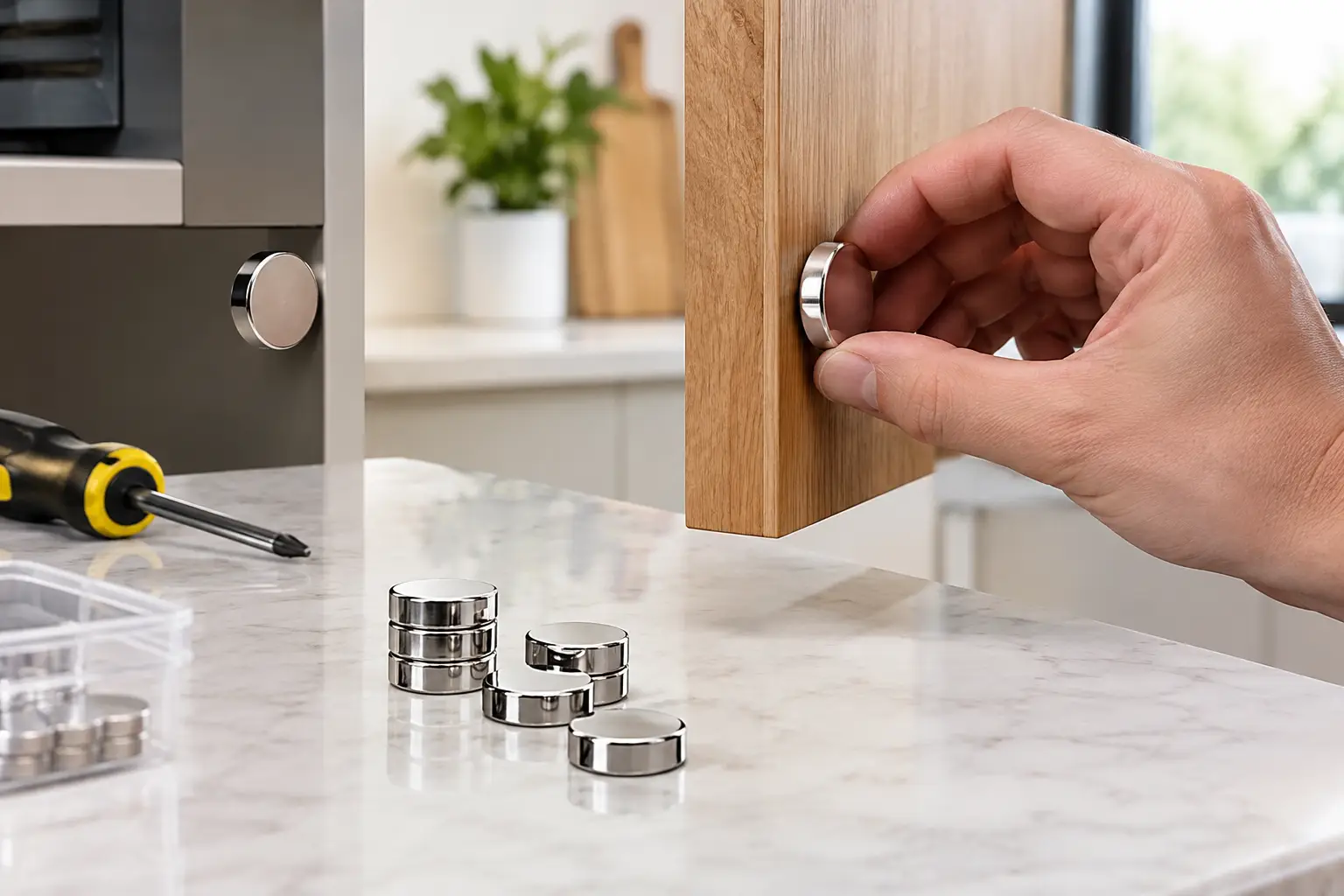
Furniture Magnet Installation That Holds Firm
A cupboard door that will not stay shut is rarely a major joinery problem. More often, it comes down to a catch that is too weak, poorly aligned or fitted across too large a gap. Get furniture magnet installation right and doors, drawers and access panels close cleanly, stay secure and remain easy to open.
For cabinet makers, fit-out teams and capable DIYers, the goal is not simply to use the strongest magnet available. It is to create a reliable closing action that suits the weight, movement and construction of the furniture. A powerful magnet is useful, but position, fixing method and the mating surface matter just as much.
Choose the right magnetic solution first
Start by deciding whether the job needs a magnetic catch or separate neodymium magnets. A purpose-made magnetic catch is usually the quickest option for standard cupboard doors. It combines a magnet in a housing with a strike plate, making alignment more forgiving and installation straightforward.
Separate disc, block or countersunk neodymium magnets offer more freedom for concealed furniture work, flush panels and custom builds. They are compact, super-strong and ideal where a conventional catch would look out of place. They do, however, demand more care during fitting. The two faces must meet consistently, and the magnets need a secure recess or fixing point.
Pull strength should match the job. A light cabinet door needs enough hold to resist vibration and minor knocks, not a magnet so powerful that opening it puts strain on hinges or a delicate handle. Heavier doors, tall wardrobe panels and frequently used retail displays may need a larger magnetic catch, two catches or a pair of stronger magnets.
The working gap is equally important. Magnetic pull falls away quickly as distance increases. A magnet that feels exceptionally strong in your hand may provide a modest hold once it sits behind a timber face, proud of a surface, or several millimetres from its strike plate. Measure the real closed gap before selecting the hardware.
Plan the furniture magnet installation
Before drilling, close the door or panel in its final position and mark where the catch will work best. For most doors, the upper corner on the opening side is a practical starting point. This keeps the hardware away from the hinge line and gives the magnet good leverage against the door springing open.
Wide, warped or heavy doors may need a catch at the top and another at the bottom. If the door closes unevenly, correct the hinge adjustment first. A magnetic catch is designed to retain a properly hung door, not pull a badly aligned one square.
Hold the magnet and strike plate in place, then test the action by hand. Check that the door closes without being pushed sideways and that the magnetic contact is broad enough to feel positive. This dry fit reveals problems while they are still easy to correct.
For a concealed installation, mark both centres from a single reference edge rather than measuring each component independently. Even a small offset can reduce holding force or cause the magnets to meet edge to edge. On face-frame cabinetry, also check that the door clears the frame and that the catch does not interfere with shelves, runners or internal hardware.
Fit catches square and secure
Most surface-mounted magnetic catches are fixed with screws to the cabinet carcass, with the strike plate fixed to the back of the door. Use the supplied fixings where suitable, but choose screws that suit the material if you are fitting into hardwood, MDF, plywood or melamine-faced board.
Drill small pilot holes in timber to reduce splitting and to prevent screws wandering off the mark. In MDF, avoid overtightening. The material can strip easily, leaving a catch that works loose after repeated use. If the fixing area is thin or damaged, a wider catch base, suitable inserts or a different mounting position may be the better answer.
Fit the catch body first, then close the door against it with the strike plate held in position. Mark the plate location only once the door sits where it should. This is more accurate than relying on a tape measure alone, particularly on older cabinets where nothing is perfectly square.
Tighten the strike plate just enough for a second test, then make any small adjustment before fully securing it. The correct position gives a distinct pull at the final part of the closing movement without a hard clack, bounce-back or visible movement in the door.
Installing countersunk magnets
Countersunk neodymium magnets are a strong choice when you want a neat mechanical fixing. Their countersunk hole allows a screw to sit flush, helping the magnet remain stable in a shallow recess or directly on a flat surface.
The key point is screw choice. The screw head must match the countersink profile and sit flush or slightly below the magnet face. A proud screw head creates a gap, weakening the hold and risking damage when the two surfaces meet. Use non-magnetic or lightly magnetic fixings where practical, as a strongly magnetic steel screw can affect seating and make handling more awkward.
Pre-drill carefully, especially near an edge. Neodymium magnets are hard but brittle. They can chip or crack if a screw is forced through at an angle, if the countersink is overtightened, or if magnets snap together during fitting. Hold each magnet firmly, keep other magnets away from the work area and bring the mating parts together slowly.
Installing recessed disc or block magnets
Recessed magnets produce the cleanest furniture finish, but the recesses must be accurate. Use a Forstner bit for round disc magnets, or a router and straight cutter for block magnets. Aim for a snug, level pocket rather than a loose hole filled with adhesive.
For adhesive fixing, clean away dust and make sure both the magnet and recess are dry. A quality two-part epoxy is often suitable for this type of installation because it fills minor irregularities and provides a durable bond. Cyanoacrylate adhesive can be quick, but it is less forgiving in gaps and may become brittle under repeated impact.
Do not rely on adhesive alone where the magnet will be pulled directly away from the surface every time the door opens. A properly sized recess gives the magnet mechanical support, while the adhesive prevents rotation and movement. On thin panels, check the remaining material thickness before drilling. A magnet may be compact, but drilling through a finished door is an expensive mistake.
Check polarity before committing
With a magnetic catch and steel strike plate, polarity is not an issue. With two neodymium magnets, it is essential. One face must attract the other. If you fit them with matching poles facing, the door will repel instead of close.
Mark the outward-facing side of each magnet with a pencil or a small piece of tape during the dry fit. Keep the orientation consistent as you prepare the recesses. This simple step avoids the frustrating situation where one magnet is already bonded in place before you discover the pair will not meet.
When the design allows, a magnet-to-steel arrangement is often easier to install than magnet-to-magnet. A steel strike plate removes polarity concerns and provides useful tolerance if the door moves slightly over time. Magnet-to-magnet setups can provide superior pull performance at close range, but they need more precise alignment.
Test for everyday use, not just first closure
Once fitted, open and close the furniture several times. Test it from the handle position, not only by pressing next to the catch. Listen for rattling, watch for a door that springs open, and make sure the catch releases without a sharp tug.
A door that closes perfectly when empty may behave differently once shelves are loaded or the unit is moved. For mobile retail units, workshop cabinets or frequently used drawers, allow a little extra holding strength. For fine furniture, balance the hold against a refined opening feel.
Moisture is another consideration. Standard neodymium magnets have protective coatings, but chipped surfaces and persistently damp locations can shorten their service life. For bathroom furniture, utility areas or outdoor-adjacent joinery, keep magnets protected within the cabinet where possible and avoid exposing damaged coatings to moisture.
Magman supplies powerful and versatile magnetic hardware for projects where ordinary catches are not enough. Selecting the correct format at the outset makes the fitting faster and the finished furniture more dependable.
A well-fitted magnetic closure should disappear into the experience of using the furniture: the door settles, holds firm and opens when required. Take the extra few minutes to mark, test and align it properly, and that small component will keep doing its job long after the final screw is fitted.