Which Magnet Suits Sliding Doors? Practical Guide
A sliding door can look perfectly fitted yet still rattle, creep open or stop short of its closed position. The usual cause is not the track – it is a closure that lacks enough holding power or is fitted in the wrong place. If you are asking which magnet suits sliding doors, start with the door’s weight, material, travel and the gap between the two closing faces. For most cabinets, wardrobes and lightweight panels, a purpose-made magnetic catch gives the cleanest, most dependable result.
Magnets are excellent at holding a sliding door closed once it reaches its end stop. They are not a substitute for correctly sized runners, guides or stops. The track carries the door; the magnet provides a positive final hold.
Which magnet suits sliding doors in practice?
For a timber, MDF or lightweight laminate sliding door, a magnetic catch with a neodymium magnet and matching steel strike plate is normally the right choice. It provides strong holding performance in a compact fitting, without a latch that can snag, wear or require a handle to operate.
Neodymium is particularly useful where the catch needs to stay discreet. Compared with larger conventional ferrite magnets, an N52 neodymium magnet can deliver superior pull strength from a much smaller size. That matters in slim cabinet sides, shallow frames and retail display units where there is little room behind the closing edge.
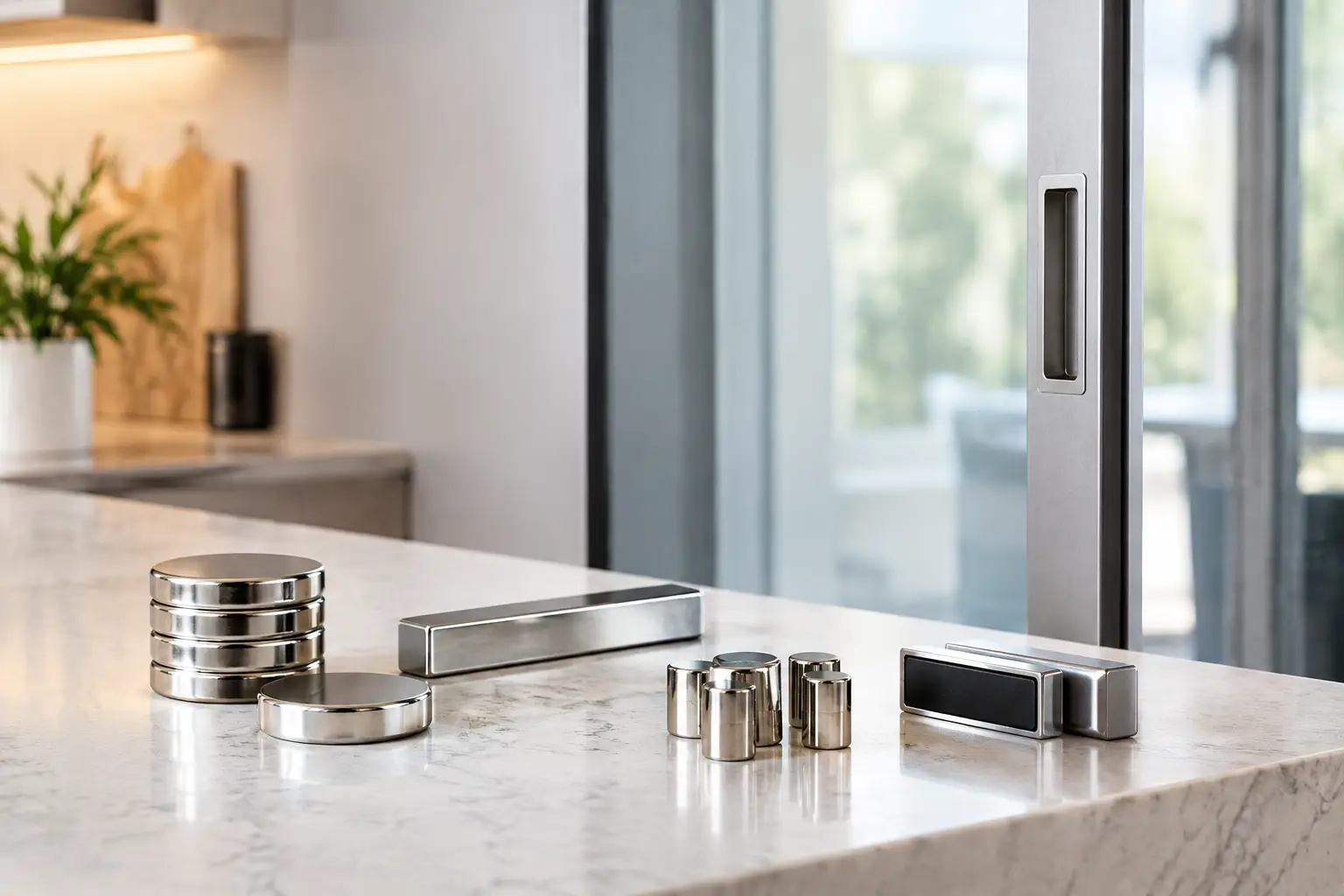
The best format depends on how the door meets the frame. A surface-mounted magnetic catch is often the most straightforward option for retrofit work and utility furniture. A countersunk magnet can create a tidier, more flush installation when you can drill into the door edge or frame. Disc and block magnets are better suited to custom-built doors where you are designing the catch arrangement yourself.
First, decide what the magnet must do
A magnet on a sliding door may have one of three jobs. It may simply prevent a light door from drifting open. It may hold a cabinet or wardrobe door shut against everyday knocks and vibration. Or it may pull the door into a repeatable closed position on a fitted unit or display.
These are different demands. A light acrylic or thin plywood panel needs modest holding force, provided the surfaces meet closely. A broad, heavy timber wardrobe door may need a stronger catch, two catches, or a mechanical soft-close system alongside the magnet. Increasing magnetic strength does not solve every issue: if the door is poorly aligned, the magnet may pull sideways, create a hard closing action or fail to meet squarely.
Think about the closing direction as well. The quoted pull strength of a magnet is measured in ideal conditions, usually straight away from a thick, flat steel surface. A sliding door places more of a shear load on the catch. Friction, alignment and the quality of the strike plate therefore matter as much as the headline pull figure.
Light cabinet and display doors
For small cabinet doors, display cases and lightweight sliding panels, a compact neodymium magnetic catch is usually enough. Place it close to the closing edge, where the door is least likely to flex. The matching plate should sit directly opposite the magnet when the door is fully shut.
Avoid choosing the smallest magnet purely to save space. A catch that only just holds in a quiet workshop may release when a cabinet is knocked or when the door is used daily. A modest margin of holding power gives a more professional result.
Wardrobe and larger furniture doors
Sliding wardrobe doors introduce more variables: they are taller, heavier and often run on rollers with low resistance. A magnet can help keep the door in its closed position, but it should complement a physical stop, not replace one. The stop takes the impact when the door closes; the magnet holds it afterwards.
For a large door, fit catches at a point supported by the frame rather than at the centre of a flexible panel. Depending on the design, one catch near the top and one lower down can reduce rattle and keep the door sitting evenly. Test the action before committing to final fixings. If the door needs a sharp pull to release, it may be inconvenient for a wardrobe used every morning.
Flush and concealed installations
Where appearance matters, countersunk neodymium magnets are a strong option. One magnet can be recessed into the door edge and a matching magnet or steel plate into the fixed frame. This creates a concealed closure with no visible catch body.
The trade-off is accuracy. Recesses must be drilled to the correct depth so the faces sit close together without protruding. Even a small air gap reduces magnetic performance considerably. A steel strike plate is often more forgiving than a second magnet and avoids the risk of installing two magnets with the wrong poles facing each other.
Choose the right shape and fitting method
The shape of the magnet should suit the space and the way you intend to fix it. Disc magnets work well in drilled recesses and give a neat circular fixing point. Block magnets provide a larger contact area and are useful inside rectangular channels, timber frames or custom catch housings. Countersunk magnets are ideal where a screw-fixed, flush finish is required.
For many practical jobs, a ready-made magnetic catch is the simpler route. It combines the magnet housing, fixing holes and strike plate in one arrangement, making positioning easier. This is often the better choice for cabinet repairs, workshop storage and general furniture builds.
Loose magnets suit fabricators and confident DIY users who need a bespoke solution. If using them, make sure the adhesive or mechanical fixing is appropriate for the load. Standard glue alone is rarely the best answer on a regularly used sliding door, especially where the magnet experiences repeated impact. Screwed countersunk magnets or a properly housed magnet offer greater long-term security.
Measure the gap before choosing strength
Magnetic force falls away quickly as distance increases. Paint thickness, edge banding, laminate, a recessed plate or a slight misalignment can all create a gap that weakens the hold. The closer the magnet sits to clean, flat steel, the better it performs.
Before ordering, close the door and measure the realistic gap at the intended catch position. Also check whether the mating surface is actually magnetic. Aluminium, brass, stainless steel and many furniture fittings will not reliably attract a magnet. If the door frame is non-magnetic, fit a mild steel strike plate rather than assuming an existing screw or bracket will work.
Keep the plate clean and flat. A distorted plate or a thick layer of paint can reduce contact and cause inconsistent closing. On timber furniture, pre-drill pilot holes to prevent splitting and to keep the plate correctly aligned.
Positioning makes the difference
A well-chosen magnet fitted in the wrong location will disappoint. Install the catch where the door naturally arrives at its fully closed position, not where it must be forced to reach. The magnet should meet the strike plate face-to-face, with the surfaces parallel.
Use the runner stop to establish the final position first. Then mark the magnetic catch with the door held shut. On double sliding doors, consider whether each door needs an individual catch to the outer frame or whether the two doors need to meet and hold together at the centre. Centre-closing doors often benefit from a strike plate or opposing magnetic arrangement that prevents one panel from pushing the other out of line.
Do not place a powerful magnet where fingers are likely to be trapped between the door and frame. This is especially relevant on small cabinets used by children. The goal is a controlled close, not the strongest possible snap.
When a magnet is not the right answer
A magnetic catch is not suitable for every sliding door. External doors, room dividers, security-sensitive cupboards and heavy commercial panels generally need a proper latch, lock, bolt or rated door system. Magnets do not provide security, fire performance or a reliable hold against substantial force.
They can also be a poor choice where a door must resist constant vibration, such as in a vehicle or mobile installation. In those cases, a mechanical catch may be needed, with magnets used only to assist positioning.
For furniture, displays and custom cabinetry, however, a quality neodymium magnetic catch is a powerful and versatile solution. Magman’s focused range makes it easier to select compact magnetic hardware with the strength needed for practical closure jobs.
Choose a catch with enough reserve strength, fit it close to a flat steel plate and let the track and stop do their own work. That combination gives sliding doors the quiet, confident close they should have.