Best Magnets for Removable Covers That Hold Firm
A removable cover should come away cleanly when you need access, then return to the same secure position without rattling, slipping or needing a screwdriver. The best magnets for removable covers are usually high-strength neodymium magnets matched to the cover’s weight, the gap between surfaces and the way it will be used. A tiny magnet can produce impressive pull, but choosing on strength alone is how covers become awkward to remove or fail to sit flush.
For access panels, cabinet backs, inspection hatches, speaker grilles, retail display covers and custom enclosures, the goal is simple: a positive hold with a repeatable fit. The right magnet format makes that result much easier to achieve.
What makes a removable cover work well?
A magnetic cover relies on more than the magnet itself. One side needs a suitable mating surface, usually a steel plate, washer, screw head or another magnet. The cover also needs to locate accurately. Magnets pull parts together, but they do not automatically stop a large cover from sliding sideways.
For small, light covers, a pair of magnets may be all that is needed. Larger or frequently handled panels benefit from corner magnets combined with a lip, rebate, locating pins or a close-fitting frame. This takes the sideways load off the magnets and gives the cover a neat, professional finish.
Consider how the cover will be opened, too. A flush panel with strong magnets can be difficult to grip. A discreet finger notch, pull tab or small handle gives the user a controlled release point. This matters particularly where the cover protects electrics, plumbing access or stock that needs regular attention.
Best magnets for removable covers by fitting style
The best choice depends on whether you are fitting into timber, MDF, plastic, metal or a finished surface where visible fixings are not acceptable. Three formats cover most jobs.
Countersunk magnets for screw-fixed panels
Countersunk neodymium magnets are often the most practical option for timber-framed covers, cabinet doors and removable access panels. Their central hole allows the magnet to be fixed with a countersunk screw, leaving the face clear for contact with a steel plate or another magnet.
This is a strong, serviceable method. If a cover needs adjustment after fitting, you can reposition the fixing rather than remove adhesive and start again. Countersunk magnets are particularly useful where a panel may be opened repeatedly, such as a meter cupboard cover, retail display unit or removable furniture panel.
Take care with screw selection. The screw head must sit fully within the countersink and must not protrude above the magnet face. Even a small proud screw head creates an air gap, reducing holding force and preventing the cover from closing squarely. Pre-drilling pilot holes is sensible in hardwood, plywood and MDF to avoid splitting or pulling the magnet out of line.
Disc magnets for concealed, flush fitting
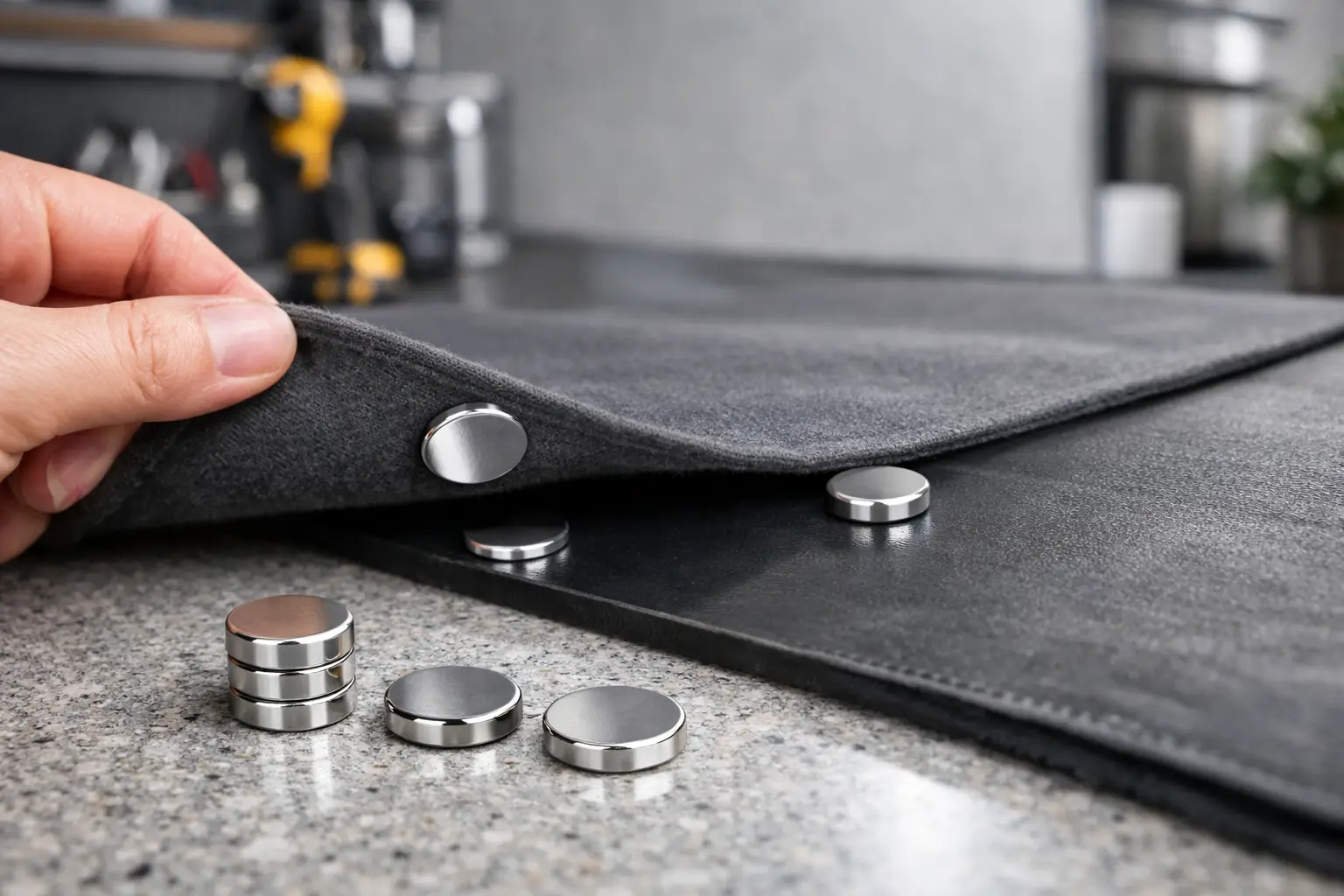
Disc magnets are compact, powerful and easy to recess into wood, plastic or composite material. They suit covers where you want the magnetic fixing hidden from view, including painted cabinet panels, speaker covers and small inspection doors.
A shallow, accurately drilled recess lets the disc sit flush with the material. Bond it with an adhesive suited to both the magnet coating and the substrate, then fit a steel strike plate or matching magnet directly opposite. Neodymium discs offer superior pull performance for their size, but the installation must be accurate. A magnet set 1 or 2 mm too deep can lose a noticeable amount of effective hold.
For a light panel, smaller discs placed near the opening edge may be enough. For a wider panel, use several magnets around the perimeter rather than one oversized magnet in the centre. The load is shared, the cover sits more evenly and removal feels controlled rather than abrupt.
Block magnets where more contact area is needed
Block magnets are a strong option for larger covers, wider frames and jobs where the magnet can be hidden inside a timber rail or fabricated enclosure. Their greater face area can provide a secure hold without needing as many separate fixing points.
They work well on removable plinths, equipment housings, workshop cabinets and display fascias. A block format also gives more scope to orient the magnet along the line of a frame, helping the cover sit consistently against its mating surface.
The trade-off is space. A block magnet needs a larger recess, and its concentrated force can make a lightweight panel snap shut if the gap is too small. If the cover will be handled by customers or children, use enough strength to hold it reliably but not so much that removal becomes a struggle.
Pull strength is not the same as real-world holding force
Published pull strength is useful for comparing magnets, but it is measured under ideal conditions: direct contact with thick, flat, clean steel and a straight pull-away force. Real covers rarely operate in those conditions.
Paint, laminate, veneer, tape, powder coating and even a slight misalignment add separation between the magnet and steel. This air gap reduces attraction quickly. Thin steel can also saturate and provide less holding force than a thicker strike plate. If the cover is pulled sideways, rather than straight off, friction and panel support become just as important as magnetic pull.
For that reason, allow a margin. A removable cover that weighs very little may still need more holding force if it is mounted vertically, subject to vibration or frequently knocked. Conversely, a cover supported on a bottom ledge needs magnets mainly to keep it shut, not to carry its whole weight.
Test one fitting position before committing to every recess or drilled hole. This is especially worthwhile on large panels, where material thickness and the frame construction affect the final result.
Magnet-to-steel or magnet-to-magnet?
Using a neodymium magnet against a steel plate is normally the simplest and most economical arrangement. It avoids polarity mistakes and makes installation easier, since the steel plate can be thin and discreet. A steel washer can work for small covers, provided it has enough diameter for the magnet face and sits flat.
Magnet-to-magnet fixing can give greater attraction, but it requires careful orientation. Fit one magnet the wrong way round and the cover will repel instead of close. It can also make the release force excessive on a light panel. Use this approach when space is tight or when both sides need to be non-ferrous, but mark the poles before bonding anything in place.
Avoid relying on stainless steel unless you know it is magnetic. Many common stainless grades have little or no attraction to a magnet. Mild steel strike plates are the dependable choice for most removable-cover projects.
Installation details that prevent frustrating failures
Accurate marking is the difference between a crisp magnetic closure and a cover that twists as it closes. Fit and align the cover first, then transfer magnet positions carefully. For recessed discs, a drill press or depth stop helps produce consistent holes. Uneven recess depths are a common reason for weak or inconsistent closure.
Keep magnet faces clean and protect plated magnets from damage during fitting. Neodymium magnets are powerful but can chip if allowed to collide. If adhesive fixing is required, lightly prepare the bonding area only where appropriate, use a suitable high-strength adhesive and allow full curing time before loading the cover.
Do not position strong magnets where they could interfere with magnetic stripe cards, sensitive electronic equipment or implanted medical devices. Keep loose magnets away from children, and separate them with spacers during installation so they cannot snap together unexpectedly.
A practical selection approach
Start with the panel, not the magnet. Measure the cover, estimate its weight, identify whether it is vertical or supported, and decide how often it will be removed. Then choose a format that fits the available material thickness and fixing method.
For a small timber access panel, countersunk magnets and steel strike plates are a dependable starting point. For a discreet flush cover, recessed disc magnets offer a clean finish. For a heavier fascia or a broad workshop enclosure, block magnets or multiple discs spread around the frame give better control.
Magman’s focused range of N52 neodymium disc, block and countersunk magnets is built for exactly these practical fixing jobs. The right selection is not necessarily the largest or strongest magnet available. It is the one that closes the cover firmly, aligns it accurately and still lets the person using it remove it without a fight.