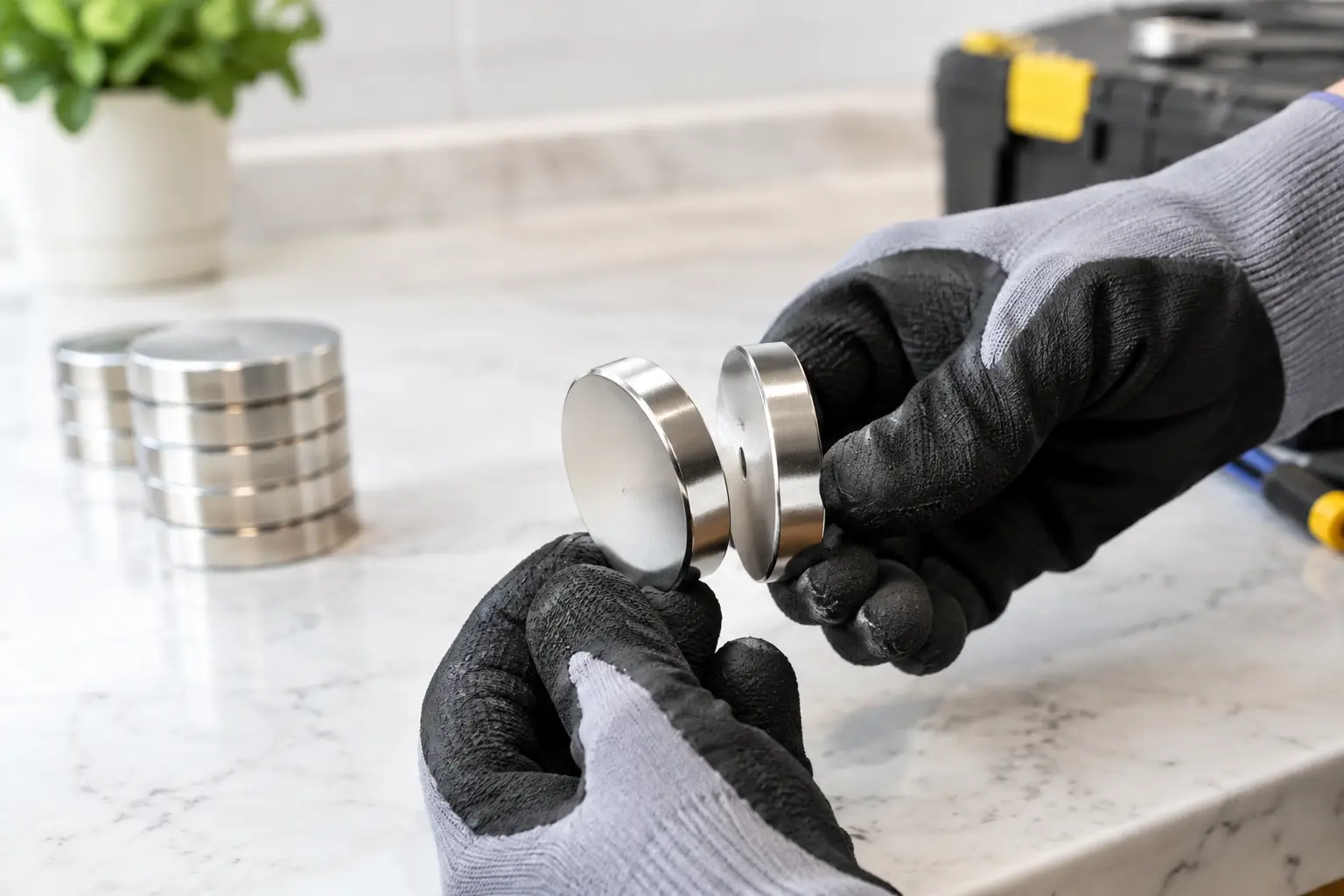
How to Separate Stuck Powerful Magnets Safely
A pair of high-strength neodymium magnets can snap together with far more force than expected. Once they are face-to-face, pulling straight apart is usually the hardest, least controlled way to deal with them. If you need to separate stuck powerful magnets, the aim is to reduce the contact area gradually, keep your fingers clear and avoid damaging the nickel coating.
This is particularly relevant with compact N52 magnets. Their size can be misleading: a small disc or block may have superior pull performance and still be difficult to handle safely. A calm setup, a solid work surface and the right separating movement make a real difference.
Why powerful magnets are difficult to pull apart
When two magnets meet over their full flat faces, they have a large contact area and a direct magnetic path between them. Pulling them apart means working directly against their full holding force. The closer they are, the stronger that force becomes.
Sliding one magnet sideways is easier because you are progressively reducing the area where the magnets overlap. Once an edge clears the other magnet, the attraction drops sharply and you can control the final separation with much less effort.
Shape matters too. Two thin discs can be awkward because they offer little to grip, while thick blocks give you more purchase but can create a stronger pinch point. Countersunk magnets need extra care: their holes and edges can make them more prone to chipping if they collide or are levered roughly.
Prepare the work area first
Do not try to separate strong magnets while standing in a cluttered workshop, balancing them in one hand or working near loose steel tools. Set up on a clear, non-metallic bench such as wood, thick plastic or cardboard over a stable table. Keep screws, drill bits, blades and other ferrous items well away, as they can be pulled in suddenly.
Wear safety glasses when dealing with larger or particularly strong magnets. Neodymium magnets are hard but brittle. If they jump together, chip, crack or shatter, small fragments can travel further than expected. Gloves can help with grip, but do not rely on them to prevent a pinch injury. Your safest protection is keeping fingers out of the closing gap.
Anyone with a pacemaker, implanted cardiac device or similar medical equipment should keep strong magnets well away and follow their clinician’s guidance. Keep magnets away from children and do not separate them where pets can reach them.
The safest way to separate stuck powerful magnets
For most disc and block magnets, use a controlled sliding method. Place the joined magnets near the edge of the non-metallic bench so one magnet can move sideways beyond the support. Hold the bottom magnet firmly in place through a piece of wood, thick card or a non-magnetic clamp arrangement. Then push the top magnet sideways, rather than lifting it vertically.
Keep the pushing force low and steady. As the top magnet reaches the edge, support it from above or beneath with a wooden or plastic tool, not with fingertips placed between the magnets. Continue sliding until more than half of the magnet extends beyond the bottom one. At that point, lift or guide it away in a smooth movement, directing it well clear of the remaining magnet.
For a stack of several magnets, remove one at a time. Trying to bend, twist or peel a whole stack apart can allow magnets to jump sideways and reconnect unexpectedly. After separating each magnet, place it on the bench with a spacer between it and the next magnet.
Use a non-magnetic spacer immediately
Once magnets are apart, they need to stay apart. Put a piece of thick card, plastic, timber or several layers of corrugated cardboard between each magnet. A spacer prevents them snapping back together and makes the next magnet easier to handle.
For storage, keep discs in stacks with separators and keep blocks arranged so opposite poles are not facing across a small gap. The exact arrangement depends on the magnet format and strength, but distance and non-magnetic packing are your two best controls.
When a wedge is the better option
A rigid non-magnetic wedge can help where the magnets are too large to slide safely at a bench edge, or where their shape leaves no useful grip. Hardwood, dense plastic and some composite shims are suitable. Avoid steel tools, which will be attracted to the magnets, and avoid thin or brittle plastic that could crack under pressure.
Start at an exposed edge and gently work the wedge into the gap as you slide one magnet sideways. The wedge should guide the magnets apart, not force them open in one movement. If you need excessive force, stop and reposition. Levering hard against a magnet risks coating damage, chips and an uncontrolled release.
A wooden handle, plastic scraper or purpose-made non-magnetic separator can provide better reach. The useful feature is not brute strength. It is the ability to apply force from a safe distance while keeping the magnets supported.
Methods to avoid
Do not pull two powerful magnets directly apart with both hands. This often causes a sudden release, which can bring them back together around a finger or send one magnet into nearby metalwork.
Do not use a screwdriver, spanner, chisel or other steel tool as a lever. It may be pulled sharply towards the magnets, creating a new pinch hazard and potentially damaging the magnet surface. Likewise, do not strike magnets with a hammer or attempt to split them by dropping them on the floor.
Avoid twisting thin magnets. Neodymium magnets do not flex. A twisting load can crack the magnet beneath its coating, leaving damage that may not be obvious until it begins to corrode. Nickel-plated magnets are designed for practical fixing and fastening work, but they still need careful handling before installation.
Finally, never heat magnets in an attempt to weaken their pull. Excessive heat can permanently reduce magnetic performance and may damage protective coatings.
Handling different magnet formats
Thin disc magnets are usually best separated with the bench-edge sliding method. Use a timber offcut or plastic block to hold the lower disc in place while the upper disc is pushed sideways. If the disc is very small, use a flat wooden stick to move it rather than trying to grip its edge.
Block magnets are often easier to control because they have flat sides. Slide the top block across the lower one, keeping it level. Do not allow one corner to lift suddenly, as this can make the magnets rotate and snap together again.
Countersunk magnets should be handled with particular care around the hole and outer rim. Use their flat face for controlled sliding and do not insert a metal screw or driver into the countersunk hole while separating them. Once apart, place each one face-down on a non-magnetic surface or separate them with card.
For installers using Magman’s powerful N52 discs, blocks or countersunk magnets, it is worth separating and spacing the magnets before taking them to the job. This keeps the installation area safer and makes it easier to position each component accurately.
If the magnets will not move
If a magnet will not slide with controlled pressure, do not increase force straight away. Check whether it is sitting on a steel bench, attached to a hidden metal surface or being affected by another magnet nearby. Move the assembly to a clear wooden surface if possible.
You may need a longer non-magnetic lever or a thicker wedge to gain safe control. For very large or high-pull magnets, use a purpose-made separator or get a second person to stabilise the workpiece while one person operates the tool. Keep roles clear, communicate before moving anything and make sure neither person has fingers near the separation line.
If a magnet has chipped or cracked during handling, collect fragments carefully while wearing gloves and eye protection. Keep broken pieces away from electronic devices and dispose of them securely. Do not continue using a damaged magnet in a visible cabinet, closure or retail fitting where the finish and reliable hold matter.
A strong magnet is a useful fixing component because it holds firmly in a compact format. Treat that strength with the same respect during preparation as you do once it is installed: slide, support, separate, and give each magnet space before moving on.