How to Install Cupboard Magnets Properly
A cupboard door that springs open by a few millimetres, rattles when shut or needs a hard push to stay closed is usually not a door problem. It is a catch problem. Knowing how to install cupboard magnets correctly gives cabinets a clean, reliable closure without bulky latches, and the result depends far more on positioning than on how quickly the screws go in.
Magnetic catches are a practical choice for kitchen units, utility cupboards, workshop cabinets, retail displays and made-to-measure furniture. They work quietly, sit neatly inside the cabinet and can provide impressive holding power in a compact fitting. The key is choosing a catch suited to the door and installing the magnet and strike plate so they meet squarely.
Choose the right cupboard magnet first
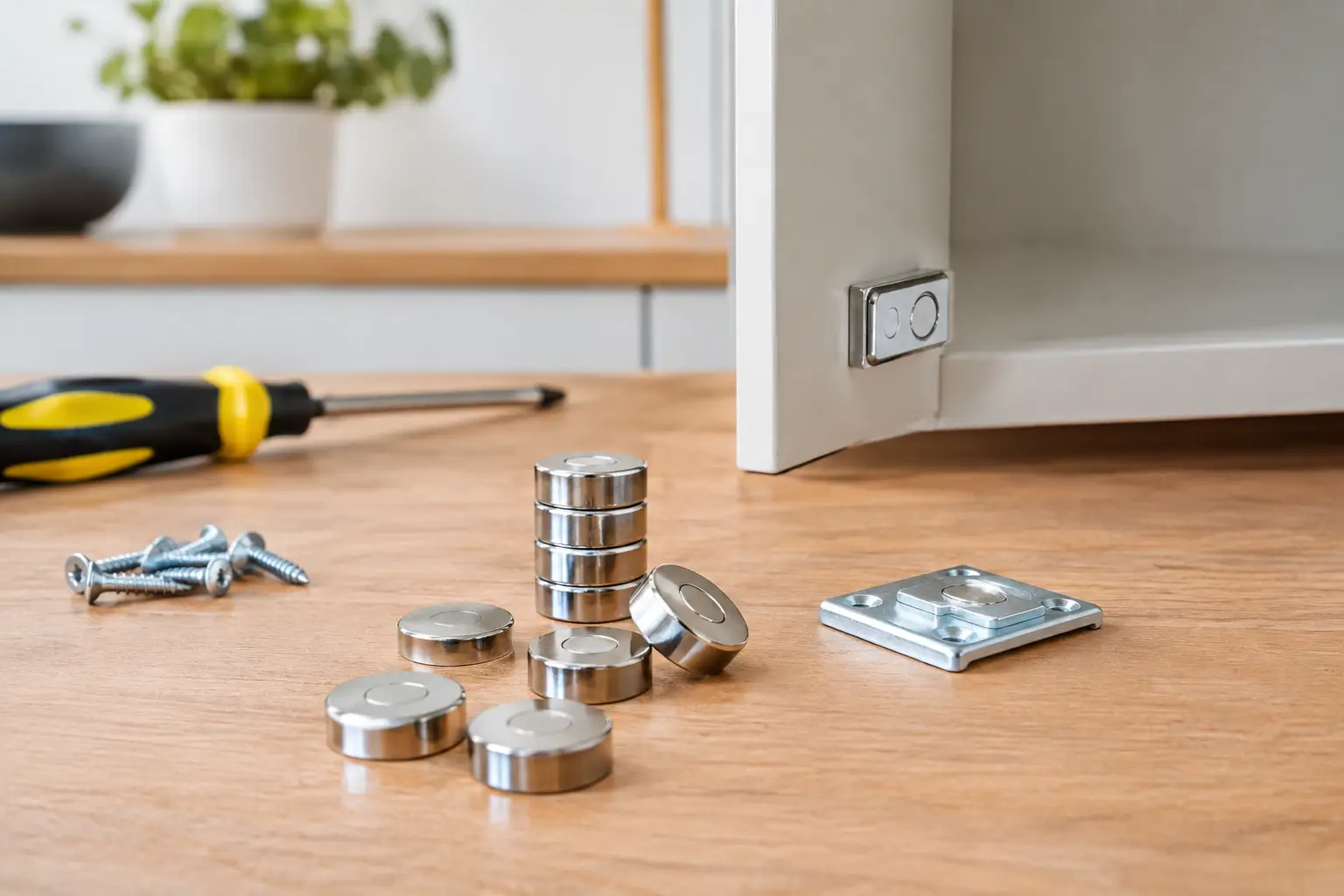
A typical cupboard magnetic catch has two parts: a magnetic body fixed inside the cabinet, and a steel strike plate fixed to the back of the door. When the door closes, the plate meets the magnet and holds it in place. Some catches use a single magnet, while stronger versions use two magnets or a larger magnetic surface.
Start with the size and weight of the door. A lightweight internal cabinet door may only need a standard catch, whereas a tall MDF door, a solid timber door or a door that is under tension from warped hinges may need a stronger magnetic catch. More pull strength is useful, but it is not always better. An overly powerful catch can make a small door feel awkward to open and may place unnecessary strain on loose hinges.
Also consider the gap between the door and cabinet. Magnetic catches work best when the strike plate closes flat against the magnet or sits at the manufacturer’s intended distance. A large gap reduces holding force sharply. If the door sits proud of the cabinet frame, select a catch with a suitable spacer, bracket or adjustment range rather than trying to compensate with a stronger magnet alone.
For compact, high-strength fixing jobs, Magman’s specialist range of magnetic hardware gives DIY users and tradespeople a dependable option where space is limited but holding power matters.
Tools and preparation for installing cupboard magnets
Before fitting anything, check that the hinges are secure and the door is properly aligned. A magnetic catch is designed to keep a correctly hung door closed. It will not reliably correct a door that has dropped, twisted or catches on the cabinet frame.
You will usually need a pencil, tape measure, screwdriver or drill driver, a small drill bit for pilot holes, and the screws supplied with the catch. A bradawl is helpful for marking timber and preventing the drill bit from wandering. For hard materials, laminate-faced chipboard or hardwood, pilot holes are especially worthwhile. They reduce the chance of splitting, oversized holes and stripped screw threads.
Open and close the door several times before marking the fitting position. Look for the point where the door naturally meets the cabinet and where there is enough clear internal space for the catch. Avoid locations where shelves, drawers, hinges or internal fittings will interfere with it.
Decide where the catch should sit
Most cupboard magnets are fitted near the opening edge of the door, usually towards the top. This provides a positive closure while keeping the hardware out of sight. For taller or heavier doors, fitting a second catch near the bottom can prevent the lower corner from drifting open.
A catch near the top is usually best for standard wall cupboards. On base units, position it where it will not clash with shelves or stored items. If you are fitting a catch to a pair of doors, install one catch per door where possible. Trying to hold two independently moving doors with one central catch often leads to uneven closure.
How to install cupboard magnets step by step
Begin by holding the magnetic catch inside the cabinet, close to the opening edge and in the chosen position. The face of the magnet must point directly towards the back of the door when it is closed. Mark the screw holes with a pencil or bradawl.
Drill shallow pilot holes, taking care not to drill through the cabinet side, face frame or top panel. Fit the magnetic body with its screws, but do not overtighten. On chipboard, firm hand pressure is enough. Excessive torque can strip the board and leave the fitting loose.
Next, close the door gently and use the installed catch as your reference point. The strike plate must land centrally on the magnet face. There are two reliable ways to mark this position. You can measure from the cabinet edge and transfer the dimensions to the rear of the door, or apply a small dab of removable chalk or masking tape to the magnet face, then close the door carefully to create a reference mark.
Hold the strike plate over the mark and check that it is level. The plate should sit flat against the door, with its centre aligned to the centre of the magnetic catch. Mark and drill pilot holes, then secure the plate loosely at first.
Close the door slowly. It should pull in during the final part of its travel and sit flush with the cabinet. If the door sits proud, the plate may be too far from the magnet, the catch may be mounted too far back, or the hinges may need adjustment. If the door has to be pushed hard before the magnet engages, move the plate slightly towards the magnet rather than forcing the closure.
Once the position is correct, tighten the strike plate screws and test the door repeatedly. Open it from the usual handle position, close it with a normal push and check whether the catch holds consistently. A reliable installation should feel positive, not difficult.
Fitting catches to face-frame and frameless cabinets
Face-frame cabinets have a timber frame around the front opening. Mount the magnetic body to the frame where its face can meet the strike plate cleanly. Check the available depth before drilling, particularly near hinges and narrow frame sections.
Frameless cabinets typically provide a flat cabinet side or mounting block inside the opening. Position the catch so its face is level with the back of the closed door. Depending on the hinge type and door overlay, you may need a spacer behind the catch to bring it forward. The aim is always the same: direct, flat contact between magnet and plate.
Inset doors need particularly careful alignment because the door sits within the cabinet opening. Even a small error can cause rubbing or leave a visible gap. Mark the catch position with the door fully closed and use a thin spacer only if required to achieve flush contact.
Common cupboard magnet fitting problems
The most common issue is poor alignment. A strike plate that only catches the edge of the magnet will provide much less holding force than one that meets it squarely. Loosen the plate screws, reposition it by a few millimetres and retest before assuming the magnet is too weak.
Another frequent issue is a door that rebounds after closing. This may be caused by concealed hinges set too tight, a shelf pushing against the door, or a warped door under tension. Resolve the mechanical issue first. Increasing magnet strength can mask the problem for a while, but it may make the door harder to open without delivering a stable fit.
If screws loosen in chipboard, remove the fitting and repair the hole before refitting. A loose catch cannot maintain alignment. Move the fitting slightly if there is room, or use an appropriate repair method and allow it to set fully before applying load.
Do not rely on adhesive alone for a cupboard catch unless the product is specifically designed for that installation and the surface is clean, flat and suitable. Screwed fixing is generally the more dependable choice for frequently used doors, workshops and commercial furniture.
Getting the holding force right
Pull strength figures are useful for comparing magnetic hardware, but real-world performance changes with the fitting. A magnet has its strongest hold when it contacts clean, flat steel directly. Paint, protective film, an air gap or a misaligned plate all reduce the effective force.
For a heavier door, first use two catches or a correctly rated stronger catch. Then make sure the strike plates are flat and the hinges are adjusted. This approach gives a more controlled closure than fitting one excessively strong magnet at a single point.
Take extra care around powerful neodymium magnets. Keep fingers clear when testing loose magnets and metal plates, and keep them away from electronic devices, bank cards and anyone with a pacemaker or other implanted medical device. Once secured inside a cupboard catch, the risk is easier to manage, but sensible handling still matters.
A well-fitted cupboard magnet should disappear from daily thought: the door closes flush, stays closed and opens without a fight. Spend an extra few minutes marking and testing the position, and the fitting will deliver the dependable closure your cabinet was built for.