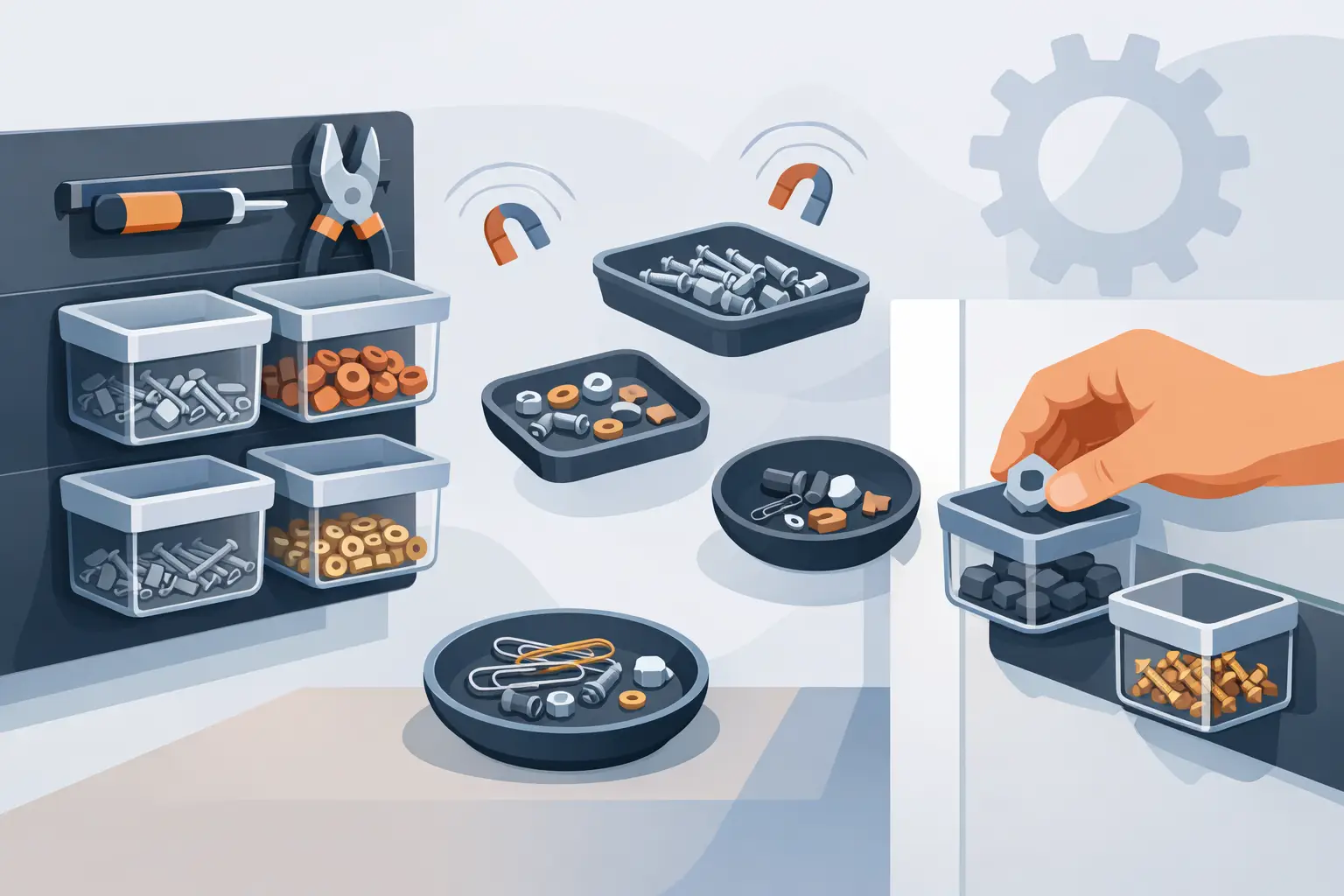
Magnetic Small Parts Storage That Works Harder
A missing screw can stop a cabinet fitting, delay a repair and turn a tidy bench into a search job. Magnetic small parts storage gives the items you reach for most a secure, visible place to sit – from drill bits and driver bits to washers, fixings and small steel components.
For workshop users, tradespeople and serious DIYers, the benefit is not simply tidiness. It is faster work. Powerful neodymium magnets can hold frequently used parts close to the task, prevent them rolling onto the floor and make clearing down far more straightforward.
Magnetic small parts storage for real workshop jobs
The most useful magnetic storage is positioned where work happens. A magnetic strip on the side of a tool chest can hold drill bits, hex keys or small hand tools. A magnetic tray beside a vice gives removed screws and bolts a temporary home during a repair. Strong magnets fixed inside a drawer or parts bin can stop steel items shifting about every time it is opened.
This matters particularly when working overhead, inside cabinets or around machinery. Small components are easy to drop and difficult to find once they land behind a bench or beneath a vehicle. A magnetic dish or a purpose-built steel-backed holder keeps compatible parts contained while both hands remain free for the job.
For cabinet makers and fit-out professionals, magnetic storage can also support repeatable installation work. Keep the required screws, catches, brackets and driver bits together at each work area. Rather than opening several boxes during every fitting, the essentials stay separated, visible and ready to use.
The approach is flexible. You may want a permanent strip for everyday tools, a removable tray for servicing work, or compact magnetic holders fixed to the inside of a van racking unit. The right arrangement depends on whether you need quick access, secure transport or both.
Where strong magnets make the difference
Ordinary magnetic strips can be adequate for light items, but their limits become obvious with heavier tools or when the strip is mounted vertically. A super-strong N52 neodymium magnet provides superior pull performance in a very compact format, allowing a storage fixture to do more without taking up valuable bench space.
Disc magnets work well where a neat, concealed holding point is needed. They can be set into a timber jig, a drawer insert or a 3D-printed organiser, provided they are fixed securely and installed with the correct polarity. Block magnets give a larger contact area and can suit wider holders, tool rails and bespoke storage projects. Countersunk magnets are particularly useful when the magnet needs to be screwed firmly into position rather than bonded in place.
A magnetic catch can be a practical alternative where storage needs a controlled closure. Use one on a small parts cabinet, workshop cupboard or access panel to keep the door shut while maintaining quick access. For a dependable hold, match the catch and strike plate to the door size, weight and expected use.
Strength should be chosen for the job, not simply maximised. Very powerful magnets are excellent for holding steel tools and fittings, but they can make small pieces harder to remove one-handed if the contact area is large. A well-designed holder balances holding force with easy retrieval.
Plan the storage around the parts you use
Start by separating items according to how often they are used. Keep daily essentials – common screws, driver bits, pencils, blades and drill bits – within immediate reach. Store less frequently used fittings in labelled drawers or compartment boxes, then use magnets to stop their contents moving or to hold removable steel bins in place.
It also helps to separate temporary storage from long-term storage. During a repair, a magnetic tray is ideal for retaining the exact screws and clips removed from one item. For permanent organisation, a magnetic rail or mounted holder makes more sense. Mixing the two usually leads to a crowded bench and components being returned to the wrong place.
Consider the material before committing to a design. Magnets will hold ferrous metals such as many steel screws, bolts, drill bits and tools. They will not reliably retain aluminium, brass, copper, most stainless steels or plastic components. If you need to store non-magnetic items, fit a steel plate, steel tin or compatible ferrous container as the magnetic target rather than expecting the magnet to grip the part itself.
A simple test with one of the actual parts is worthwhile. Coatings, component shape and the amount of flat contact all affect the practical hold. A small screw may attach securely to a magnet, while a larger item with a curved or uneven surface may need a broader magnetic base or a mechanical lip for support.
Fixed holders versus removable trays
Fixed storage is best for standardised, repeat-use setups. A rail near the drill press, a row of magnets under a shelf or a countersunk magnet set into a workbench insert keeps key items in the same position day after day. This reduces searching and makes it easier to spot when a bit or tool has not been put back.
Removable magnetic trays are better for mobile work and maintenance. Take the tray to the vehicle, appliance, retail unit or fitting bench, then return it when the work is complete. Choose a tray with raised sides where possible. Magnetic force prevents parts from sliding, but sides provide useful protection if the tray is bumped or carried at an angle.
For van or site storage, use both magnetic and mechanical security. Magnets are excellent for keeping items in place during normal handling, yet a lidded box, retaining edge or proper drawer system is safer where vibration, sudden braking or rough movement is expected.
Build a holder that stays secure
The magnet itself is only one part of the installation. The surface it is attached to must also be capable of taking the load. When bonding a magnet, use an adhesive suited to the base material and allow full curing time before loading it. Clean, dry surfaces give the best results. For heavy-use fixtures, a countersunk magnet secured with an appropriate screw offers a more positive mechanical fixing.
Avoid relying on a small magnet to hold a heavy steel tool on a painted, uneven or vibrating surface. Pull-force figures are typically measured under ideal conditions: direct contact with clean, thick steel and a straight pulling action. In a real workshop, an air gap caused by paint, tape, a coating or an uneven surface can significantly reduce holding power. Shear loads, where an item slides down a vertical face, are also different from a direct pull.
For heavier items, increase the contact area, use more than one magnet, add a supporting ledge or select a purpose-designed rail. This is more dependable than choosing one extremely strong magnet and hoping it will compensate for a poor mounting surface.
Keep powerful magnets safe in use
Neodymium magnets are compact but powerful. Handle larger or stronger magnets with care, as they can snap together quickly and pinch fingers. Keep them away from children, and do not leave loose magnets where they could be swallowed.
They should also be kept clear of magnetic-stripe cards, mechanical watches, sensitive electronics and devices affected by magnetic fields. Anyone with a pacemaker or other implanted medical device should follow their clinician’s guidance and keep suitable distance from strong magnets.
Protective coatings can chip if magnets are allowed to collide, particularly where bare metal edges are involved. Separate and place them carefully during installation. Once fitted behind a cover, within a timber holder or inside a drawer insert, they are far less likely to suffer accidental impact.
Choosing magnetic small parts storage that earns its space
The best setup is rarely the biggest one. It is the arrangement that keeps the right parts close to hand, holds them securely enough for the environment and remains easy to reset after each job. Begin with one high-friction area of the workshop: the bench beside the drill, the cabinet installation kit or the repair station where screws always disappear.
A few well-placed, high-strength magnets can turn that area into a faster and more controlled workspace. Choose the right magnet format, mount it properly and let every small part have a place worth returning to.