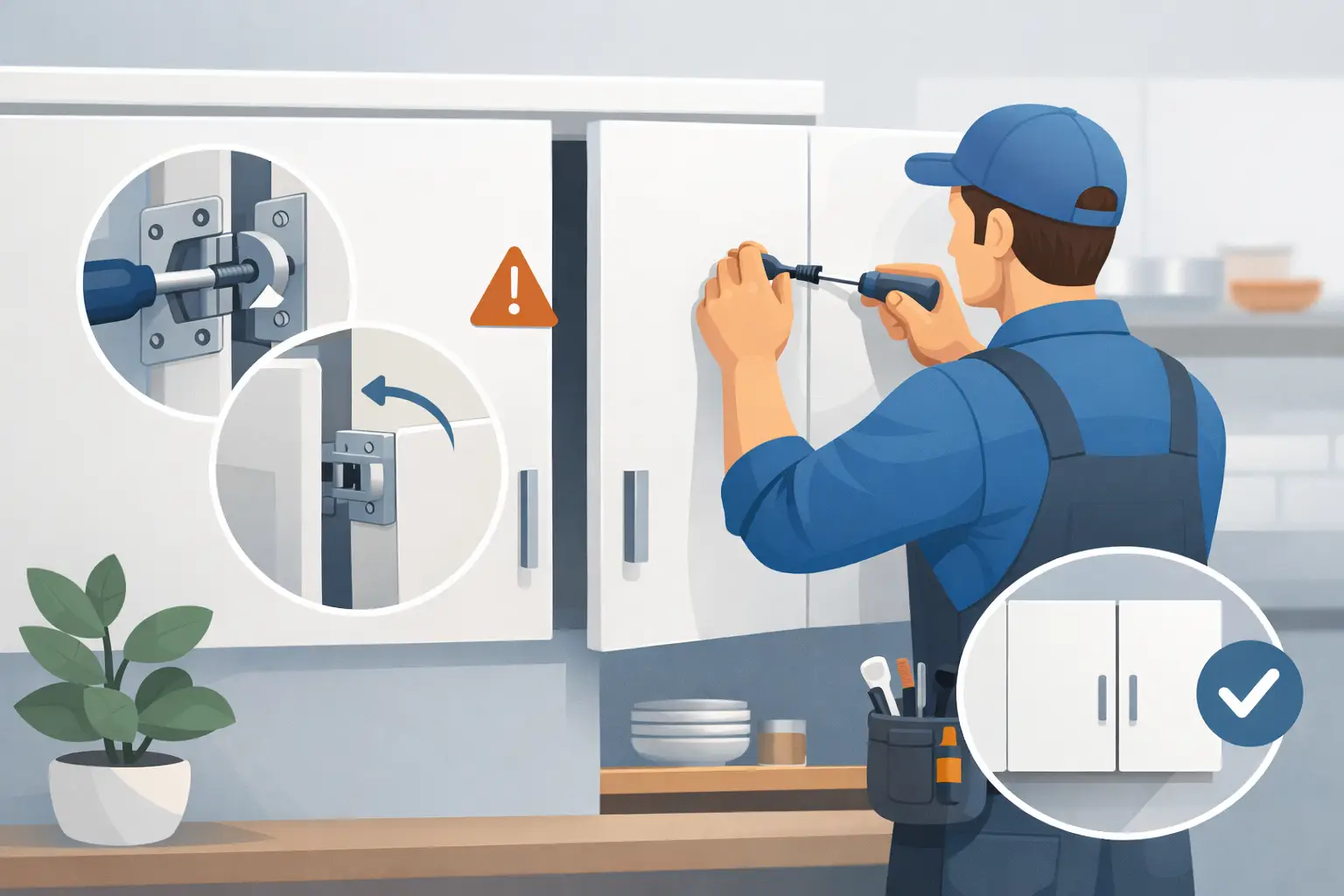
How to Fix Cupboard Door Alignment Properly
A cupboard door that catches on its neighbour, sits lower than the rest, or springs open after closing can make otherwise good joinery look unfinished. The good news is that learning how to fix cupboard door alignment is usually a matter of making small, controlled hinge adjustments rather than rebuilding the cabinet. Work methodically, change one setting at a time, and check the door after every adjustment.
Start by Identifying What Is Out of Line
Before reaching for a screwdriver, close the door and look at the gaps around all four edges. The gap, often called the reveal, should be even enough to look deliberate and allow the door to move freely. Do not judge the door only by its top edge. A door can look level at the top but still be too close to the cabinet side or twisted against the frame.
Most alignment faults fall into one of four patterns:
- The door is too high or too low, leaving an uneven horizontal gap.
- The door sits too far left or right, so it rubs another door or the cabinet side.
- The top or bottom of the door stands proud, or sits too far back, against the cabinet.
- The door is level but will not stay shut, often because the hinges, cabinet, catch or door itself needs attention.
Open and close the door slowly while watching where it touches. A pencil mark on the cabinet edge can help pinpoint a rubbing corner. If two doors meet in the middle, assess both doors before adjusting either one. The fault may be shared, and moving the wrong door can make the overall layout worse.
Check the Basics Before Adjusting Hinges
Loose screws are a common cause of doors drifting out of position. Check the screws holding each hinge to the door and the hinge mounting plate to the cabinet. Tighten them firmly, but do not overtighten. Screws driven too hard can strip chipboard or damage the hinge cup fixing in an MDF door.
Next, check whether the cabinet itself is secure and level. A wall cabinet that has moved on its fixings, or a base unit standing on an uneven floor, can make every door appear misaligned. If the cabinet is visibly out of square, hinge adjustment can improve the appearance but cannot fully correct the underlying problem.
Also inspect the door for warping. Lay a straightedge across it, or sight along its edge. A badly bowed solid timber or MDF door may touch at one corner while leaving a large gap at another. Hinges have limited adjustment, so a warped door may need replacing or reworking rather than endlessly tweaking its settings.
For standard concealed cabinet hinges, keep a Pozidriv or Phillips screwdriver to hand, depending on the screw type. A small spirit level, tape measure and pencil are useful where several doors need to line up. Avoid using a drill driver for fine adjustments. Its torque makes it too easy to strip a fixing or move a screw beyond the point you intended.
How to Fix Cupboard Door Alignment with Concealed Hinges
Most modern kitchen, bathroom and fitted furniture doors use concealed European-style hinges. These normally provide adjustment in three directions: side to side, up and down, and in and out. Exact screw positions vary slightly by hinge manufacturer, so examine the mechanism rather than relying on one layout for every cabinet.
Adjust the door left or right
The adjustment screw nearest the hinge arm usually moves the door sideways. Turn it in small increments, often no more than a quarter turn at a time, then close the door and assess the reveal. This is the adjustment to use when two doors overlap, the central gap is uneven, or a door is rubbing the cabinet side.
When working on a tall door with three hinges, adjust the top and bottom hinges first to establish the line of the door. Use the centre hinge only to support that position. Moving every hinge by a different amount is a reliable way to introduce a twist.
Adjust the door up or down
Height is normally adjusted at the mounting plate fixed to the cabinet side. Loosen the screws only enough for the plate to slide, support the weight of the door, move it a few millimetres, then retighten. Some hinges use a slotted plate; others have a dedicated height-adjustment screw.
A second person is useful for heavy wardrobe or tall utility doors, but it is not essential. A folded timber offcut or a stack of cards beneath the door can support it while you set the correct bottom gap. Once the door is in position, tighten both plates before checking it again.
Adjust the door depth
The rear adjustment screw on many concealed hinges moves the door closer to, or farther away from, the cabinet. Use this when the door does not sit flush when closed, catches on a frame, or leaves too much of the cabinet edge visible.
Depth adjustment is particularly relevant on face-frame cupboards and cabinets fitted with door buffers or catches. A door set too far in may strike the catch before the hinge reaches its natural closed position. Set the door position first, then fine-tune any closing hardware.
Adjust Traditional Butt Hinges Carefully
Older cupboards, handmade furniture and some utility cabinets use butt hinges rather than concealed hinges. They offer far less built-in adjustment, so the fix depends on the source of the movement.
If the door has dropped, start by tightening the hinge screws. Where a screw spins in a worn timber hole, remove it and repair the hole with glued hardwood slivers or a suitable timber repair plug. Let the adhesive cure fully before re-fitting the screw. Forcing a larger screw into a thin door edge can split the timber and create a bigger repair.
If the door is consistently too low or high but the hinges are sound, a thin packing shim behind one hinge leaf can alter its position. This is a precise job: even a thin card or veneer shim can make a noticeable difference. Use durable material for the final repair, not card, and test the door before trimming or fixing anything permanently.
A door that binds along its full edge may need a very small amount removed with a plane or sandpaper block. Only take material off once you have confirmed the cabinet is square and the hinges are tight. Removing timber is permanent; a hinge adjustment is not.
Set Catches After the Door Is Straight
A magnetic catch should keep a correctly fitted door closed, not pull a poorly aligned one into place. If a catch is fitted before the hinges are set, it can disguise the real issue and put unnecessary strain on the door, screws and hinge mechanism.
With the door aligned, close it gently and mark where the catch and strike plate meet. The two components need to face each other squarely for reliable holding force. If they meet off-centre, the magnet may still catch, but it will have less effective pull and can make the door feel inconsistent.
For lightweight cabinet doors, a compact magnetic catch is often enough to provide a clean, dependable closure. Larger doors, doors in busy retail units, or doors that are slightly prone to springing back may need a stronger option. Choose holding strength to suit the door weight and the force needed to open it. Excessive pull can make a small door awkward to use, while an underpowered catch will not solve a persistent opening problem.
If you are fitting separate neodymium magnets, use the correct fixing method and keep them away from direct impacts. N52 magnets offer superior pull performance for their size, but they are brittle and can snap together with surprising force. Countersunk magnets provide a more secure mechanical fixing where the material and screw size are suitable. Check polarity before drilling or fixing, especially where several doors must close against matching magnets.
Test the Door in Real Use
Close the door from several positions, not just by pushing the handle. Check that it clears adjacent doors, does not scrape under its own weight, and remains shut without needing a slam. Then open it fully and make sure the hinge arm, catch and handle do not foul shelves, drawers or neighbouring units.
Newly fitted hinges and catches can settle slightly after repeated use, particularly where screws are fixed into chipboard. Recheck the fixings after a few days if the cupboard is heavily used. If the door keeps moving despite tight hardware, inspect for stripped holes, a loose cabinet carcass or a distorted door rather than continuing to adjust the hinge screws.
A well-aligned cupboard door should look right without effort and close with a positive, controlled feel. Take the time to correct the hinge position before adding extra holding force, and the finished cupboard will perform as neatly as it looks.