Best Magnets for Acrylic Displays That Stay Put
Acrylic displays look clean because their fixings are meant to disappear. The problem is that weak magnets, a poor mounting surface or an oversized gap can quickly turn a smart sign holder, retail plinth or display case into a loose-fitting frustration. The best magnets for acrylic displays combine high pull strength with the right shape, sensible spacing and a fixing method that does not crack or mark the acrylic.
For most display work, high-grade neodymium magnets are the clear choice. They deliver serious holding power from a compact size, giving you a neat result without bulky catches or obvious hardware. Choosing the correct format matters just as much as choosing a strong magnet.
What makes a magnet suitable for acrylic displays?
Acrylic is non-magnetic, so a magnet will not attach to it on its own. Your display needs a matching magnet, a steel plate, or another ferrous fixing point on the opposite surface. In practical terms, the magnetic connection has to work across the acrylic panel, adhesive layer, paint finish or any small air gap between the two parts.
That gap is where many installations go wrong. Magnetic pull falls quickly as distance increases. A magnet that feels extremely strong when attached directly to steel can become noticeably weaker through a thick acrylic sheet. For this reason, thin panels, recessed magnets and close-fitting display components generally give the best results.
The right choice also depends on what the magnets are doing. A small acrylic price holder needs enough grip to stay aligned while customers handle it. A removable wall-mounted graphic, cabinet door or access panel needs greater resistance to accidental pulling and repeated opening. Large sheets may need several magnets to spread the load and keep corners from lifting.
The best magnets for acrylic displays by application
N52 disc magnets for discreet fixing
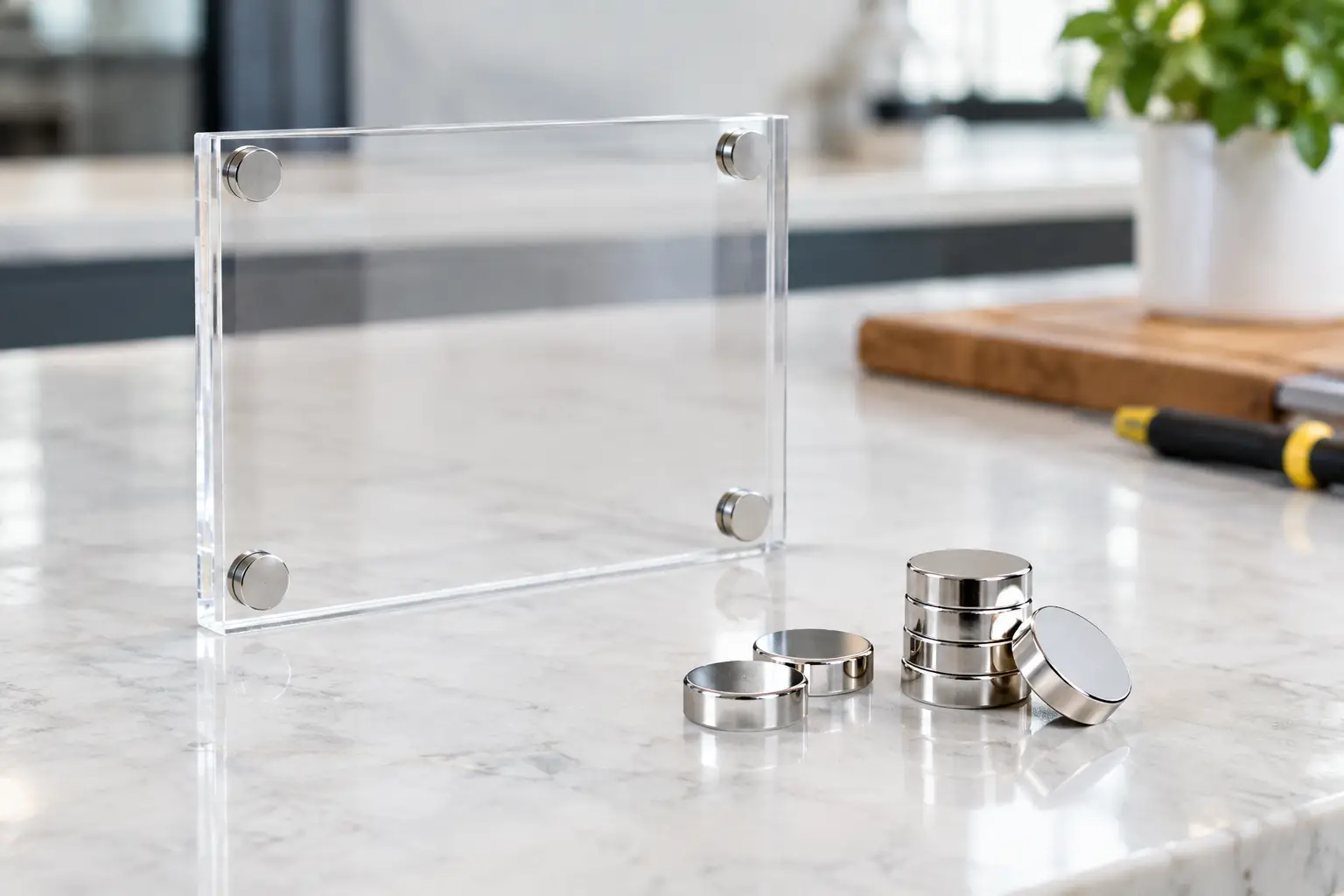
N52 neodymium disc magnets are often the best all-round option for acrylic displays. Their round shape is compact, easy to position and well suited to flush mounting in drilled recesses or behind a panel. Used with a matching disc magnet or steel washer, they create a clean, concealed fixing for signs, menu holders, retail graphics and lightweight removable panels.
Disc magnets work particularly well where the display must sit flat against a surface. A wider disc usually gives more holding area than a very small one, while a thicker disc can improve pull performance where there is a slight gap. The best balance depends on the available space behind the acrylic and how often the panel will be removed.
For a light display, small discs may be all that is needed. For larger panels, it is usually better to fit several appropriately sized magnets around the perimeter than rely on one very powerful magnet in the centre. This keeps the panel straight, reduces flexing and makes removal more controlled.
Countersunk magnets for secure screw fixing
Countersunk neodymium magnets are a strong choice when you need a more permanent, mechanically fixed installation. The countersunk hole allows a screw head to sit flush, making these magnets useful for timber backboards, retail units, cabinet interiors and fabricated display frames. Once fixed in place, the magnet can hold a steel plate or matching magnetic component attached to the acrylic display.
This format is especially useful when adhesive alone may not be reliable, such as in busy retail environments, warm areas or installations subject to regular movement. The screw takes the load of holding the magnet in position, while the magnet provides the quick-release function.
Avoid driving a countersunk screw directly into acrylic unless the acrylic has been correctly drilled and supported. Acrylic can crack if it is overtightened, particularly near an edge. Where possible, fix the countersunk magnet to the backing surface and use a bonded steel plate or a recessed counterpart on the acrylic section instead.
Block magnets for frames and larger panels
Block magnets provide a larger contact area and can be useful in display frames, plinths, acrylic boxes and access panels. Their flat faces make them easier to bond into routed channels, while their rectangular form helps prevent the display component from twisting.
They are a practical option where a panel has to stay precisely aligned, rather than simply held against a surface. For example, a pair of block magnets positioned near the top and bottom of an acrylic cover can keep it square within a frame. The trade-off is that blocks need more room than discs and must be carefully aligned during installation.
Magnetic catches for opening acrylic doors
For acrylic cabinet doors, display cases and protective covers, magnetic catches can be more practical than loose magnets. They are designed as a complete closure solution, typically combining a magnet housing with a strike plate. This gives a consistent closing point and makes it easier to open the door without pulling against an excessively powerful magnet.
A magnetic catch is often the better choice for a door that is opened throughout the day. It offers dependable closure while avoiding the sudden snap associated with two bare neodymium magnets meeting at close range. Check that the catch is rated for the door size and that hinges carry the weight properly. A catch should hold a door closed, not compensate for poor hinge alignment.
Choosing the right pull strength and size
More pull strength is not automatically better. An acrylic panel that needs to be removed by staff may become awkward or unsafe if the magnets grip too aggressively. Very powerful magnets can also chip acrylic if the panel is allowed to snap into place, especially when the magnets are close to an edge.
Start by considering the panel’s weight, dimensions and use. A static lightweight sign needs less holding force than a tall display cover that may be knocked or handled frequently. Then allow for the distance between the magnet and its mating surface. Acrylic thickness, double-sided tape, vinyl graphics and protective pads all reduce effective pull.
It is also worth considering the direction of force. Magnets resist a straight pull apart more effectively than sideways sliding. If an acrylic panel could slide down under its own weight, add a small physical support such as a bottom ledge, locating pins or a frame lip. Let the magnets hold the panel in position rather than asking them to carry every load in shear.
Installing magnets without damaging acrylic
Recessing magnets gives the neatest finish, but it needs care. Use a sharp acrylic drill bit or a suitable step drill at low speed, support the sheet fully and avoid forcing the tool. Heat can melt or stress acrylic, while pressure near corners can cause cracks. Test the drilling method on an offcut before working on a finished display.
For bonded installations, prepare both surfaces properly. Acrylic and plated magnet surfaces should be clean, dry and free from dust or grease. Choose an adhesive designed for the materials and the expected load, and allow it to cure fully before testing. A shallow recess can also help protect the adhesive joint from side loads.
Keep polarity under control before fixing anything. Mark one face of every magnet with a pen or small label, then dry-fit the complete arrangement. If one magnet is accidentally reversed, the panel will repel instead of connect. With multiple fixing points, a polarity mistake can be surprisingly time-consuming to correct after adhesive has cured.
Handle strong neodymium magnets with care during fitting. Keep fingers clear as magnets approach steel or one another, and store them apart from electronic devices and magnetic cards. If children will be near the display, make sure magnets cannot become loose or accessible.
When steel plates are better than matching magnets
A magnet-to-magnet connection provides high pull strength, but it is not always the best answer. For thin, lightweight acrylic, a steel plate can be easier to fit and less likely to cause a sharp snap when the panel closes. It also removes the need to match polarity across multiple points.
Steel plates are particularly useful on removable retail signs, menu boards and changeable information panels. Fit the magnets to the fixed backing board, then use small steel counterparts on the acrylic panel. The result is simple to align, economical and easier for staff to refit consistently.
Matching magnets are worth considering when the gap is greater, the panel is heavier or you need maximum holding power from a limited area. In those cases, use enough fixing points to distribute the force rather than selecting one oversized magnet.
Acrylic displays work best when the magnetic fixing is planned as part of the build, not added at the end. Select the magnet format around the panel thickness, expected handling and available mounting surface, then test the arrangement before committing to the final installation. A compact N52 magnet, fitted in the right place, delivers the strong, tidy hold that a professional display needs.