How Strong Is N52 Magnet Pull Force in Practice?
A small N52 neodymium magnet can hold far more than its size suggests. But N52 magnet pull force is not a single fixed figure that applies to every job. The quoted pull is measured under controlled conditions, while real installations involve paint, gaps, different metals, angled loads and repeated use.
For cabinet work, displays, workshop fixtures and bespoke builds, understanding that difference helps you specify a magnet that performs properly rather than one that only looks strong on paper. The right N52 magnet delivers compact, superior holding power. The wrong size or format can make an otherwise good installation unreliable.
What N52 magnet pull force actually means
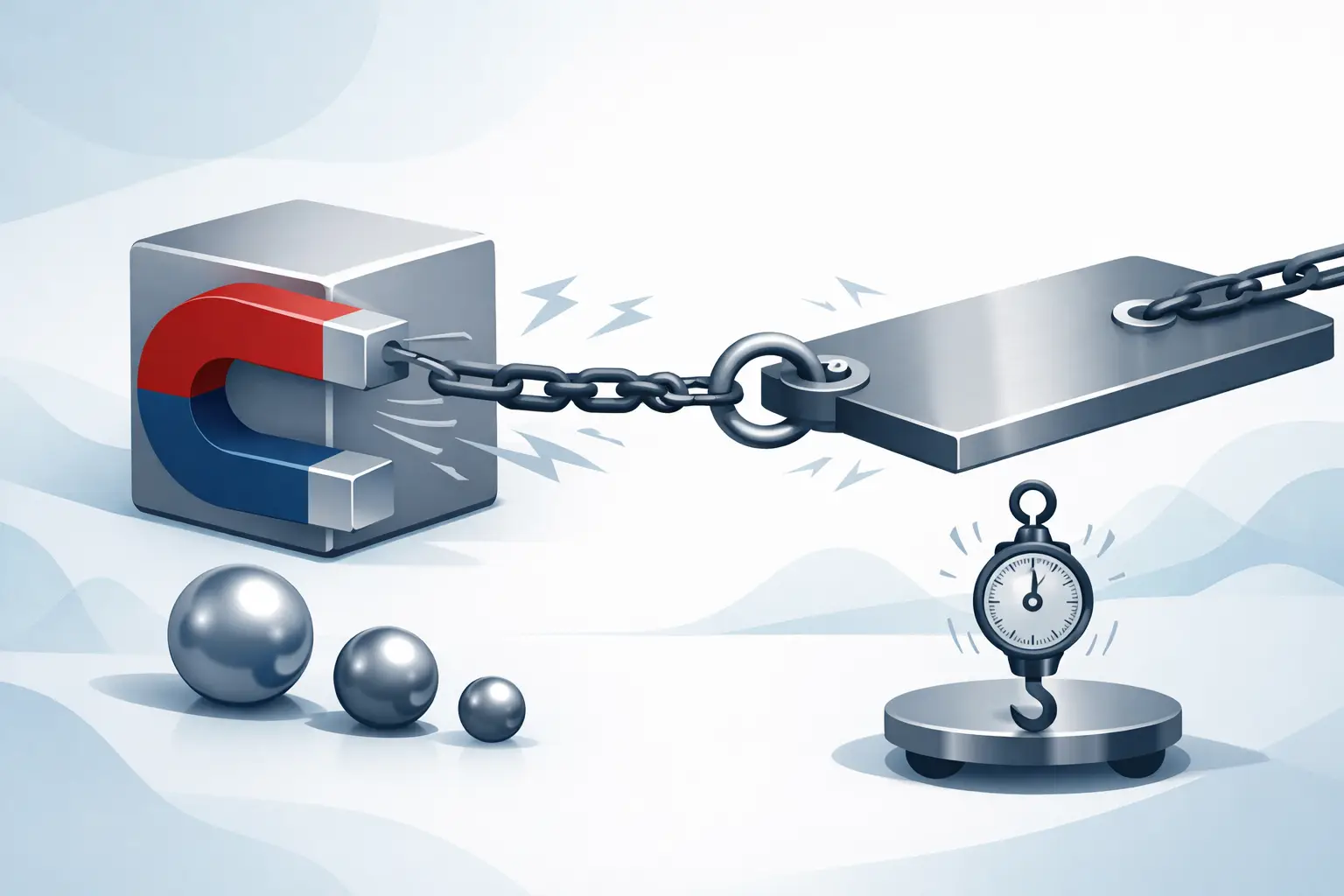
Pull force is the maximum direct force needed to separate a magnet from a suitable piece of steel. It is usually tested with the magnet sitting flat against clean, thick, low-carbon steel, with full surface contact and a straight pull away from the steel.
That test gives a useful comparison between magnets, but it represents a best-case result. If a product is rated for a certain pull force, it does not mean it will safely hold that same weight from a vertical wall, beneath a shelf or across a painted surface. In those positions, gravity creates a sliding or peeling force rather than a clean, straight pull.
N52 is the highest commonly available grade of neodymium magnet. The grade describes magnetic material strength, not the physical size of the magnet. A larger N52 disc generally produces more pull force than a small N52 disc, while a compact block may suit a narrow fixing point better than either. Grade and dimensions need to work together.
Why the stated pull force changes in a real installation
The surface is often the deciding factor. A magnet in direct contact with bare, flat steel can use its full magnetic circuit efficiently. Add even a very thin air gap from powder coating, paint, laminate, tape, fabric or a protective film, and holding power drops noticeably. Magnetic force reduces quickly as distance increases.
Steel type and thickness matter too. Mild steel is normally the best partner for a neodymium magnet. Thin steel can become saturated, meaning it cannot carry the magnetic field as effectively as a thicker plate. Stainless steel is not one material in magnetic terms: some grades attract a magnet, while many common austenitic stainless steels do not. Aluminium, brass, copper and timber are not magnetic at all.
Contact area also affects performance. A disc magnet sitting flat on a smooth steel plate gets a strong, even grip. The same magnet placed on a curved rail, rough weld, countersunk screw head or uneven painted surface has less contact and less effective pull. This is why a magnet that feels exceptionally strong in the hand may be less impressive once fitted to a real component.
Load direction is equally important. Pull force describes separation perpendicular to the steel surface. A vertical door catch, tool holder or sign mount often asks the magnet to resist shear, where the object tries to slide down the steel. Friction helps, but it is much less dependable than direct pull. For a sliding load, choose a larger safety margin, add a mechanical stop where possible, or use a magnet arrangement designed to resist movement.
Choosing the right N52 magnet for the job
Start with the job rather than the headline pull figure. Ask what material the magnet will meet, whether it will have direct contact, how the load acts, and how often the parts will be separated. This quickly narrows the right format.
N52 disc magnets are a practical choice when a neat, concealed circular fixing point is needed. They suit closures, removable panels, display fittings and workshop projects where depth is limited. A wider disc normally gives greater contact area, while extra thickness can add strength, particularly when working against thicker steel.
N52 block magnets are useful when a rectangular shape gives better coverage or alignment. They work well in cabinet doors, jigs, bespoke housings and retail fit-outs. Their flat faces provide a stable mounting surface, and their shape can be easier to recess into timber or composite materials. However, sharp edges can chip if two powerful blocks snap together, so they need careful handling during fitting.
Countersunk N52 magnets offer a more secure route when the magnet itself needs to be screwed into place. A suitable countersunk screw holds the magnet flush to a surface, creating a clean fixing for catches, door closures and removable covers. The screw secures the magnet mechanically, while the magnetic face provides the closure force. It is a strong combination for installations that see regular use.
For cupboard doors, access panels and similar closures, do not simply select the highest pull force available. An over-powerful magnet can make a lightweight door awkward to open, pull a fixing loose from soft timber, or create a harsh snap shut. A well-matched magnetic catch should close positively but remain comfortable to release.
Allow a realistic safety margin
A sensible safety margin turns a quoted figure into dependable performance. If the item is held in direct pull against clean steel and is only removed occasionally, a modest margin may be enough. If it is mounted vertically, exposed to vibration, subject to knocks or separated by paint and fittings, allow considerably more capacity than the object’s simple weight suggests.
For example, a small steel-backed sign may weigh very little, but people can knock it sideways. A magnetic tool holder carries changing loads and may be fitted to painted steel. A cabinet door creates repeated impact as it closes. These applications benefit from more than the minimum calculated pull force.
There is also a practical limit to increasing strength. Higher pull can mean difficult positioning, finger trapping risk and more stress on adhesive, screws or the material receiving the magnet. In a timber installation, the magnet may be stronger than the timber fibres or the screw fixing around it. Strength should be balanced across the entire assembly.
Mounting details that protect pull performance
Keep mating faces clean and as flat as possible. Sawdust, swarf, paint buildup and raised screw heads all create a gap. Where a magnet is recessed into wood, ensure it sits flush rather than below the surface, unless the matching steel plate is also shaped to maintain close contact.
If bonding a magnet in place, use an adhesive suited to the base material and allow full cure time before loading it. The bond must resist the force created when the magnet attracts its steel counterpart. For high-use or higher-load work, a mechanical fixing is usually preferable where the magnet format allows it.
Polarity needs attention when magnets face magnets rather than steel. Two magnets can attract strongly or repel completely depending on their orientation. Mark one face before installing several pieces, especially in paired closures or removable panels. Correct polarity saves the frustration of fitting a component only to find that it pushes away from its matching magnet.
Avoid relying on magnetism alone where failure could cause injury, damage or a safety issue. Neodymium magnets are excellent for practical holding and closure tasks, but they are not a substitute for rated structural fasteners, safety latches or engineered lifting equipment.
Handling powerful N52 magnets safely
N52 magnets are compact and powerful, so treat them with care. Larger pieces can snap together unexpectedly, trapping skin or chipping on impact. Keep them spaced apart during storage, use a controlled sliding motion to separate them from steel, and avoid letting two magnets collide face to face.
Keep neodymium magnets away from pacemakers and other implanted medical devices. They should also be kept clear of bank cards, magnetic storage media and sensitive electronics. Children should never handle small magnets unsupervised, as swallowed magnets require urgent medical attention.
A chipped neodymium magnet can still work, but damaged coating may eventually allow corrosion. Handle magnets with clean, dry hands and protect them from hard impacts. For a visible fitting or a frequently handled closure, choosing an appropriate size and mounting method is often better than forcing a small magnet to work at its limit.
Stronger results come from better matching
N52 magnets give excellent pull performance for their size, making them a practical choice where space is tight and reliable holding matters. At Magman, the focus is on powerful, versatile neodymium magnet formats that make selection straightforward for trade and DIY work alike.
The most useful question is not simply, “How much can this magnet pull?” It is, “How will it be used?” Match the size, shape and fixing method to the steel, the gap and the direction of load, then allow enough margin for everyday use. That is how a compact N52 magnet becomes a dependable part of the finished job.