Magnetic Catches vs Roller Catches Compared
A cupboard door that will not stay shut is a small fault that quickly becomes irritating. A door that shuts too aggressively, rattles in use or needs a hard pull to open is no better. When weighing up magnetic catches vs roller catches, the right choice comes down to the door, the expected use and the finish you want from the installation.
For many cabinet, joinery and DIY projects, both options provide a neat secondary closure without the need for a visible latch. They work in different ways, though. Magnetic catches use attraction to hold a strike plate in place, while roller catches use spring-loaded rollers that grip a strike plate as the door closes. That difference affects holding power, fitting tolerance, wear and the feel of the finished door.
Magnetic catches vs roller catches: the key difference
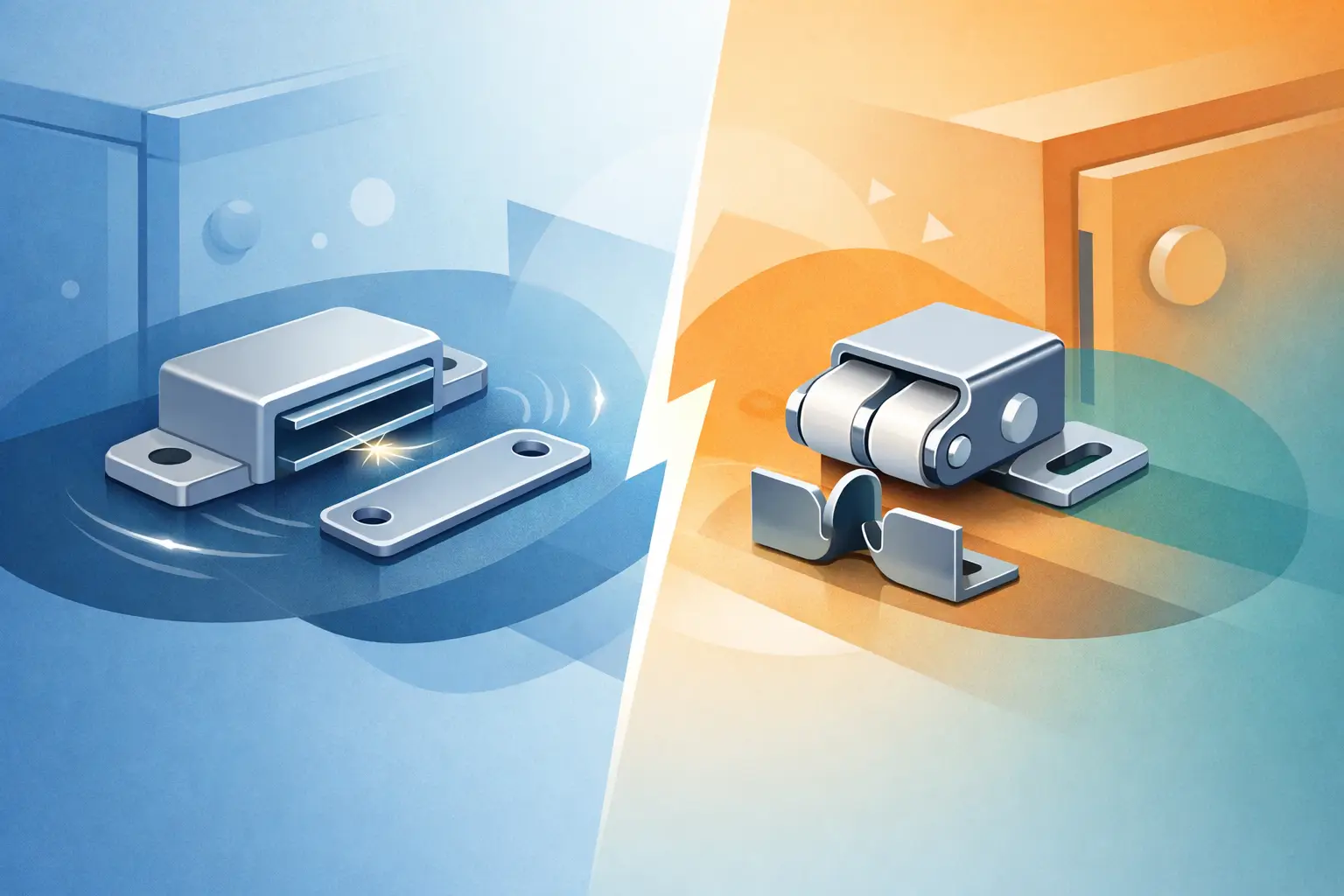
A magnetic catch consists of a magnet housed in a compact fitting and a steel strike plate fixed to the door or frame. As the two parts meet, the magnet pulls the plate into position and holds the door closed. The action is quiet, simple and generally forgiving of slight movement in the door over time.
A roller catch has two sprung rollers, usually set inside a metal housing. The strike plate passes between them as the door closes. The rollers compress, then spring back to hold the plate. To open the door, the rollers must be pushed apart again.
Neither is automatically the better fitting. A roller catch gives a positive mechanical grip, whereas a magnetic catch provides a clean, controlled pull. The best choice is the one that suits the door weight, hinge arrangement and how frequently the unit will be opened.
When a magnetic catch is the better option
Magnetic catches are a practical choice for lightweight to medium-weight cupboard doors, display units, wardrobes, utility cupboards and many made-to-measure furniture projects. They are particularly useful where a quiet close matters or where you want the door to sit closed without a distinct snap from a mechanical catch.
Their main advantage is that there is no roller pressure to overcome during closing. The magnet begins pulling the strike plate in as the gap closes, helping the door settle into place. This can be useful on doors with soft-close hinges, where the final movement is already controlled.
High-strength magnetic catches also offer excellent closure performance from a small fitting. A compact neodymium magnet can provide powerful holding force without adding a bulky latch to the cabinet interior. For installers working on slim frames, shallow cupboards or clean retail displays, that space saving matters.
Magnetic catches are also less prone to the gradual stiffness associated with mechanical springs. There are no rollers to collect debris or lose tension. The magnet itself will retain its performance for a very long time when used correctly, although the whole fitting still depends on secure screws, a flat strike plate and sensible alignment.
That said, magnetic catches are not the answer to every closure problem. A magnet holds best when the strike plate meets it squarely and with minimal gap. If a warped door leaves a large gap, or if hinges allow the door to sag noticeably, the holding force will reduce. The catch cannot correct poor door alignment.
Choose magnetic catches for a quieter, cleaner closure
A magnetic catch is usually the stronger all-round choice when you need a discreet closure that is easy to operate. It suits kitchen-style cabinets, built-in storage, retail units and workshop cupboards where access is frequent and a smooth pull-open action is preferred.
It is also a good option when the door may be subject to minor alignment changes through seasonal movement. Wood expands and contracts, especially in older properties or unheated spaces. A magnetic catch often continues to perform acceptably with small variations that may make a tightly set roller catch feel awkward.
When roller catches make sense
Roller catches are familiar hardware for internal cupboards, wardrobe doors and traditional fitted furniture. Their mechanical grip can feel reassuring because the door is physically retained between the rollers rather than held by magnetic attraction.
They work well where the door closes directly and consistently against a fixed stop. Once fitted accurately, a roller catch gives a firm close and a clear release as the door is opened. Some users prefer this positive action on lightweight doors that might otherwise feel as though they could be pulled open too easily.
Roller catches can be suitable where magnetic components are undesirable, such as installations close to magnetically sensitive equipment or specific specialist applications. In most domestic and trade furniture work this is not a major concern, but it can be relevant in technical environments.
The trade-off is fitting accuracy. The strike plate needs to enter centrally between the rollers. If it is too high, low or offset, the door may resist closing, fail to stay shut or wear unevenly. A catch that is slightly too tight can also place unnecessary pressure on hinges, particularly on a light cabinet door.
Roller catches contain moving parts, so they can eventually become less consistent through wear, dirt or corrosion in damp conditions. This does not make them unreliable hardware, but it does mean they are less forgiving than a well-chosen magnetic catch in busy, dusty workshops or utility areas.
Holding force is not the only decision
It is tempting to select a catch purely by how strongly it holds, but excessive holding force can make a cabinet frustrating to use. The catch should resist normal vibration, draughts and accidental knocks while still allowing the user to open the door without tugging the cabinet or stressing the hinges.
For a small, lightweight door, a moderate magnetic catch is often sufficient. For a taller or heavier door, use a stronger catch, consider fitting two catches, or first check whether the hinges and door stops are doing their job. A catch is a closure aid, not a substitute for properly fitted hinges.
Door style matters too. Frameless cabinet doors may need careful positioning so the catch and strike plate meet cleanly. Face-frame cabinets often provide a straightforward mounting surface, but the catch must not prevent the door sitting flush. For inset doors, allow for the closing gap and test the position before tightening every screw.
Fitting advice for reliable results
Start by fitting the catch body to the cabinet frame or the area with the most solid fixing surface. Close the door gently against it to mark the strike plate position, then attach the plate loosely and test the action. This approach is more reliable than measuring from an edge that may not be perfectly square.
With a magnetic catch, aim for face-to-face contact between the magnet and strike plate. Keep the plate flat and remove any packing material that creates an unnecessary gap. If the door has a tendency to spring back after closing, check the hinges and door stop before simply moving to a stronger magnet.
With a roller catch, take extra time to centre the strike plate. The door should close with firm but reasonable pressure. If it requires a slam, adjust the position rather than accepting a poor fit. Repeated force can loosen screws and shorten the useful life of the catch.
For timber, use pilot holes to reduce the risk of splitting, especially near narrow frame edges. For metal cabinets, select suitable fixings and make sure the mounting surface is rigid. A high-performance catch only works as well as the surface it is fixed to.
Which catch should you buy?
Choose a magnetic catch if you want a compact, quiet and powerful closure with minimal moving parts. It is the practical choice for most modern cabinets, storage units, displays and custom builds, particularly where superior pull performance is useful in a small space.
Choose a roller catch if you prefer a traditional mechanical hold and can achieve accurate, stable alignment. It can work very well on correctly fitted furniture, but it is less tolerant of a door that moves, sags or sits inconsistently.
For dependable cabinet closures, focus on the complete installation: sound hinges, a square door, secure fixings and a catch matched to the job. Magman’s strong magnetic catches are built for buyers who need compact, practical holding power rather than a compromise that has to be replaced after a few months. Fit the closure carefully, test it before final tightening, and the door should feel right every time it is used.