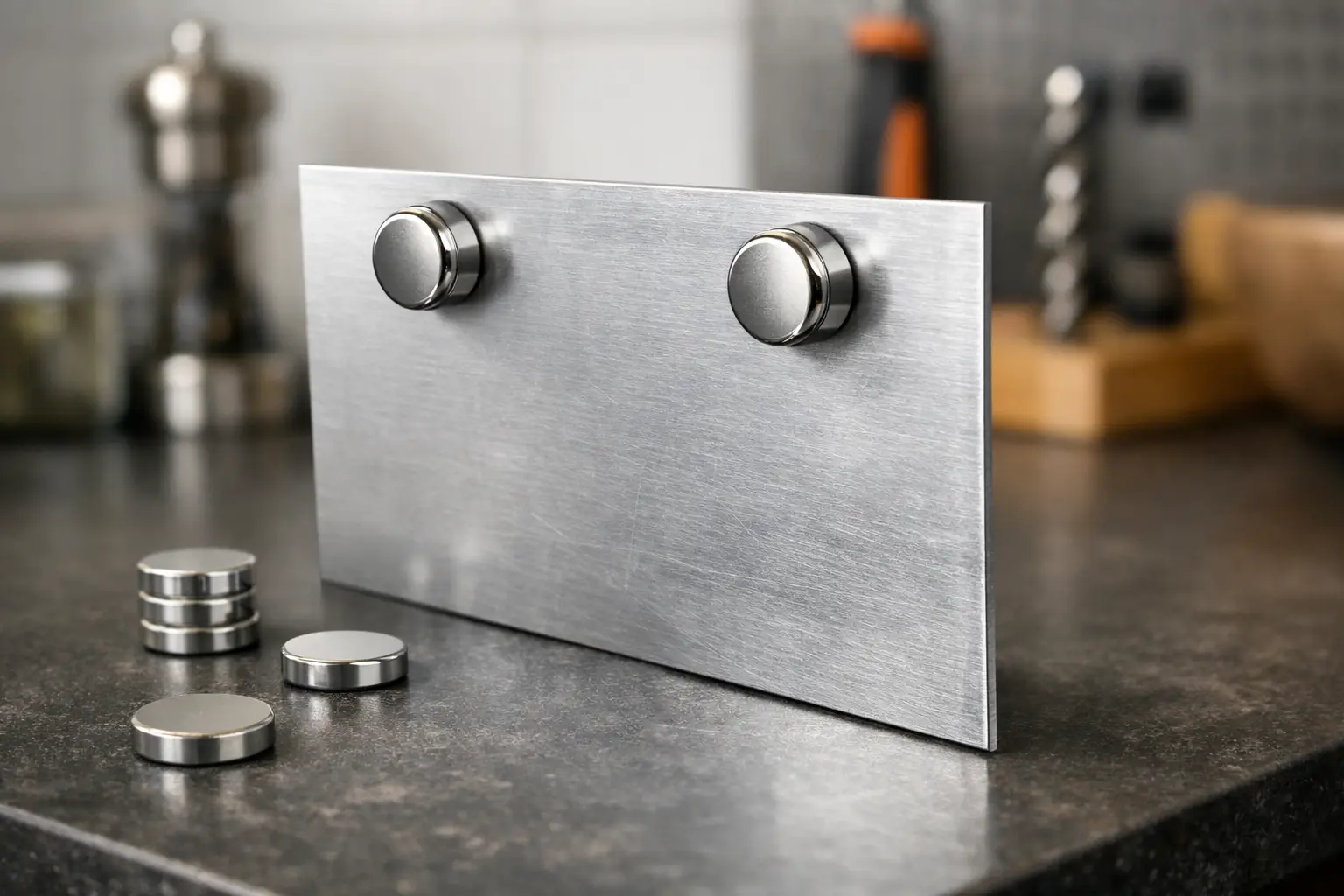
What Magnets Hold Aluminium? The Practical Answer
Ask what magnets hold aluminium, and the direct answer is: none will hold to bare aluminium in the way they hold to steel. Aluminium is non-ferrous, so even a super-strong N52 neodymium magnet will not create a useful static grip on an aluminium sheet, extrusion or panel.
That does not make magnets unsuitable for aluminium projects. It simply changes the fixing method. In cabinet work, retail displays, access panels and workshop builds, the reliable approach is to add a ferrous steel contact point, then use the magnet where its superior pull performance matters.
Why magnets do not stick to aluminium
A permanent magnet needs a magnetic material to complete the connection. Iron, mild steel, nickel and cobalt are ferromagnetic, which means their internal structure responds strongly to a magnetic field. Aluminium does not behave this way. It is very weakly paramagnetic, but that effect is far too small to support a practical fixing.
This is why a neodymium disc magnet can grip a steel washer firmly yet slide straight off an aluminium door. The strength rating of the magnet does not change the material science. A larger or higher-grade magnet increases pull force against suitable steel, not against bare aluminium.
Occasionally, a magnet appears to stick to an aluminium surface. Usually, there is steel beneath the surface, such as a frame, screw, bracket, reinforcement plate or hidden fixing. Check the construction before choosing a magnet size. Assuming an aluminium panel is magnetic because one area attracts a magnet can lead to an unreliable installation.
What about moving aluminium?
Strong magnets can interact with moving aluminium because they induce eddy currents in the metal. This can create resistance, braking or a floating effect in specialist equipment. It is not the same as a magnet sticking to aluminium, and it is not a solution for holding a cabinet door, sign or removable panel in place.
For everyday fixing work, treat aluminium as non-magnetic and plan for a steel strike plate, washer or insert.
What magnets hold aluminium in practical installations?
The magnet does not hold the aluminium directly. Instead, it holds a steel component attached to the aluminium. This gives you a compact, clean and repeatable closure or mounting point without relying on weak adhesives or improvised catches.
Neodymium magnets are usually the best choice because they deliver high pull strength from a small footprint. The right format depends on how the aluminium part is built and how much load, gap and movement the fixing must handle.
Countersunk magnets for flush mechanical fixing
Countersunk neodymium magnets are a practical option when you can screw the magnet to a timber frame, steel bracket or another suitable substrate. Pair the magnet with a steel countersunk screw, steel strike plate or washer fitted to the aluminium component.
This arrangement works well for cupboard doors, access hatches, display panels and lightweight aluminium covers. The magnet sits neatly flush with its mounting surface, while the steel counterpart can be secured to the aluminium with a rivet, screw, bolt or appropriate structural adhesive.
Do not rely on the countersunk screw alone to provide the contact surface unless it is exposed and positioned accurately. A dedicated steel plate generally gives a broader target area and more consistent holding performance.
Disc magnets for concealed catches
Disc magnets are a strong choice for concealed closures. They can be recessed into timber, plastic or a non-magnetic composite frame, with a steel washer or plate fixed behind the aluminium-facing part.
The key measurement is the air gap. Every millimetre between the magnet and steel reduces the available pull force. Paint, laminate, thick adhesive pads, plastic trims and misalignment all create separation. A magnet that feels exceptionally powerful when touching a steel plate may be much less effective through a gap.
For an aluminium cabinet door, position the steel strike plate as close to the magnet as possible. If the door has a folded edge or internal void, test the final spacing before drilling or bonding all components permanently.
Block magnets where more contact area is needed
Block magnets suit applications that need a larger contact area or resistance to twisting. They are useful behind removable aluminium panels, in retail fixture covers and in fabricated enclosures where the magnet can be mounted inside a frame.
A rectangular steel plate is often the best counterpart for a block magnet. It gives the magnet a full, flat surface to engage with and makes alignment more forgiving than a small washer. Where the panel must be removed frequently, a larger target also helps the magnet find its position cleanly rather than snapping to one edge.
Magnetic catches for doors and panels
For repeated opening and closing, a purpose-made magnetic catch is often more practical than fitting loose magnets. Magnetic catches combine the magnet, housing and fixing points into a straightforward unit, usually with a steel strike plate for the moving part.
They are particularly effective on aluminium-framed cabinets, lightweight doors and access panels where you want a tidy, predictable closure. Choose the catch based on the panel weight, the force likely to pull it open and the gap between the catch and strike plate. A catch designed for a small cupboard door may not be suitable for a larger panel exposed to vibration or regular handling.
Choosing the steel counterpart
The steel part is as important as the magnet. Mild steel is normally the dependable choice because it responds strongly and is readily available in washers, plates and brackets. Thin steel can work, but a thicker plate usually allows better magnetic engagement, particularly with larger neodymium magnets.
Stainless steel is not automatically suitable. Some grades are magnetic, while others are not or have only weak attraction. If the project needs a corrosion-resistant visible plate, test the specific stainless grade with the selected magnet before committing to the installation.
For aluminium installations, common options include a zinc-plated steel washer, a small mild-steel strike plate, a steel bracket behind the panel, or a purpose-made plate supplied with a magnetic catch. Select a counterpart that is wider than the magnet face where possible. This improves alignment and lets the magnet use more of its available pull strength.
How to fit a magnetic fixing to aluminium
Mechanical fixing is usually the most dependable route. Aluminium can be drilled and fitted with screws, bolts, rivets or threaded inserts, provided the material thickness and load are suitable. Use a steel strike plate on the aluminium section and secure the magnet to the opposing frame or housing.
Bonding can be useful where you cannot drill through a finished panel. Surface preparation matters: remove grease, lightly abrade where appropriate and use an adhesive rated for the materials and working environment. However, adhesive strength, temperature changes and repeated impacts can all affect long-term performance. For high-use doors, heavier panels or safety-critical work, mechanical fixing is the safer choice.
Avoid placing a brittle neodymium magnet where it can slam directly into bare steel. These magnets are powerful but can chip or crack on impact. A recessed mount, a thin protective cover, or a controlled magnetic catch housing helps protect the magnet and produces a neater finish.
Match magnet strength to the job
More pull force is not always better. An overpowered magnet can make a small aluminium cabinet difficult to open, pull a bonded strike plate loose, or pinch fingers during fitting. Conversely, an undersized magnet can let a panel rattle or open when the unit is moved.
Think about the real working conditions. A lightweight indoor access flap needs a different solution from an aluminium retail display panel that is handled all day. Consider panel weight, leverage from the hinge position, vibration, surface gap, opening frequency and whether the installation is vertical, horizontal or overhead.
Magman’s N52 neodymium magnets provide powerful and versatile fixing options, but performance depends on a suitable steel contact surface and a well-planned fit. Test the arrangement with the actual materials where possible, especially if paint, trims or spacing are involved.
A reliable approach for aluminium projects
For a clean result, mount the magnet securely to the fixed side of the assembly and fit a mild-steel plate to the aluminium moving part. Keep the contact faces flat and close, allow enough steel area for easy alignment, and select a pull force that suits the panel rather than simply choosing the strongest magnet available.
That small change turns a material mismatch into a dependable magnetic fixing: aluminium provides the light, durable structure, while steel gives your neodymium magnet the surface it needs to do its job.