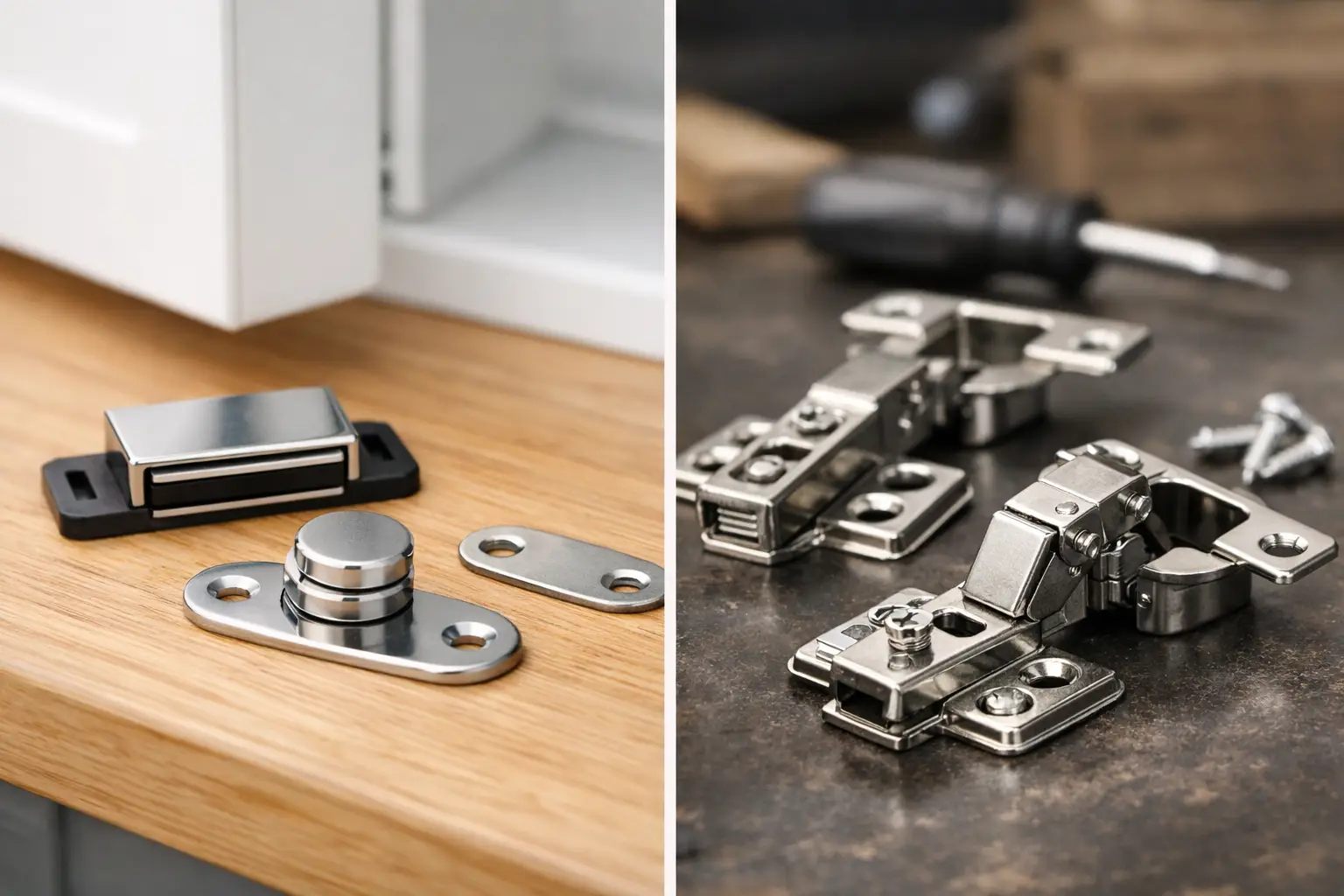
Magnetic Catches vs Hinges: Which Closure Works?
A cabinet door that drifts open, rattles in use or needs a hard push to shut is rarely a minor annoyance. It affects the feel of the whole build. When comparing magnetic catches vs hinges, the key point is that they usually perform different jobs: hinges allow the door to move, while a magnetic catch keeps it closed. Choosing the right combination gives cupboards, display units and workshop enclosures a more reliable finish.
Magnetic catches vs hinges: understand the difference
A hinge is a mechanical pivot. It carries the door, sets its opening movement and, depending on its type, may control how far the door opens or whether it closes softly. Butt hinges, concealed cabinet hinges, piano hinges and lift-off hinges all serve this core purpose.
A magnetic catch is a closure device. It uses a magnet and a steel strike plate, or two mating magnetic parts, to hold a door or panel in its closed position. It does not support the door’s weight and it will not replace a hinge where a panel needs to swing, fold or lift.
That means this is not always an either-or decision. A typical cupboard door uses hinges for movement and a magnetic catch for positive closure. The catch stops the door from creeping open when a cabinet is slightly out of level, when contents press against it, or when vibration is part of normal use.
There are exceptions. A removable access panel, lightweight cover or retail display sign may be held entirely by magnets, with no hinge required. The right answer depends on whether the item must pivot or simply be removed and replaced.
When magnetic catches are the better choice
Magnetic catches are particularly useful when you need a clean, repeatable hold without a visible latch. They are common on kitchen cabinets, wardrobe doors, utility cupboards, media units, inspection hatches and retail fixtures.
They provide positive closure
A well-matched magnetic catch pulls the door into its final closed position and holds it there. This is valuable on doors with no spring-loaded hinge, older cabinets with tired hardware, and handmade units where the door may not naturally sit flush.
For cabinet makers and DIY users, the benefit is simple: the closure feels intentional. The door stays shut until it is pulled open, rather than relying on friction alone.
They suit slim, practical installations
Magnetic catches are compact and can often be fitted inside the cabinet, out of sight. Surface-mounted catches are straightforward for quick installations, while countersunk magnetic options can create a neater, more discreet result on purpose-built furniture and panels.
Neodymium magnets are especially useful where space is limited. Their superior pull performance allows a small magnet to deliver a strong hold, provided the mating surfaces are aligned correctly. This makes them a practical option for narrow frames, small access doors and lightweight display panels.
They work for removable panels
Where access is needed but a swinging door would get in the way, magnets can be more convenient than hinges. Think of a removable panel covering cable routes, plumbing access, electrical equipment or a built-in speaker. The panel can sit flush, be removed cleanly and refitted without mechanical catches or visible fixings.
This approach needs sensible planning. The panel must have a safe way to be lifted or pulled away, such as a finger recess, small gap or concealed pull point. A powerful magnet may hold brilliantly, but it is not useful if there is no practical way to release the panel.
When hinges are essential
Hinges are the correct choice whenever a door needs controlled movement. They carry the load, maintain the relationship between door and cabinet, and reduce strain on the surrounding material.
A magnetic catch cannot safely support a heavy timber door, a frequently used gate-style panel or a door that must open to a set angle. Attempting to use magnets alone in these applications can lead to sudden release, poor alignment and damage to the panel edge.
Hinges are also better for larger doors. The heavier and wider the door, the more important it becomes to use the correct number, size and type of hinge. A magnetic catch may still be fitted, but it should be treated as the closing aid rather than the structural fixing.
Hinges control movement, not always closure
Many modern concealed hinges have an integrated spring, which pulls the door shut during the final part of its travel. In a well-fitted cabinet, that may remove the need for a separate magnetic catch.
However, a catch can still be worthwhile where doors are prone to bounce open, where soft-close hardware does not provide enough final holding force, or where a lightweight door needs extra reassurance. It is common to add a magnetic catch to improve an existing installation rather than replace the hinges already in place.
Choosing the right closure for the job
Start with the door or panel itself. Consider its weight, size, material, frequency of use and how it needs to open. A light MDF access panel and a solid oak cupboard door may both look similar from the front, but they place very different demands on the hardware.
For a standard cupboard door, use hinges to hang the door and a magnetic catch only if additional holding force is needed. For a removable cover, a magnetic fixing can be the complete solution. For a display door that is opened throughout the day, hinges take the repeated load while a catch keeps the presentation tidy between uses.
The required holding strength deserves careful thought. More pull force is not automatically better. An overly strong catch on a small, flexible or thin panel can make opening awkward and may pull the panel out of position. It can also cause a sharp snap when the magnet engages.
Conversely, a catch that is too weak will allow the door to pop open under vibration or when a cupboard is full. Match the magnetic strength to the panel weight and the forces likely to act on it. A workshop cabinet, mobile display unit or caravan installation may need more holding power than a stationary living-room cupboard.
Alignment matters as much as magnet strength
Magnetic catches perform best when the magnet meets the strike plate squarely and with minimal gap. Even a powerful magnet loses effective holding force when the surfaces are misaligned, separated by thick material or allowed to meet at an angle.
Before drilling final fixing holes, position the catch and strike plate with the door closed. Check that the door sits flush and that the contact point is centred. Small adjustments at this stage prevent weak holding, uneven gaps and unnecessary force on the hinges later.
If the door has a tendency to twist, fit the catch where it gives the best control. A catch near the opening edge is usually most effective, but very wide doors may benefit from two catches. This spreads the holding force and helps prevent one corner from sitting proud.
Fitting magnetic catches for dependable results
Fit the catch to a solid, flat area of the cabinet and secure the strike plate to the door, unless the product design states otherwise. Avoid fixing into damaged chipboard, thin unsupported material or a location where screws may break through the visible face.
Use the supplied fixings where suitable, but check their length against the material thickness. For hardwood, drilling a small pilot hole helps prevent splitting. For metal cabinets and fabricated enclosures, choose fixing methods that suit the material and allow the components to sit flat.
Leave enough clearance for the door to close naturally on its hinges. The magnet should draw the final few millimetres of movement, not compensate for a badly fitted door or a hinge that is under strain. If the door rubs, binds or sits unevenly, adjust the hinges first.
For high-strength neodymium magnetic catches, keep fingers clear as the parts come together. Their compact size can be deceptive, and a strong pull can close the gap quickly. Handle the components with care during test fitting, particularly around fragile finishes and glass-fronted units.
A reliable closure is usually the result of using each component for the job it is designed to do. Let hinges carry and guide the door, then use a powerful, well-aligned magnetic catch where the build needs confident holding force and a clean closing action.