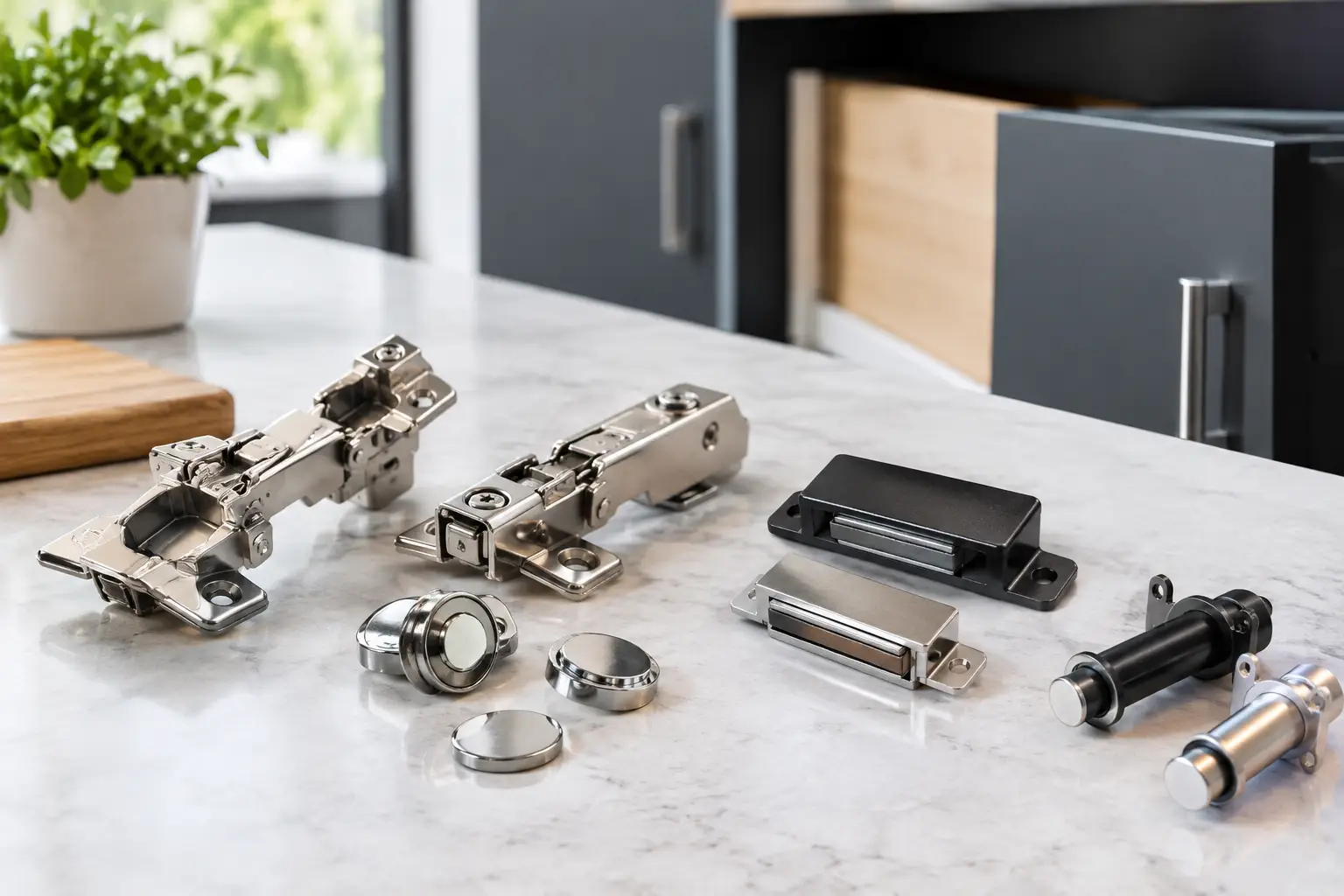
Trends in Cabinet Closure Hardware for 2026
A cabinet door that rattles, sits proud of the frame or needs a hard push to stay shut can make an otherwise excellent build feel unfinished. The biggest trends in cabinet closure hardware are responding to that problem with quieter operation, cleaner lines and more dependable holding power. For cabinet makers, fit-out teams and capable DIYers, the best choice is increasingly less about a single fashionable fitting and more about matching the closure to the door, use case and finish.
Trends in cabinet closure hardware: cleaner and quieter
The visible latch is disappearing from many modern cabinet projects. Handleless kitchen units, fitted wardrobes, retail displays and media furniture all favour a clean front with as little exposed hardware as possible. Concealed hinges remain central to this look, but the closure method matters just as much. A door can pivot invisibly on good hinges and still look poorly made if it will not sit neatly closed.
Soft-close hinges and runners have become a baseline expectation in many domestic installations. They reduce noise, protect door edges and give lightweight doors a controlled finish. On a busy kitchen, they also limit repeated impact on fixings and carcass joints. However, soft-close is not a complete closure solution on its own. A hinge damper slows the final movement, but it may not hold a warped, shallow or frequently used door tightly against the cabinet.
That is where magnetic catches are gaining ground. A well-chosen magnetic catch provides a positive closing pull without adding a visible catch body to the front of the unit. It suits doors that need to look simple, open quickly and close reliably, particularly where a conventional mechanical latch would be bulky or awkward.
Stronger magnets in smaller spaces
Cabinet designs are getting slimmer. Shallow wall units, compact utility storage, display plinths and made-to-measure furniture often leave little room for large catches. At the same time, users expect doors to stay closed during everyday knocks, vibrations and repeated use.
High-strength neodymium magnets answer this need because they deliver substantial pull performance from a compact format. A small disc or block magnet can be recessed into timber, mounted behind a panel or paired with a steel strike plate where space is limited. Countersunk magnet formats are particularly useful when a flush screw-fixed installation is required.
Small does not automatically mean suitable, though. Pull strength figures are typically measured in ideal conditions, with direct contact against clean, flat steel. Cabinet doors rarely offer those conditions. Paint thickness, laminate, misalignment, a gap between surfaces and an angled pull all reduce the holding force available in practice.
For that reason, specifying a magnet only by its listed pull strength can lead to disappointment. Consider the door size, its weight, the position of the catch and how the door is opened. A tall pantry door may need more than one closure point to prevent the top or bottom edge from drifting open. A small cupboard door may only need modest holding force, especially if the user needs to open it with a simple finger pull.
The trade-off between holding force and opening effort
The strongest catch is not always the best catch. Excessive magnetic pull can make a small door frustrating to open, loosen an adhesive-mounted strike plate over time or put unnecessary stress on thin MDF fixings. The aim is a controlled close, not a fight every time the cabinet is used.
A practical approach is to choose enough force to overcome hinge tension, door bounce and normal movement, then test the opening action before finalising the installation. On larger or heavier doors, spreading the holding force across two magnets is often better than relying on one oversized catch. The door closes more evenly and the force required to open it feels more predictable.
Push-to-open remains popular, but it has limits
Push-to-open systems continue to appeal where handleless furniture is the priority. They create an uncluttered appearance and can work well on wardrobes, kitchens and contemporary retail units. Mechanical push latches offer a clear release action, while magnetic push-to-open fittings use magnetic attraction to pull the door shut after it has been pressed closed.
Their performance depends heavily on accurate fitting. The door must be aligned, the gap must be consistent and the opening mechanism must have enough travel to release cleanly. On lightweight doors, that is usually straightforward. On wide doors, bowed fronts or cabinets exposed to vibration, a push-to-open catch can become temperamental if tolerances are poor.
For practical builds, many installers now favour a hybrid approach. Soft-close hinges manage the movement, while a compact magnetic closure provides reliable final contact. This can be especially effective for utility cupboards, van racking, workshop cabinets and display units where the door must stay shut but the front should remain tidy.
Hardware that tolerates real installation conditions
Another clear shift is towards closure hardware that is easier to fit accurately and easier to adjust later. Cabinet work is rarely as perfect as a drawing. Timber moves, carcasses can be slightly out of square and doors can settle after installation. A catch that only works within a very narrow alignment range can cost time on site.
Adjustable plates, slotted fixing holes and screw-mounted catches give the installer room to tune the final position. This matters more than it may first appear. Even a few millimetres of adjustment can change a closure from weak and noisy to firm and clean.
When choosing a magnetic arrangement, allow for four real-world factors:
- The air gap between magnet and steel strike plate once finishes are applied.
- The direction in which the door is pulled open, not just the force needed to separate flat surfaces.
- The material available for fixing, particularly on thin doors or lightweight panels.
- The chance of impact, vibration or frequent use in workshops, retail and mobile installations.
Screw fixing is generally the dependable option for long-term cabinet use. Adhesive pads can be useful for light-duty panels or quick positioning, but they depend on a clean surface and may struggle with repeated shock loading. If a magnet is recessed into timber, ensure it is seated squarely and does not sit so deep that the closing gap weakens its effective hold.
Finish quality is shaping the hardware choice
Cabinet closure hardware is no longer judged only by whether it works. It is judged by what the user sees, hears and feels. A soft close, a consistent reveal around the door and a firm final pull all contribute to perceived quality.
This is one reason concealed magnetic closures suit so many current projects. They can be hidden behind the door or within the carcass, allowing the cabinet face to remain the focus. For retail units, this also keeps visual distractions away from the merchandise. For home storage, it supports the simple, built-in look many customers want.
There is still a place for traditional roller catches, touch latches and mechanical bolts. Roller catches can be economical and effective for light internal doors. Mechanical latches may be the safer choice where a cabinet needs a defined lock-like engagement or where a magnetic field is unsuitable. The trend is not that every closure should become magnetic. It is that installers are choosing magnetic hardware more deliberately when compact strength, concealed fitting and quick access matter.
Choosing the right closure for the job
Start with the function of the cabinet rather than the appearance of the catch. A kitchen cupboard, a workshop tool cabinet and a retail display case may all have similar doors, yet their closure requirements are very different. Think about door weight, frequency of use, available fixing depth, the desired opening action and whether the unit will experience vibration.
For lightweight domestic doors, soft-close hinges paired with a modest magnetic catch can give a quiet, reassuring finish. For deeper doors or demanding workshop storage, stronger neodymium magnets and secure mechanical fixing offer greater confidence. Countersunk magnets make sense where you need a neat screw-fixed solution, while disc and block magnets give flexibility for recessed or custom-built closures.
Magman focuses on powerful, versatile N52 neodymium magnets and magnetic hardware for projects where ordinary catches do not provide enough holding performance. Selecting the right size and format before drilling or routing helps avoid the common problem of fitting a catch that is either too weak to hold or too strong to use comfortably.
The most useful closure is the one that disappears into the way the cabinet is used. Test the door with its final handles, finish and hinges fitted, then make small adjustments before committing to every fixing. That final check is often what turns a good cabinet into one that feels properly made.