Guide to Magnetic Retail Signage for Shops
A good retail sign should earn its space: it should be easy to read, quick to change and secure enough to stay put through a busy trading day. This guide to magnetic retail signage focuses on the practical side of creating displays that work hard without leaving permanent fixings, damaged surfaces or slow changeovers behind.
Magnetic signage is particularly useful where prices, promotions, product information or seasonal messages change regularly. From shelf-edge notices and point-of-sale boards to window displays and cabinet labels, a well-chosen magnet gives you a clean, repeatable fixing method. The key is matching the magnet format and strength to the sign, the mounting surface and the way staff will use it.
Why magnetic retail signage works
Traditional adhesive pads can leave residue, lose their grip or make a display difficult to reposition. Screws are secure, but they require drilling and make frequent updates impractical. Magnetic fixings allow signs to be removed, moved and reused with far less effort.
For retail fit-outs, that flexibility matters. A promotion can change overnight, a new product line may need clearer labelling, or a counter display might need to move during a refit. Magnets keep these small adjustments straightforward while helping displays retain a professional finish.
They also reduce clutter. Instead of visible clips, cable ties or improvised tape, magnets can sit behind a sign panel, inside a frame or beneath a graphic. The result is a cleaner display that keeps attention on the message rather than the fixing.
There is a trade-off. Magnetic signage depends on having a suitable ferrous surface, such as steel shelving, metal display units or a purpose-built steel backing plate. Aluminium, brass, copper and most stainless steel surfaces are not magnetic. If the intended surface is non-magnetic, build a steel receiver plate into the display rather than assuming the magnet will hold.
Start with the sign and the surface
Before selecting a magnet, assess the complete assembly. The sign’s weight is only one part of the decision. Its size, thickness, position and exposure to knocks are just as relevant.
A small acrylic price card on a steel shelf may need only a compact disc magnet. A larger foam board sign fixed vertically to a metal gondola has more leverage, particularly when customers brush past it. A sign mounted overhead or on a door is subject to movement and vibration, so it needs a greater safety margin.
The surface condition matters too. Paint, powder coating, vinyl, dust and small gaps all reduce magnetic contact. A magnet rated for strong pull performance on clean, bare steel will not deliver the same holding force through several millimetres of material. For retail use, test the finished sign on the actual fixture before committing to a full roll-out.
It is also worth considering whether the magnet is resisting a direct pull or supporting a load that wants to slide down a vertical surface. Sliding loads are more demanding because grip is affected by friction. In these cases, use additional magnets, a larger contact area or a physical ledge to take some of the weight.
Choose the right magnet format
The best format is normally the one that fits naturally into the sign design rather than the one with the largest advertised pull force. Powerful N52 neodymium magnets offer superior pull performance in a compact size, but they still need to be positioned correctly.
Disc magnets for concealed sign fixing
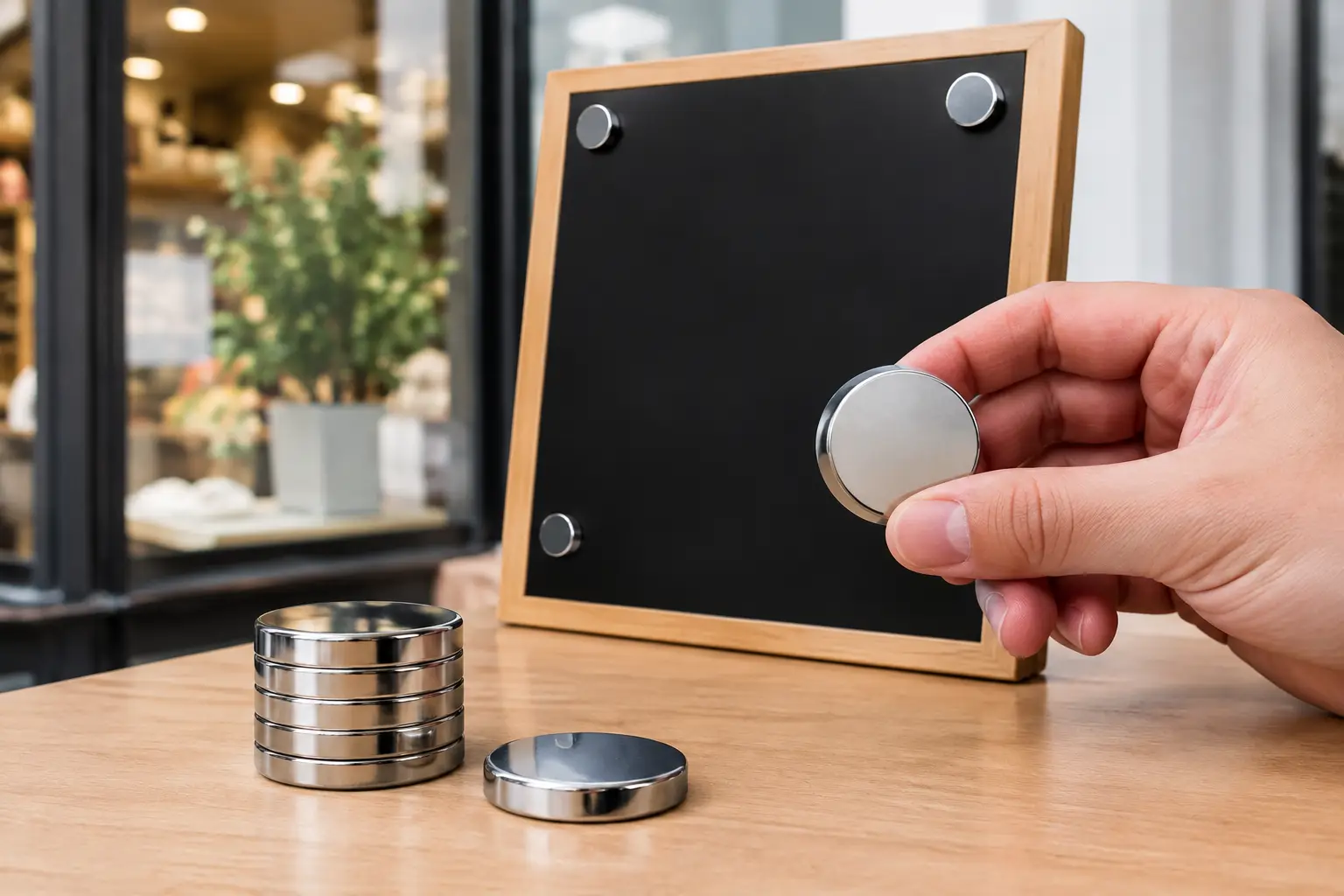
Disc magnets are a practical choice for lightweight signs, printed panels and acrylic holders. Their flat profile makes them easy to bond into a recessed pocket or onto the rear of a display. Placing several smaller discs around the perimeter often gives better support and alignment than using one large magnet in the centre.
For a sign that needs to sit flush against steel, keep the magnet close to the rear face. Every added layer between magnet and steel reduces the holding force. Avoid thick foam tape where possible, particularly on displays that will be handled frequently.
Block magnets for larger panels
Block magnets provide a larger contact area and are well suited to wider signs, timber-backed display panels and custom-built POS units. Their shape also makes them easier to align in a channel or recess during fabrication.
Use blocks where a sign has enough thickness to accommodate them safely. A shallow recess allows the magnet to sit flush, protecting it from knocks and preventing it from creating an uneven stand-off from the mounting surface.
Countersunk magnets for screw-fixed displays
Countersunk magnets are useful when a more permanent fixing is needed on the sign itself. They can be secured with a suitable screw into timber, MDF, plywood or certain plastics, leaving the magnetic face exposed for attachment to steel.
This is often a stronger, more reliable option than adhesive alone for reusable shop fittings. It is especially useful for menu boards, display headers and fabricated units that will be moved repeatedly. Take care not to overtighten the screw, as neodymium magnets are hard but brittle and can crack under excessive pressure.
Magnetic catches for opening panels
Not every retail sign is a flat panel. Magnetic catches are a straightforward solution for access doors, changeable menu boxes, storage units and display cabinets. They keep a panel closed neatly while allowing staff to open it without visible latches.
For a catch, think about the use cycle rather than pull force alone. A very strong catch can be frustrating on a panel opened dozens of times a day. The right choice should hold securely without making routine access awkward.
Build for quick updates, not just initial installation
Retail signage is rarely static. The most useful designs are easy for staff to update without tools, special knowledge or a lengthy reset. Consider where a person will grip the sign, how they will remove it and whether the magnets will help it return to the same position.
A simple locating edge, shallow recess or pair of alignment points can make a magnetic sign feel far more precise. This prevents crooked displays and reduces the chance of staff placing panels over an unsuitable area of the fixture.
For interchangeable graphics, fit the magnets to a reusable backing board rather than every printed sheet. The printed message can then be replaced at low cost, while the magnetic hardware remains part of the display system. This approach is particularly effective for sale signage, promotional boards and product-category headers.
If signs are handled by customers as well as staff, conceal the magnets where possible. Exposed magnets can attract loose metal items, chip if struck or create an opportunity for tampering. A recessed magnet behind acrylic, timber or a thin plastic backing is usually the better long-term option.
Make strength work safely
Super-strong neodymium magnets are useful because they offer serious holding power in a small component. That strength also calls for sensible handling during installation. Keep fingers clear when bringing magnets near steel or another magnet, as they can snap together quickly and cause a painful pinch.
Use eye protection when cutting, drilling or modifying sign materials around magnets. Neodymium magnets should not be drilled, ground or machined, as the material is brittle and its coating can be damaged. Select the correct size and mounting method from the outset instead.
Keep powerful magnets away from sensitive electronics, magnetic stripe cards and people with pacemakers or implanted medical devices. In a retail environment, store spare magnets in a clearly marked container rather than leaving them loose in a fitting-out kit.
For customer-facing displays, build in redundancy where a falling sign could cause damage or injury. Use more than the minimum number of magnets, add a retaining lip or cable where appropriate, and inspect fittings as part of routine shop maintenance. A sign that holds well during installation may perform differently after months of opening, cleaning and daily contact.
Common problems and practical fixes
When magnetic retail signage fails, the issue is often the installation rather than the magnet itself. A sign that slides can usually be improved by increasing the number of magnets, using a larger format or adding a discreet bottom support. A sign that sits proud may have magnets that are too thick for the backing material, so recessing them can improve both appearance and grip.
If adhesive-mounted magnets come loose, check the substrate first. Dusty, textured or low-energy plastic surfaces can make bonding unreliable. Clean and dry the surface thoroughly, select an adhesive suited to the material, and allow adequate cure time before loading the sign. For higher-value or frequently handled displays, mechanical fixing is the safer route.
If staff struggle to remove a sign, add a small finger gap or non-magnetic pull tab. The aim is controlled removal, not maximum force at every point. A practical display system should be secure in use and easy to manage when a price, message or promotion needs changing.
Magman supplies focused ranges of high-strength neodymium magnets and magnetic catches for projects where compact size and dependable holding power matter. Choosing the right format at the design stage saves time later and gives every display a cleaner, more professional finish.
The strongest retail signage is not simply the one that stays on the wall. It is the one your team can update confidently, your customers can read clearly and your fixtures can support day after day.