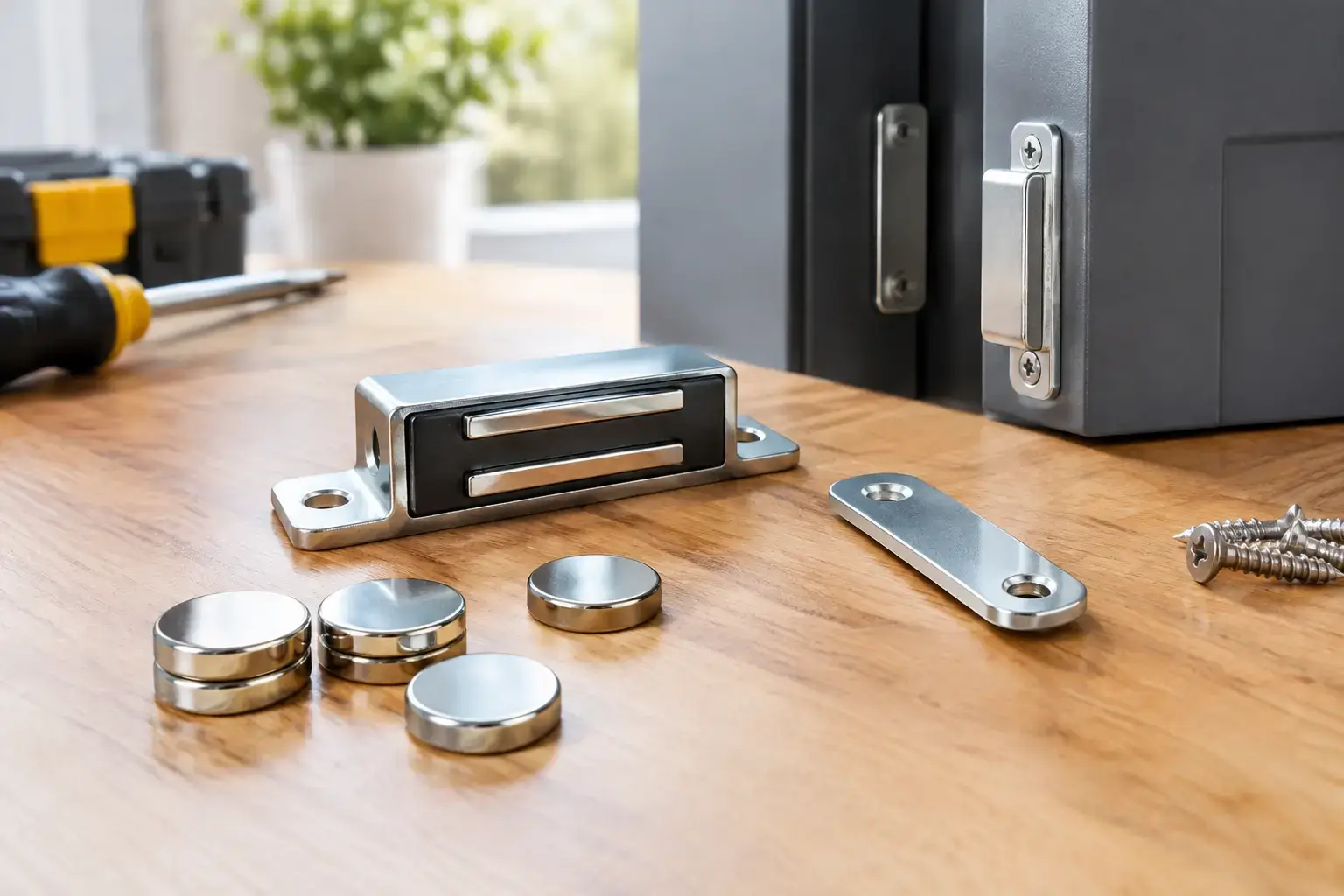
Magnetic Catch Durability Review for UK Builds
A cabinet door that drifts open after a few weeks is rarely a major joinery problem. More often, the catch is too weak for the door, poorly aligned, or fitted where moisture and repeated impact shorten its working life. This magnetic catch durability review looks at what genuinely determines whether a catch keeps performing in a kitchen unit, workshop cabinet, retail display or custom build.
A good magnetic catch is a small component with a straightforward job: pull the door or panel closed and keep it there until it is opened. For that job to remain dependable, the magnet, housing, strike plate and fixings all need to suit the application. The quoted pull strength matters, but it is only one part of the decision.
What durability means in a magnetic catch
Durability is not simply whether the magnet still attracts steel. Permanent magnets can retain their magnetic field for a very long time when used within their limits. In everyday installations, catches usually fail for more practical reasons: a loose screw, a bent strike plate, a cracked plastic case, corrosion, or an alignment that causes the door to hit rather than meet cleanly.
A durable catch should keep a consistent hold through thousands of opening and closing cycles. It should also tolerate the conditions around it. A dry bedroom wardrobe, for example, places modest demands on a catch. A utility-room cupboard, a garage door or a retail unit used throughout the day creates a harder test.
Holding force is not the whole story
Pull strength is generally measured when a magnet and steel plate meet flat, square and with no gap. That is useful for comparing products, but a fitted catch almost never works in such perfect conditions. A slightly warped door, a hinge that settles over time, paint build-up or a strike plate sitting a millimetre away can noticeably reduce the effective hold.
For this reason, selecting the strongest available catch is not always the best answer. Excessive force can make a lightweight cabinet awkward to open, strain small hinges or cause the catch to release suddenly with a sharp snap. The right result is controlled, reliable closure, not maximum resistance at any cost.
The parts that decide service life
The magnet itself is only one element of the assembly. A quality catch needs a stable housing that holds the magnet securely and presents it correctly to the strike plate. If the magnet can shift within its case, the contact area changes and holding performance becomes less consistent.
Plastic-bodied catches are common and can work well on light internal doors. Their limitation is impact resistance. If a door is repeatedly slammed, or the catch is overtightened during fitting, the housing can split around the screw holes. Metal-bodied options are often better suited to heavier doors, frequently used cupboards and commercial fit-outs, provided the finish is appropriate for the environment.
The strike plate deserves equal attention. A thin plate can flex, while a poorly finished plate may corrode or develop burrs that prevent a flush meeting surface. A flat, properly positioned steel plate gives the magnet the clean contact it needs. If the plate is plated, scratched edges and exposed steel can become weak points in damp locations.
Fixings are another common source of disappointment. Short screws in thin chipboard can work loose long before the catch has reached the end of its useful life. Use screws suited to the substrate, avoid damaged pilot holes, and consider a stronger fixing position where a door is heavy or sees constant use. On aluminium, timber and composite panels, the fixing method may need to change even when the catch size stays the same.
Where magnetic catches wear out first
Repeated misalignment is the most common durability issue. If the door needs to be pushed sideways or lifted to close, the catch and plate are being loaded in a way they were not designed for. The magnet may still hold, but the housing, screws and plate will gradually suffer.
The second issue is impact. Magnetic catches are intended to pull together over a short final distance, not stop a fast-moving door. Soft-close hinges, door buffers or careful adjustment protect the catch by reducing the force transferred to it. This is particularly worthwhile on tall cabinet doors and doors with solid timber fronts.
Moisture and contamination also matter. In kitchens, workshops and utility areas, airborne grease, dust and cleaning residue can build up on the plate. This creates a small gap that reduces holding force. In sheds, near external doors or in humid settings, corrosion protection becomes more significant. Standard catches may be perfectly adequate indoors, but should not be assumed suitable for exposed or persistently damp locations.
Neodymium magnets offer powerful holding performance in a compact size, but they should be protected by a suitable coating or housing. If a plated magnet is chipped and then exposed to moisture, corrosion can affect both appearance and long-term performance. A catch installed inside a dry cabinet is a very different prospect from one fitted in a marine, outdoor or wash-down environment.
Installation has a direct effect on durability
A careful installation can make a standard catch last far longer. Start by fitting the catch body square to the closing edge, then close the door gently to mark the correct strike-plate position. The plate should meet the magnet face centrally and as flat as possible.
Do not use the magnetic pull to correct a badly aligned door. Adjust the hinges first. Once the door closes evenly, set the catch so it engages near the end of travel without forcing the door out of line. This reduces side loading and prevents the familiar problem of a door that appears shut but springs back open.
Leave enough clearance for paint, edging tape and seasonal timber movement. A catch set perfectly flush on the day of installation may become too tight after a coat of paint or too weak if a panel bows slightly. Where adjustment is likely, slotted fixing holes or a small packing piece behind the catch can save time later.
For heavier doors, test the setup before completing the build. Open and close the door repeatedly, then check whether the screws have begun to move and whether the strike plate still lands centrally. This simple check reveals problems while they are easy to correct.
Choosing a catch for the job
Lightweight cupboard doors and small access panels generally need moderate holding force and a compact body. Here, neat fitting and reliable alignment matter more than extreme pull strength. A catch that is too powerful can be less pleasant to use than one that is correctly matched.
Medium-weight kitchen units, workshop cabinets and storage doors usually benefit from a stronger catch with a more durable housing and secure fixing points. Consider the size of the door, the hinge quality and whether vibration or draughts could encourage it to open.
For retail displays, plant-room access panels, large cabinet fronts and other demanding applications, assess the full closing arrangement rather than relying on one catch alone. Two catches may provide better balance across a wide door. Mechanical latches may be the better choice where security, weather resistance or high shock loading is required.
A specialist range makes it easier to match compact size with superior pull performance. Magman supplies powerful and versatile magnetic hardware for practical builds, helping trade and DIY customers select components that suit the job rather than settling for a weak, general-purpose fitting.
A practical magnetic catch durability review verdict
The most durable magnetic catch is not necessarily the largest or strongest. It is the one with sufficient holding force, a sound housing, a flat strike plate and fixings that stay secure in the chosen material. Used within those limits, a quality catch can provide years of dependable daily closure.
Before fitting, take a moment to check the door weight, alignment, environment and expected use. That small amount of planning usually matters more to service life than the catch’s advertised pull figure alone.