Magnetic Fasteners for Stronger Everyday Closures
A cabinet door that will not stay shut, a retail panel that shifts out of place, or a removable cover held on with ordinary clips can quickly make a good build feel unfinished. Magnetic fasteners offer a cleaner, more reliable answer when you need a secure closure without a visible latch or complicated mechanism.
For cabinet makers, fit-out teams and capable DIYers, the appeal is simple: powerful neodymium magnets provide serious holding force in a compact format. Used properly, they make doors, access panels, presentation cases and custom enclosures easy to open while keeping them firmly closed in day-to-day use.
Choosing magnetic fasteners that hold properly
The right fastening arrangement depends on more than choosing the strongest magnet available. Pull strength matters, but the installation, material, gap between surfaces and direction of force all affect real-world performance.
A magnet delivers its best holding power when it meets a clean, flat ferrous surface directly. Even a small air gap caused by paint, laminate, fabric, a misaligned door or a recessed fitting can reduce the available pull considerably. If a closure needs to hold through a gap, select a larger or thicker magnet than you would for direct contact, and allow for testing before finishing the installation.
It also helps to distinguish between a magnetic catch and a magnet used as a custom fastener. A magnetic catch is usually the quickest option for a standard cupboard, wardrobe or lightweight door. It is designed as a practical closure system, with a magnet and strike plate positioned for repeated use. A separate neodymium magnet gives more freedom over placement, appearance and holding strength, making it suitable for bespoke joinery, removable panels and fabricated units.
For most projects, the choice comes down to three questions: how much force must the fastener resist, how often will it be opened, and how much room is available behind the surface? Answer those before looking at sizes.
Pull strength is not the whole story
Published pull strength is generally measured under ideal conditions: direct contact, straight pull and a suitable steel surface. A cupboard door does not behave like a controlled test. It may twist slightly as it opens, pull away at an angle or carry a load that creates leverage on the catch.
This is why an apparently powerful magnet can feel disappointing in a poorly aligned installation, while a modest magnetic catch can work perfectly on a light door. Build in a sensible margin. For a frequently used door, it is usually better to choose a fastening arrangement with enough strength to resist knocks and vibration without requiring a sharp tug every time someone opens it.
Very high pull force is not automatically better. A catch that is too strong can make a slim cabinet door flex, pull fixings loose over time or become awkward for children and older users. For display panels and heavy access doors, stronger is useful. For a small bathroom cabinet or a decorative box, controlled holding force is often the better result.
Choose a format that suits the job
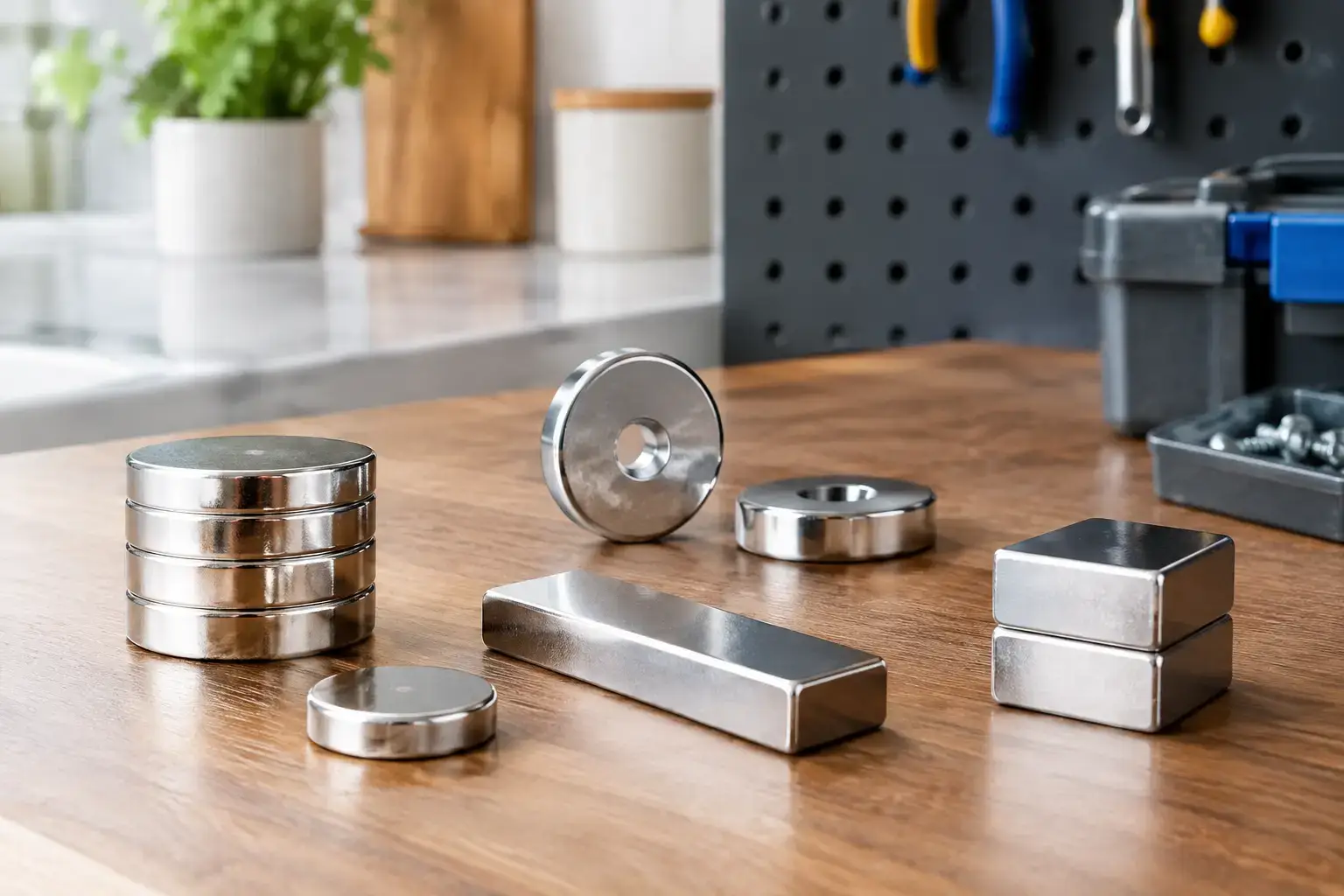
Disc magnets are a strong all-round choice where the magnet can be recessed into timber, plastic or a fabricated component. Their round shape is easy to drill for, and they can be concealed beneath a thin surface for a clean finish. They are especially useful for box lids, flush cabinet doors, removable fascias and timber projects.
Block magnets provide a larger contact area and are useful when space is limited in one direction but a wider fixing can be accommodated. They suit straight-edged closures, display panels, workshop jigs and custom fabricated housings. Their shape can make positioning straightforward, although they need a properly sized recess or secure bonding surface to prevent movement.
Countersunk magnets are made for a mechanical fixing. A screw passes through the magnet, allowing it to be mounted without relying solely on adhesive. This is a practical advantage on doors, panels and fixtures that are opened regularly or exposed to changing temperatures. Use an appropriate screw head and tighten carefully: neodymium magnets are extremely strong but can chip or crack if overtightened.
Magnetic catches are the sensible choice when speed and consistency matter more than creating a hidden bespoke fitting. They are well suited to standard cabinet doors, utility cupboards, retail furniture and light access panels. Install the catch body and strike plate squarely, then adjust their position until the door closes cleanly without needing to be forced.
Where magnetic fasteners perform best
Magnetic fasteners work particularly well when a closure needs to look uncluttered. In fitted furniture, they remove the need for visible knobs, roller catches or surface bolts. In retail displays, they allow staff to access stock or service areas quickly without compromising the front-facing finish.
They are also valuable in workshop and fabrication work. A removable cover over electrical equipment, a tool storage flap or a lightweight inspection panel can be held securely yet released without tools. For exhibition stands and point-of-sale units, magnets can make transport and assembly simpler, provided the panels are aligned accurately and the magnet strength is matched to the panel weight.
For timber cabinetry, recessing magnets produces a neat result, but accuracy matters. Drill to a controlled depth so the magnet sits flush, then check polarity before applying adhesive or fitting the second magnet. If two magnets face each other, they must attract rather than repel. A steel strike plate avoids polarity issues and is often the more forgiving option.
Magnetic closures are less suitable where a fixing must carry sustained structural load, prevent forced entry or hold components safely against heavy vibration. A magnet can supplement another fixing method in these cases, but it should not replace a rated latch, lock, bolt or mechanical safety catch. The application always decides the appropriate solution.
Installation details that make the difference
Good preparation prevents most fastening problems. Mark the closed position first, then test the arrangement before committing to screws, adhesive or a drilled recess. The strike point should meet the magnet face squarely. A few millimetres out of line can turn a strong closure into an unreliable one.
When bonding magnets, use an adhesive suitable for both the magnet coating and the material being fixed. Clean dust, oil and loose finish from the surfaces, and allow the adhesive to cure fully before loading the fastening. Adhesive is useful for concealed work, but screws or a mechanical recess are normally the safer choice for high-use doors and heavier panels.
Take care around edges. Neodymium magnets can snap together with surprising force, especially larger N52 formats. Keep fingers clear when bringing paired magnets together, and avoid allowing magnets to strike each other or a hard steel surface. The protective coating can be damaged by impact, which may shorten service life in damp settings.
If the fitting will be exposed to moisture, choose the location carefully and avoid trapping water around the magnet. Standard coated neodymium magnets are excellent for many indoor applications, but they are not a substitute for purpose-designed marine or fully weatherproof hardware. In kitchens, utility rooms and sheltered outdoor units, a well-sealed recess and appropriate material choices make a meaningful difference.
A practical way to specify your fastener
Start with the door, panel or lid rather than the magnet. Consider its weight, size, opening direction and how it will be used. A wide door creates more leverage than a narrow one, even if both weigh the same. A vertical panel needs enough holding force to resist accidental knocks, while a horizontal lid may need a different arrangement to prevent it lifting at one corner.
Then choose the mounting method. Use a magnetic catch for a straightforward surface-mounted closure. Choose countersunk magnets where secure screw fixing is needed. Use discs or blocks where the magnet will be recessed, bonded or hidden inside the build. Finally, allow for the opposing surface: mild steel provides a reliable target, while stainless steel, aluminium, timber and plastic will not provide the same attraction.
For a polished result, test with offcuts or a temporary mounting before completing the final assembly. This small step helps you judge opening feel, alignment and holding force under real conditions. It is far easier to change magnet position before a cabinet is sprayed, installed or fitted with finished panels.
Magman focuses on high-strength neodymium magnets and practical magnetic catches for jobs where ordinary hardware is not enough. Select the format around the application, fit it accurately and give the closure enough strength to work confidently without becoming difficult to use. That is how a small magnetic component delivers a fastening that feels properly built.