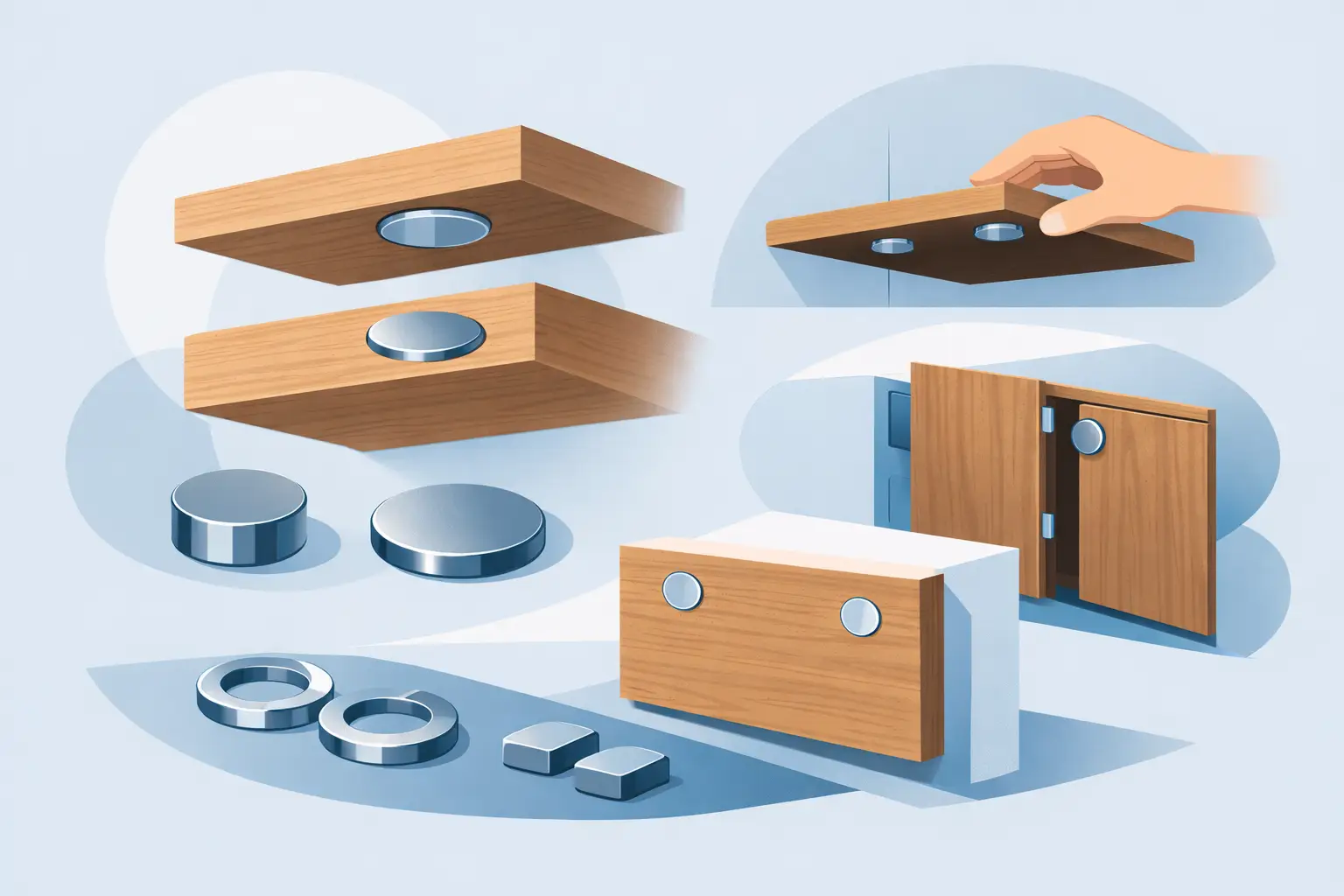
Best Magnets for Hidden Fixings
When a fixing needs to disappear, the magnet matters more than the screw. The best magnets for hidden fixings give you a clean finish without sacrificing holding power, whether you are fitting access panels, cabinet doors, display boards or removable covers in a workshop build.
Hidden fixings only work well when the magnet suits the job. Too weak, and panels shift or drop. Too strong, and removal becomes awkward, especially on tight tolerances or lightweight materials. The right choice comes down to magnet format, pull strength, mounting method and the surface you are fixing against.
What makes the best magnets for hidden fixings?
For most concealed fixing jobs, neodymium magnets are the obvious choice. They deliver far more holding force than ferrite magnets for the same size, which means you can keep the fitting compact and still get strong, reliable retention. That matters when space behind a panel or inside a cabinet is limited.
The best magnets for hidden fixings also need consistency. In practical terms, that means predictable pull performance, decent plating, and shapes that are easy to install accurately. If the magnet is difficult to seat, misaligns during fitting, or chips under pressure, the neat hidden result you wanted quickly turns into a frustrating rework.
In most DIY and trade applications, three formats stand out – countersunk magnets, disc magnets and block magnets. Each has a place, and choosing between them is less about which is strongest on paper and more about which works cleanly in the build.
Countersunk magnets for secure concealed mounting
If you want the magnet itself fixed firmly in place, countersunk magnets are often the best option. They are designed to be screwed down through the centre, which makes them especially useful for timber panels, carcasses, access hatches and removable fascias.
The main advantage is control. A countersunk magnet stays where you put it, resists twisting, and is less likely to shift over time than a glued-in magnet under repeated use. For cabinet makers and fit-out work, that makes installation more dependable.
They also suit jobs where the hidden fixing needs to be serviceable. If a panel may be removed repeatedly for maintenance, a screwed countersunk magnet gives a more stable long-term fixing than adhesive alone. Pair it with a steel strike plate or washer and you get a simple, tidy catch with very little visible hardware.
There is a trade-off. Countersunk magnets need enough material depth to take both the magnet and the screw head without breaking through the face. On thin board, that can be limiting. They are also not ideal where the screw itself could interfere with surrounding components or where perfectly flush routing is difficult.
Disc magnets for compact hidden fixing points
Disc magnets are a strong choice when space is tight and you want a simple concealed hold. They are commonly used in drilled recesses, behind panels, inside joinery and within custom housings where a clean circular magnet is easy to bed in.
Their strength-to-size ratio is excellent, especially in higher grades such as N52. For lightweight doors, covers, signs and removable trims, a small disc magnet can provide more than enough hold without adding bulk.
Disc magnets are often bonded into place with adhesive, which keeps the fixing fully hidden. This works well when the load is moderate and the magnet is supported by the recess rather than relying on glue alone. In routed timber or machined plastic, that can give a very neat result.
The caution with disc magnets is shear force. A magnet may feel very strong in direct pull, but if the panel can slide sideways, the hold is reduced. For hidden fixings under movement or vibration, the design should include a lip, pin or rebate to take the sideways load while the magnet handles retention.
Block magnets for larger panels and greater contact area
Block magnets come into their own when you need more surface contact or a broader magnetic field. They are useful for hidden fixings on larger access panels, retail display elements, workshop doors and fabricated covers where a small point hold is not enough.
Because of their shape, block magnets can spread holding force across a wider area. That helps with panel alignment and can reduce wobble on longer edges. In some builds, using two or more smaller block magnets gives a better result than one oversized disc magnet, particularly when you need balanced retention across a door or removable face.
They also work well when embedded behind thin material, as the rectangular format can sit neatly inside rails, frames or routed channels. For shopfitting and bespoke display work, that flexibility is useful.
The downside is fitting accuracy. Block magnets need careful positioning so that polarity and contact alignment are correct. If they are set slightly off, the panel may sit unevenly or pull sideways as it closes. They can also be more vulnerable to edge chipping during handling if forced together carelessly.
Choosing the right strength
This is where many hidden fixing projects go wrong. Buyers often assume the strongest available magnet must be the best option. In practice, the best magnets for hidden fixings are the ones that hold securely but still allow the panel, door or cover to be removed without damage.
A small cabinet door, for example, does not usually need extreme pull force. Too much magnet strength can make opening awkward and put unnecessary stress on hinges or fixings. By contrast, a larger access panel in a van conversion, workshop unit or retail display may need stronger retention to prevent rattling or movement.
Material thickness matters as well. Magnetic pull drops quickly with distance, so even a strong neodymium magnet loses effectiveness if it sits behind thick timber, MDF or acrylic. If the fixing must remain fully hidden behind a surface, you need to account for that gap rather than relying on stated pull figures alone.
As a rule, compact N52 neodymium magnets are a strong starting point because they offer superior pull performance for their size. That gives you more options. You can either keep the fitting small or step up holding force without using oversized hardware.
Magnet-to-magnet or magnet-to-steel?
For hidden fixings, magnet-to-steel is often the cleaner and more economical setup. One magnet pulls to a steel washer, plate or strike surface, which simplifies alignment and avoids the snap and chip risk of two neodymium magnets meeting directly.
This arrangement also makes it easier to fine-tune the hold. Changing the size or thickness of the steel strike piece can influence performance without replacing both sides of the fixing.
Magnet-to-magnet can work, especially where you need stronger engagement in a compact space, but it needs more care. Polarity must be correct, placement must be accurate, and closing force can be sharper. For repeated use on lightweight panels, that can feel less controlled.
Installation matters as much as the magnet
A strong magnet installed badly will still give a poor result. Hidden fixings depend on clean seating, accurate spacing and a sensible approach to the load path. If the magnet is doing all the work, including resisting panel shift, impact and misalignment, performance will suffer.
It is usually better to let the magnet handle closure and retention while the joinery or fabrication controls position. Simple rebates, locating pegs or stops can make a magnetic hidden fixing feel much more solid.
Surface finish matters too. Neodymium magnets are typically nickel plated, which is suitable for many indoor applications, but if the fixing will be exposed to damp conditions, you should think about protection and placement. A concealed magnet inside a bathroom cabinet or utility area may need more care than one in a dry bedroom unit.
Which magnets are best for common hidden fixing jobs?
For cabinet doors and small access flaps, countersunk magnets or compact disc magnets are usually the strongest choice. They give a tidy hold without taking much room.
For removable panels in furniture or wall features, block magnets often make more sense because they provide broader contact and steadier alignment. For retail displays and shopfitting, a mix of countersunk and block magnets can work well depending on whether the component needs a fixed mounting point or a concealed embedded hold.
For workshop jigs, machine guards and custom enclosures, stronger neodymium magnets are often worth the upgrade because repeated use exposes any weakness very quickly. This is where quality matters. Cheap magnets that chip, lose coating or vary in strength create more problems than they solve.
If you want a straightforward route, a specialist range built around powerful and versatile neodymium formats is usually the safest place to start. That is why many trade and DIY buyers stick with focused suppliers such as Magman rather than trawling through general hardware listings.
The smartest hidden fixing is the one nobody notices and nobody has to fight with. Choose a magnet that matches the material, the opening action and the amount of use, and the finished job will feel cleaner, stronger and far more professional.
hi need magnetic for
315x1000mm tile for bath panel , what do u suggest