Are Neodymium Magnets Safe Indoors? A Practical Guide
A small N52 magnet can hold far more than its size suggests. That is exactly why neodymium magnets work so well for cabinet doors, display panels, workshop storage and discreet fixings – and why sensible handling matters. So, are neodymium magnets safe indoors? Yes, when they are chosen for the job, fitted securely and kept away from the people and items they can harm.
Neodymium magnets do not release fumes or create a general household health risk simply by being indoors. The practical risks come from their exceptional pull strength: two magnets snapping together, a loose magnet being swallowed, or a powerful magnet sitting too close to sensitive equipment. Treat them as high-performance hardware rather than household toys and they are powerful, versatile components for indoor projects.
Are neodymium magnets safe indoors?
For adult DIY, trade and cabinet-making applications, neodymium magnets are safe to use indoors when they are installed in a controlled location and handled with care. A magnet used as a cupboard catch, removable access-panel fixing or retail display mount should be retained mechanically or enclosed within the finished assembly. It should not be left loose in a drawer, on a workbench within a child’s reach, or attached where it can unexpectedly pull free.
The answer changes where young children, pets, vulnerable adults or people with implanted medical devices may have access. In these settings, the magnet itself is not the problem – access and placement are. A well-fitted countersunk magnet inside a cabinet closure is very different from several loose discs stored in an open tub.
Strong magnets are also brittle. Despite their impressive pull performance, neodymium magnets can chip or crack if allowed to collide. The nickel-based coating may then be damaged, which can leave sharp fragments and reduce corrosion resistance over time. Indoor use is straightforward, but it still needs the same care you would give any compact, high-strength fixing component.
The main indoor risks to control
Swallowing is the most serious risk
Loose neodymium magnets must be kept completely out of reach of children and pets. If more than one magnet is swallowed, they can attract through the walls of the digestive system. This is a medical emergency that can cause severe internal injury. Do not wait for symptoms if you suspect a magnet has been swallowed: seek urgent medical help immediately.
Avoid using loose magnets as fridge decorations, desk toys or play items. If magnets are part of a finished indoor product, make sure they cannot be pulled out, prised loose or released if the product is dropped. For cabinet work and permanent fittings, a recessed pocket, adhesive suited to the substrate and a positive mechanical fixing where possible provide much greater confidence than adhesive alone.
Pinching, impact and flying together
Neodymium magnets can accelerate towards steel or another magnet with surprising force. Larger discs and blocks can trap skin, particularly fingers, between themselves and a steel surface. They can also chip when they slam together.
Keep magnets separated with card, timber or plastic spacers until you are ready to fit them. Slide magnets apart sideways rather than pulling directly against their full holding force. When working with a pair of magnets in a door or panel, check their polarity before applying adhesive or drilling final positions. A simple dry fit prevents the frustrating – and sometimes forceful – discovery that the magnets repel.
Eye protection is sensible when handling larger magnets, stacks of magnets or brittle magnets near steel tools. If a magnet cracks, collect every fragment carefully and dispose of damaged pieces so they cannot be reused in a safety-critical fitting.
Medical devices and sensitive equipment
Strong magnetic fields can interfere with some pacemakers, implantable cardioverter defibrillators, insulin pumps and other medical devices. Anyone with an implanted or body-worn medical device should follow the device manufacturer’s guidance and keep powerful magnets at the recommended distance. If there is any doubt, choose another fixing method for that location.
Magnets can also affect items that rely on magnetic data or magnetic sensors. Keep them away from hotel key cards, access cards, older hard drives, magnetic measuring equipment and similar equipment. Modern phones and tablets are generally designed around magnetic accessories, but a strong loose magnet can still interfere with a compass, sensors or camera stabilisation while it is close by.
Do not place powerful magnets directly on laptops, routers, televisions, speakers or electrical control equipment unless the application has been assessed properly. They are excellent for holding physical objects; they are not a substitute for an electrical mounting solution.
Electrical and fire considerations
A neodymium magnet is not a heat source and does not create a fire risk merely by being mounted indoors. However, it is conductive. A loose magnet can bridge battery terminals or contacts and create a short circuit. Keep magnets away from exposed wiring, battery packs, chargers, electrical distribution boards and the inside of appliances.
Heat also matters to performance. Excessive temperatures can permanently reduce a magnet’s strength, depending on its grade and specification. For indoor projects near ovens, solid-fuel stoves, radiators, hot lighting or machinery, check the expected operating temperature before selecting the magnet. A standard high-strength magnet may not be the right choice beside a sustained heat source.
How to fit magnets safely in the home or workshop
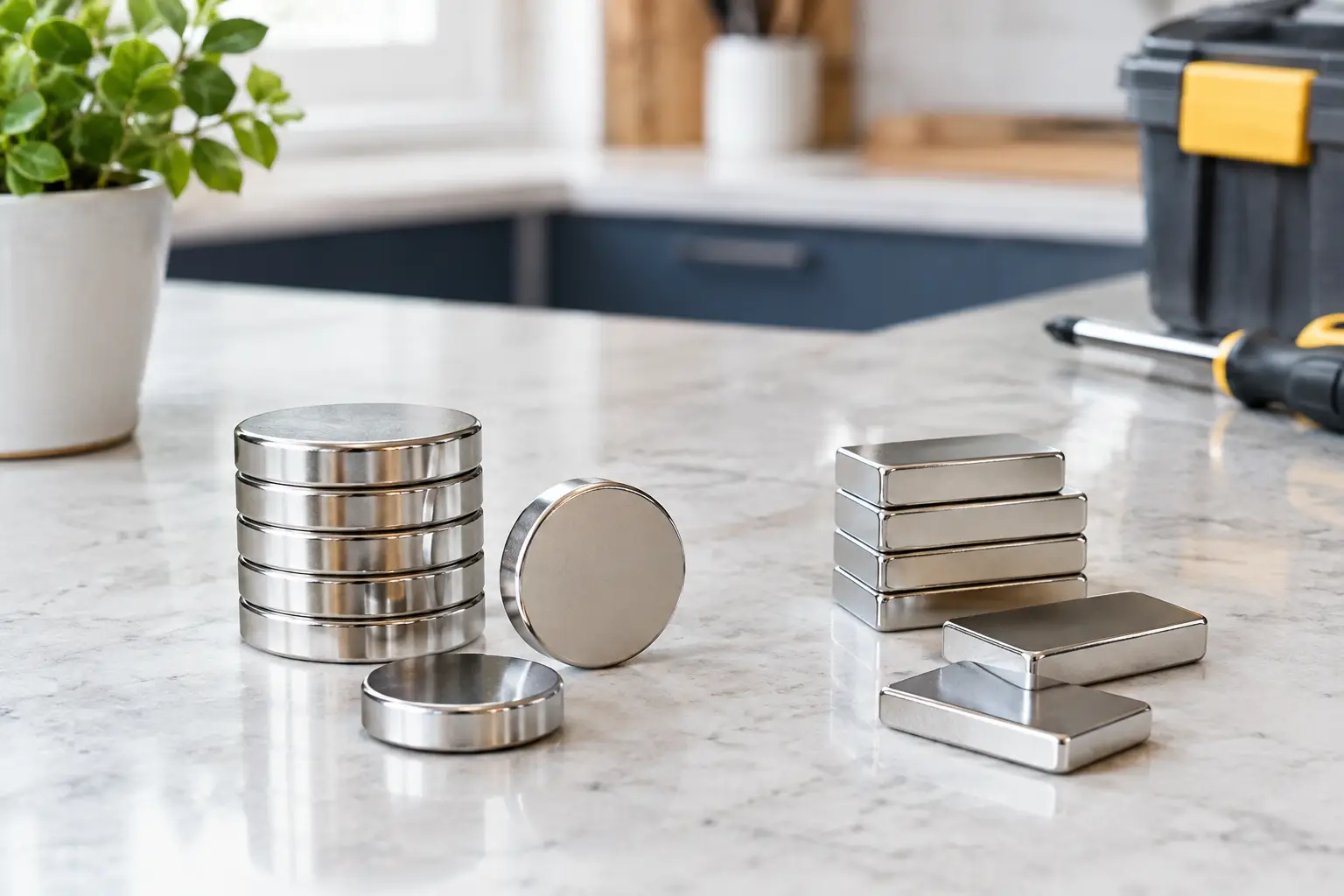
Start by selecting the correct format rather than simply the strongest magnet available. A disc magnet is useful for concealed closures and light removable panels. A block magnet offers more contact area for practical holding and locating tasks. A countersunk magnet is often the better option where a screw-fixed installation is needed, such as cupboard doors, timber frames and display fittings.
Holding force figures are useful for comparison, but real performance depends on the installation. A magnet achieves its best pull on thick, clean, flat mild steel with full contact. Paint, a gap, a thin steel strike plate, an angled pull or a sliding load can reduce the effective hold considerably. For a door catch, also consider the force needed to overcome the hinge tension and the weight of the door, not just the magnet’s quoted pull.
Fit magnets into a properly sized recess where possible. This protects edges from knocks and gives a cleaner finish. For countersunk magnets, use a suitable screw and tighten only enough to seat the magnet securely. Overtightening can crack the brittle material around the hole. A pilot hole in timber helps keep the screw centred and reduces stress on the magnet.
For adhesive fitting, clean and dry both surfaces first. Use an adhesive compatible with the base material, allow full curing time and test the assembly gradually. Adhesive can be effective for light-duty positioning, but a screw, recessed housing or retaining lip is preferable where the magnet carries weight, receives repeated impacts or sits above head height.
Before final installation, test the opening and closing action. A cabinet catch should feel positive without needing a sharp pull that could loosen the magnet or strain the door. If the attraction is excessive, reduce contact area, increase the gap slightly or select a smaller magnet. More pull strength is not always better; the right controlled hold gives a better result.
Storage rules for spare magnets
Keep spare magnets in their original packaging or in a sturdy, clearly labelled container. Separate them using card, plastic or timber dividers so they cannot connect unexpectedly. Store the container high up, dry and away from tools, electronics and any area accessed by children.
Do not carry several strong magnets loose in a pocket. They can clamp onto keys, tools or metal furniture, damaging clothing and pinching skin. In a workshop, keep them away from grinding dust and steel swarf, which can cling tightly to the magnet and make handling more difficult.
If a magnet’s coating is badly chipped, it has split, or it no longer suits the project, remove it from service. A damaged magnet is harder to clean, more likely to corrode and less predictable in a finished installation.
Safe use comes down to control
Neodymium magnets are a practical indoor fixing solution because they deliver serious holding power in a compact format. Used in cabinet catches, removable panels, displays and workshop builds, they create clean, reliable results without bulky hardware. The safe approach is equally practical: keep loose magnets secured, design around the actual load, protect people and electronics from unnecessary exposure, and install each magnet as a permanent part of the job rather than an afterthought.
For a strong, tidy fitting that performs day after day, choose the magnet format and pull strength that suit the application, then give the installation the same attention as any other load-bearing component.