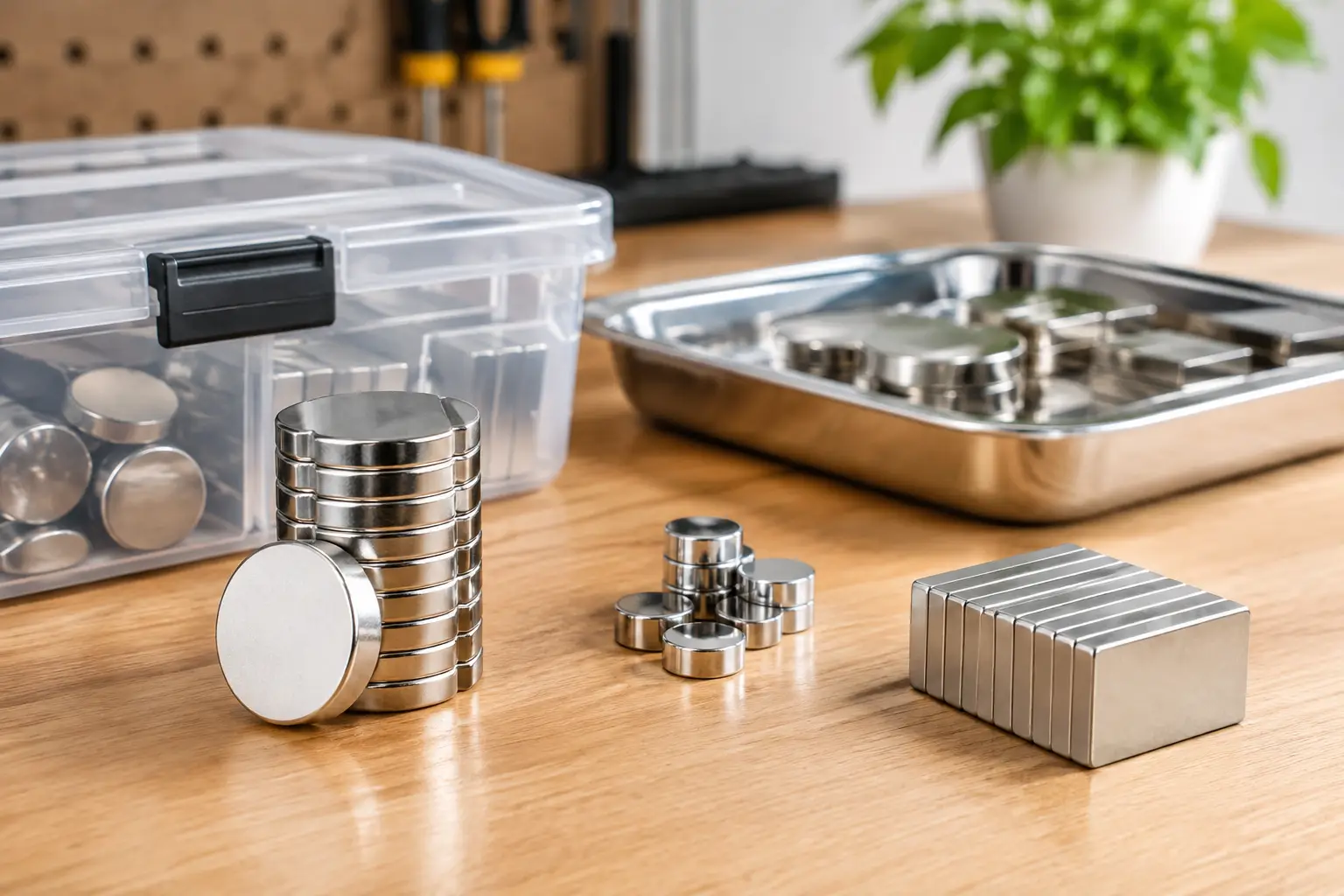
Magnet Storage Methods That Protect Pull Strength
A powerful N52 magnet can turn an untidy drawer into a frustrating and potentially costly problem. The right magnet storage methods keep magnets easy to identify, prevent chips and snapped edges, and reduce the risk of powerful pieces clamping together where you cannot separate them safely. For workshop users, cabinet makers and installers, good storage also means the correct magnet is ready when the job starts.
Neodymium magnets are compact, super-strong and highly useful, but they deserve more care than ordinary hardware. A box that works well for screws or hinges may not be suitable for discs, blocks or countersunk magnets. Storage should protect the magnet, the surrounding tools and the people using them.
Why magnet storage matters
Neodymium magnets do not normally lose their pull strength simply because they are stored for a few months. The larger concern is physical damage. When two strong magnets strike together, the nickel coating can chip, edges can crack and brittle magnet material can break. A damaged coating also leaves the magnet more exposed to corrosion, particularly in damp workshops, vans or sheds.
Uncontrolled attraction creates another practical issue. Magnets can leap towards steel shelving, hand tools, drawers and nearby stock. Once several discs or blocks have attached in the wrong order, separating them can require more force than expected. That wastes time and can cause pinched fingers.
A sensible storage setup gives every magnet a fixed place, keeps incompatible items apart and makes it clear what size and format you are picking. This is especially useful where a job calls for several similar-looking discs with different diameters, thicknesses or pull performance.
Magnet storage methods for discs, blocks and catches
The best method depends on the shape, quantity and intended use of the magnets. There is no benefit in overcomplicating it, but strong magnets should not be left loose in a mixed hardware tub.
Keep magnets in their original packaging
For unopened stock or spare magnets, the original packaging is often the simplest option. Quality packaging usually holds magnets in a stable arrangement with spacers or protective material between groups. Keep the packaging dry, clearly labelled and stored away from loose ferrous tools.
This method works particularly well for small quantities of N52 disc magnets or countersunk magnets kept for repeat installations. Write the size, strength and intended project on the outer label if it is not already obvious. It avoids the common mistake of opening several packs and later having no reliable way to tell similar magnets apart.
Once a pack is opened regularly, transfer only the working quantity to a more accessible tray or compartment. Leave reserve stock protected in its packaging rather than placing everything in circulation.
Use non-magnetic compartment boxes
Plastic organiser boxes with separate compartments are a practical choice for workshops and fitting teams. The key is to choose a box with sufficiently strong dividers and a secure lid. Thin, flexible dividers can bow or move when magnets pull towards one another, allowing stock to cross compartments.
Store one size and type per compartment. A label should include diameter or length, thickness, magnet format and, where relevant, countersunk hole size. For example, keep 20 mm x 5 mm discs separate from 20 mm x 3 mm discs, even if the difference appears minor. Their pull performance and suitability for a task can be very different.
For compact but powerful magnets, add a piece of card, foam or plastic between individual stacks. This prevents sudden impact when pieces are returned to the box and makes it easier to remove one magnet at a time.
Create dedicated drawer storage
A shallow drawer fitted with non-magnetic inserts is a strong option for users holding multiple sizes. Timber, plastic or dense foam dividers can create purpose-made bays for discs, blocks and magnetic catches. The drawer should close securely and be positioned away from the edge of a steel bench or cabinet where magnets may pull unexpectedly.
Dedicated drawers make stock control straightforward. Keep each product format in its own area: disc magnets in labelled slots, block magnets in protected rows, and countersunk magnets in individual bags or divided trays. Magnetic catches are best stored with their matching strike plates and fixings, so complete sets are ready for cabinet or display work.
Avoid packing the drawer too tightly. A little free space around each compartment gives you room to remove magnets without levering them against another powerful stack.
Separate stacks with spacers
Stacks are space-efficient, particularly for disc magnets, but they need control. Place a non-magnetic spacer between groups rather than allowing one long stack to build up. Cardboard, plastic sheet, foam or purpose-cut timber strips can all work, provided the material is dry and thick enough for the magnet size.
Smaller stacks are easier to handle and less likely to snap together with damaging force. They also make counting stock simpler. If ten magnets form a standard stack, you can quickly see when you need to reorder.
For block magnets, keep the polarity and orientation consistent within each stored group. This reduces unexpected sideways movement and helps you return matching pieces in a predictable arrangement. Do not force magnets together if the poles repel. Turn one magnet carefully rather than pressing against the resistance.
Use protective bags for mobile work
If magnets travel between jobs, use individual resealable bags, small plastic cases or padded compartments inside a tool case. Loose magnets in a van toolbox are likely to find steel drill bits, hand tools and fixings. Apart from making them awkward to retrieve, repeated impacts can damage the coating.
Keep magnets away from devices and items that can be affected by a magnetic field, including bank cards, access cards, watches and sensitive electronic equipment. Do not place strong magnets in a pocket with personal items. For trade use, a labelled protective case is quicker, safer and easier to account for at the end of the day.
Store magnets in dry, stable conditions
Most neodymium magnets have a protective coating, but storage conditions still matter. Damp air, condensation and contaminated surfaces can compromise that coating over time. Keep stock dry and away from sinks, unheated sheds with regular condensation, and wet materials.
Temperature matters too. Standard neodymium magnets are not designed for every high-heat environment. Storing them beside heaters, in direct summer sun behind glass, or near processes that generate sustained heat is unnecessary risk. A cool, dry cupboard or indoor workshop drawer is the better choice.
Before returning magnets to storage, wipe away dust, metal swarf and moisture with a dry cloth. Fine steel particles can cling firmly to a magnet and make the next installation less accurate. In countersunk magnets, check that the hole is clear before packing them away so the fixing sits correctly next time.
Avoid these common storage mistakes
The most damaging habit is throwing powerful magnets into a steel tin, metal drawer or mixed tub of fixings. It may look convenient, but every retrieval becomes a fight against unwanted attraction. It also increases the chance of chips, trapped fingers and lost components.
Avoid storing magnets where children can access them. Small magnets are a serious ingestion hazard, while larger magnets can cause injury if they snap together around skin. Keep storage boxes closed, clearly marked and out of reach.
It is also wise to keep strong magnets away from anyone with a pacemaker or other implanted medical device. Follow the device manufacturer’s guidance on safe separation distances. In a shared workshop, make sure other users know where powerful magnet stock is kept.
Do not assume a painted steel cabinet is neutral storage just because the magnets are inside a box. Strong magnets can still pull towards the cabinet walls if the container is thin or poorly divided. Plastic or timber organisers placed within the cabinet offer better control.
Build a storage system around the job
For occasional DIY use, original packaging inside a dry plastic box may be all that is required. For cabinet making, retail fit-outs or repeated production work, labelled drawer storage with separate working stock will save time and prevent mistakes. The more sizes you carry, the more valuable a clear system becomes.
Magman’s focused range of high-strength disc, block and countersunk magnets makes it easier to standardise the formats used across regular jobs. Once you have selected the right magnet for a closure, mounting point or display fixture, store that format with a clear label and its associated fixings.
A well-organised magnet store does more than protect stock. It keeps super-strong magnets clean, identifiable and ready to deliver the pull performance your next build depends on.