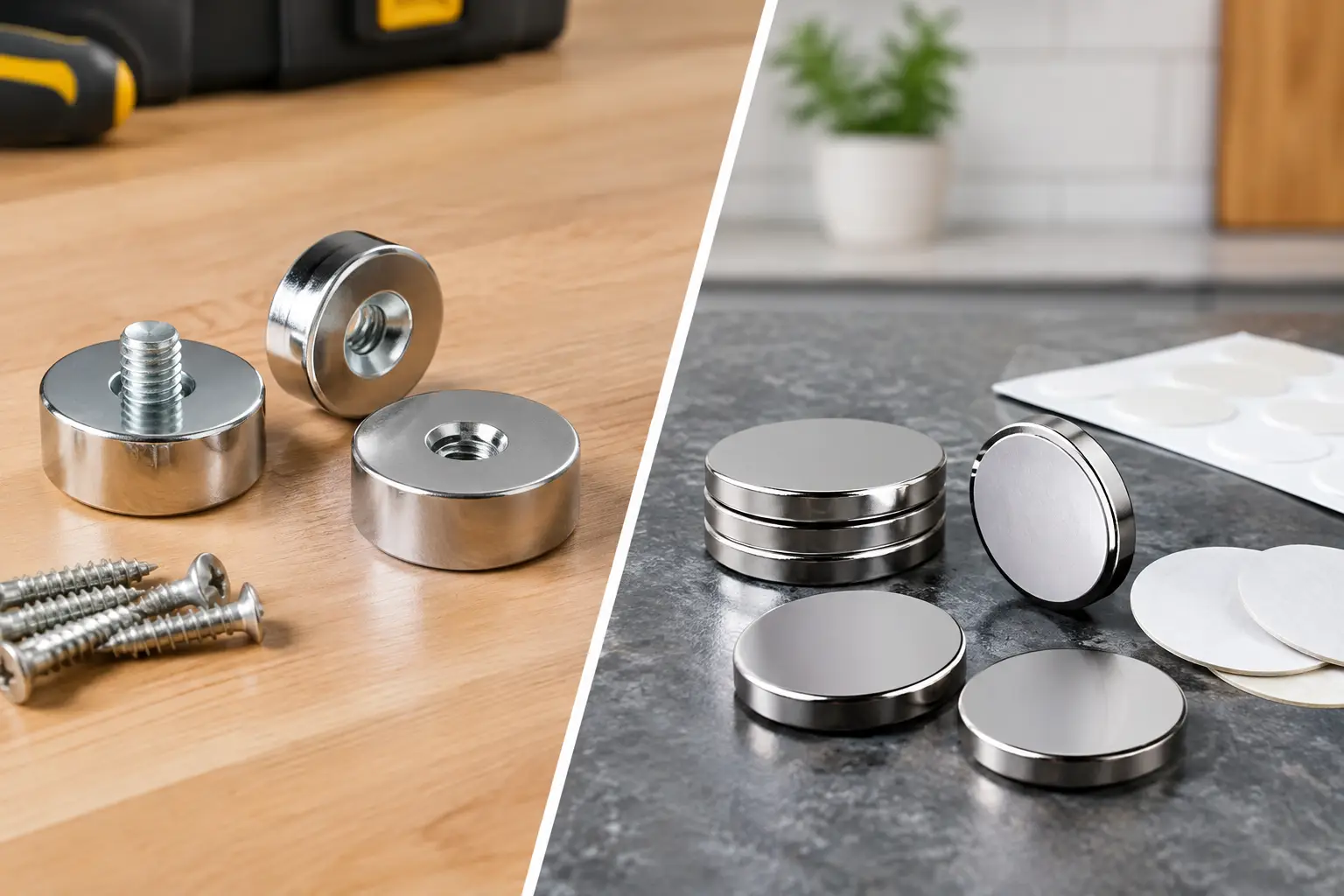
Screw Mount Versus Glue Magnets Compared
A cabinet door that will not stay shut, a display panel that slips after a few weeks, or a magnetic catch that pulls away from its fixing point usually has the same cause: the magnet was strong enough, but the mounting method was not. In the screw mount versus glue magnets decision, the best choice depends less on raw pull strength and more on the surface, load direction and expected use.
For a permanent, hard-working fitting, a countersunk screw mount is usually the more dependable answer. For clean, concealed installations where drilling is not possible or desirable, a bonded magnet can be highly effective – provided the adhesive and preparation are right. The key is to treat the magnet and its fixing as one system.
Screw Mount Versus Glue Magnets: The Core Difference
Screw-mounted magnets are normally countersunk neodymium magnets designed to accept a suitable flat-head screw. The screw provides a mechanical fixing, holding the magnet in place even when it experiences repeated pulling, twisting or side loads. They are a strong option for cupboard catches, access panels, workshop storage, gates, retail fittings and any job where the item will be opened and closed regularly.
Glue-mounted magnets are plain discs, blocks or other non-countersunk formats fixed using an adhesive. This can produce a neat finish with no visible screws and no need to drill into the mounting surface. It is often the better route for thin panels, finished furniture, acrylic displays or projects where the magnet needs to sit fully flush.
Neither method automatically makes the magnetic connection stronger. A powerful N52 magnet still delivers its pull performance according to its size, grade, air gap and the steel plate or opposing magnet it meets. The difference is whether the magnet remains securely attached to its own mounting surface.
When Screw Mounting Is the Better Choice
Choose a countersunk magnet and screw fixing when reliability matters more than a hidden finish. A correctly fitted screw gives a positive mechanical hold that does not rely on a bonded joint resisting every movement.
This is particularly useful on cabinet doors and magnetic catches. Each time a door is pulled open, the magnet may be subjected to a sudden separating force, as well as a small amount of twisting. Over hundreds or thousands of cycles, that movement can test an adhesive bond. A screw-mounted magnet is far less likely to creep, rotate or detach.
Screw mounting also makes future adjustment easier. If the catch position is slightly off, or a door needs realigning after installation, you can loosen and reposition the fixing. With glue, moving the magnet may mean prising it free, cleaning away adhesive and starting again – with a risk of marking the surface.
It is usually the sensible option for timber, plywood, MDF of adequate thickness and other materials that can hold a screw securely. Pre-drilling a pilot hole helps prevent splitting and makes it easier to drive the screw straight.
Countersunk magnets need the right screw
Use a countersunk magnet only with a suitable countersunk or flat-head screw. The head should sit flush in the recess rather than standing proud. A proud screw head creates an air gap between the magnet and its contact plate or opposing magnet, reducing the available holding force.
Do not overtighten. Neodymium magnets are extremely hard but brittle, and a screw driven too firmly can crack the countersunk area. Tighten until the magnet is secure and seated flat, not until the screw is forced down as hard as possible.
Avoid drilling, filing or trying to create your own countersink in a standard neodymium magnet. This can damage the coating, produce sharp fragments and compromise the magnet. If the job needs a screw, select a magnet manufactured for screw mounting from the outset.
When Glue Magnets Make More Sense
Glue mounting is the practical choice when screws would spoil the finish, damage the material or simply have nowhere to go. It is often used for discreet closures on veneered furniture, lightweight removable panels, signage, point-of-sale displays, craft work and compact custom builds.
It can also be the only sensible option for materials such as glass, some plastics, thin sheet, ceramics or surfaces with limited depth behind them. A low-profile disc or block magnet bonded into place can keep the finished item looking clean while still providing a powerful closure.
The trade-off is that adhesive strength is not fixed by the magnet alone. The result depends on the adhesive, the surface condition, the bond area, curing time and the way the load acts on the joint.
A magnet pulling directly away from its glued surface puts the adhesive under peel stress, which is demanding. A magnet sliding sideways places the bond under shear stress, which many adhesives handle better. Repeated impacts, vibration, heat, damp and uneven surfaces can all shorten the life of a glued fixing.
Choose adhesive for the material and load
For demanding installations, a quality two-part epoxy is often a dependable choice because it creates a strong, gap-filling bond on many common materials. It suits timber, metal and many rigid plastics when used correctly. Construction adhesives can be useful for larger magnets and uneven surfaces, but check that the product is suitable for the materials involved and does not remain excessively flexible.
Cyanoacrylate, commonly called super glue, can work for small magnets and close-fitting parts, but it is not always the best choice for a high-load or frequently used catch. It can become brittle and may struggle where there is shock, movement or a slight gap between surfaces.
For smooth, non-porous materials, some specialist acrylic or structural adhesives may be appropriate. Always check the adhesive manufacturer’s guidance for surface compatibility, cure time and working temperature. The strongest-looking bond is not necessarily the longest-lasting one.
Preparing a Magnet for Bonding
A glue-mounted magnet succeeds or fails during preparation. Clean both the magnet and the mounting surface to remove dust, oil, polish, grease and loose material. Isopropyl alcohol is commonly used for this purpose, provided it is suitable for the surface being cleaned.
If the surface is painted, flaky, heavily textured or contaminated with wax, the adhesive will be attached to that weak layer rather than the underlying material. In that situation, even a strong adhesive can pull away with the finish still attached.
Lightly abrading a suitable non-visible mounting area can give some adhesives more grip, but do not aggressively sand a coated magnet. The nickel coating on a neodymium magnet helps protect it from corrosion. Damaging it may reduce the magnet’s service life, especially in damp locations.
Apply enough adhesive to create full contact, but not so much that the magnet sits on a thick, uneven bed. An adhesive layer that holds the magnet at an angle can weaken the magnetic connection by introducing an unnecessary air gap. Clamp or hold the assembly in position if the adhesive instructions require it, then allow the full curing time before loading the fitting.
Consider the Whole Magnetic Catch
A strong magnet cannot compensate for poor alignment. On a cabinet or access panel, the magnet should meet a flat steel strike plate or its opposing magnet squarely. If the parts only touch at an edge, the effective hold will be lower and the fixing may experience more twisting force.
The magnetic gap matters just as much. Paint, veneer, tape, a raised screw head or a slightly warped door can all reduce pull performance. If a closure feels weak, check alignment and contact before assuming a bigger magnet is the answer.
For heavier doors or panels, use more than one fixing point where appropriate. Two magnets can spread the holding load, reduce strain on each mount and help keep a panel aligned. This is often more reliable than asking one very strong magnet and one small adhesive patch to do all the work.
A Practical Choice for Common Jobs
For cabinet doors, workshop drawers, access hatches, tool storage and retail units that will be handled every day, screw-mounted countersunk magnets are usually the strongest long-term choice. They offer secure fixing, straightforward adjustment and dependable performance under repeated use.
For a clean-faced display, a thin decorative panel, a lightweight removable cover or a surface that cannot be drilled, glue-mounted magnets are often the right solution. Use a magnet with enough contact area, select an adhesive for the material, and give it time to cure fully before putting it into service.
If you need both a concealed finish and maximum security, consider a recessed installation. A magnet bonded into a correctly sized pocket has more support around its edges and is less likely to be pulled away than one fixed only to a flat surface. Just keep the magnet face close enough to the matching plate for strong engagement.
Magman’s countersunk and plain N52 neodymium magnet formats make it easier to match the fixing method to the job rather than forcing one approach onto every project. The right mounting choice protects the finish, preserves pull strength and gives the completed fitting the reliability it needs.
Before ordering, look at where the force will go when the item is opened, pulled or knocked. That one check will usually tell you whether a screw is the sensible insurance policy or whether a carefully bonded magnet will give you the clean result you want.