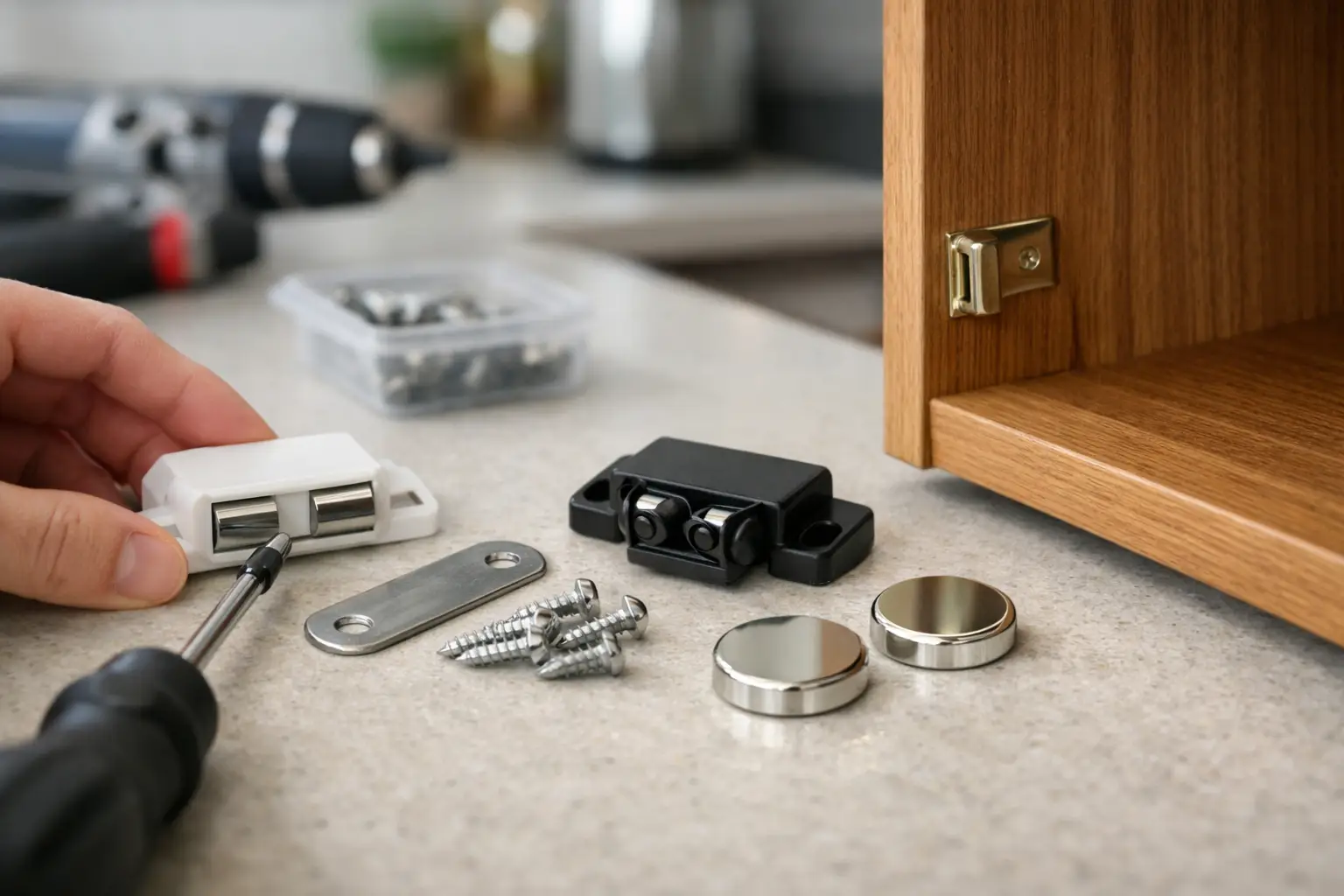
Cabinet Catch Replacement Guide for Strong Closures
A cupboard door that drifts open is rarely a major repair, but it is a daily nuisance. This cabinet catch replacement guide explains how to identify the failed part, select a suitably strong replacement and fit it so the door closes cleanly every time. For most DIY and trade installations, a magnetic catch is a compact, reliable answer – provided its pull strength and alignment suit the cabinet.
Start by finding the real cause
Do not assume the catch is at fault simply because the door will not stay shut. Open and close the door slowly while watching the gaps around it. If the door scrapes the frame, sits low or springs away from one corner, worn hinges or loose hinge screws may be the first issue to correct.
A catch is more likely to be the problem when the door is correctly positioned but no longer holds at the closed point. Common signs include a cracked plastic housing, a loose magnet, stripped screw holes, a bent strike plate or a magnet that has lost contact because the two parts are no longer aligned.
On older furniture, you may find a roller catch, ball catch or spring latch rather than a magnetic fitting. These can be replaced like-for-like, but a magnetic catch is often the more straightforward upgrade for lightweight and medium-weight doors. It has fewer moving parts, closes quietly and is less likely to wear through repeated use.
Choose the right replacement catch
The best replacement is not automatically the strongest one. A super-strong catch can make a small cupboard awkward to open, particularly where the door has a small knob or no handle. Too little pull strength, meanwhile, will not resist a warped door, vibration or a cabinet used regularly in a busy workshop.
Start with the door itself. Light kitchen cupboard doors, utility units and small furniture doors usually need a modest magnetic hold. Taller doors, doors with heavier fronts, and cabinets on mobile units may need greater pull performance. If the cabinet is exposed to knocks or vibration, such as in a vehicle fit-out or retail display, allow extra holding strength.
The mounting arrangement matters just as much. A typical magnetic catch has a magnet body fitted inside the cabinet and a steel strike plate fitted to the rear of the door. When shut, the plate must meet the face of the magnet squarely. Even a powerful neodymium magnet cannot deliver its expected holding force across a large air gap or against an off-centre plate.
Check the dimensions of the existing catch before ordering. Measure the body length, width and projection, then check whether the new unit can sit clear of shelves, hinges and cabinet edges. If you are using existing screw holes, compare their spacing too. Reusing sound holes makes the job quicker, but only if the replacement catches in the correct position.
Magnetic catch types and when to use them
Single magnetic catches are compact and suit smaller doors. Twin catches offer a broader contact area and can be useful on wider doors or where a more positive hold is required. Catches with countersunk fixing holes give a neater finish and help screws sit flush, reducing the risk of snagging.
Neodymium magnetic catches are a strong choice where space is limited but a dependable grip is needed. Their superior pull performance compared with ordinary ferrite magnets means a small fitting can provide serious holding power. That said, strength must be matched to the application. On a delicate or very light door, choose a catch that releases comfortably rather than one that requires a sharp pull every time.
Tools and preparation
Most cabinet catch replacements need only a screwdriver, pencil, tape measure and a drill with a small pilot bit. Keep a few toothpicks or wooden splinters and wood glue nearby if the original screw holes have become loose. For laminated chipboard or MDF cabinets, take particular care not to over-tighten screws, as the material can strip easily.
Empty the cabinet shelf nearest the catch before starting. You need a clear working position and should be able to close the door fully during testing. If you are replacing a catch on a painted or veneered cabinet, place masking tape over the drilling point before marking it. This helps reduce chipping when drilling a pilot hole.
Cabinet catch replacement guide: fitting a magnetic catch
Remove the old catch and strike plate first. Keep the screws only if they are undamaged and match the new catch, although fresh fixings are generally the better choice. If the old catch location worked well, hold the new body in the same area, usually near the opening edge of the cabinet and clear of the hinges.
Fit the magnetic body to the cabinet side, top rail or underside of a shelf, depending on the available fixing surface. Do not fully tighten the screws at this stage. Leaving them slightly loose gives you room for minor adjustment after the strike plate is in place.
To mark the strike plate position, close the door until it sits correctly within the frame. A simple method is to place a small piece of masking tape on the door where the magnet will meet it, then lightly press the magnet against the tape to create a reference point. Alternatively, use a pencil mark taken from the centre of the magnet face.
Position the steel plate so its centre aligns with that mark. Drill small pilot holes where appropriate, then fasten the plate to the inside of the door. Shut the door gently and check that the plate meets the magnet face flat. The door should pull closed for the final few millimetres, without needing force or bouncing back.
Now tighten the catch body screws. Open and close the door several times, including from different opening angles. A catch that works once may still be misaligned if the door needs to be pushed upwards, downwards or sideways to engage.
Repairing loose screw holes
A replacement catch will not stay secure if its screws are turning in damaged timber or board. For small holes in solid wood, add a little wood glue to toothpicks, press them into the hole and trim them flush once dry. Drill a small pilot hole into the repaired area before refitting the screw.
For badly damaged chipboard or MDF, moving the catch a short distance to fresh material is often the more reliable repair. Make sure the new position still allows full contact between magnet and strike plate. A slightly relocated catch is preferable to a fitting that works loose again after a few weeks.
Get the alignment right before increasing strength
When a cabinet catch seems weak, the first instinct is often to fit a larger magnet. Check alignment before doing that. A strike plate that meets only the edge of the magnet has far less effective contact area. Likewise, a door that is held 2-3 mm away by a proud hinge, bowed panel or thick paint build-up may not close strongly even with a powerful catch.
Adjust the plate or catch body in small increments. Moving either component by a millimetre can transform the hold. If the door is flush but still releases too easily, then consider a higher-strength magnetic catch or a twin-magnet configuration.
There is also a practical balance between holding power and user experience. A pantry door storing heavy items may benefit from a firmer closure. A bedside cabinet, display unit or frequently used kitchen door should release with a controlled pull rather than a sudden tug that stresses the hinges.
Common problems after replacement
If the door springs open immediately, the magnet and plate are likely misaligned, or the door is under tension from hinge adjustment. If it stays closed but has to be slammed, move the catch back slightly or check whether the plate is catching on the magnet housing.
A door that rattles despite staying shut may need the catch moved closer to the cabinet face, provided the door still closes flush. Where the plate is bent or corroded, replace it rather than trying to straighten it repeatedly. A flat, clean steel plate gives the magnet the best possible contact.
If a neodymium catch is being handled loose during fitting, keep it away from mobile phones, bank cards, watches and sensitive electronic devices. Larger high-strength magnets can snap together sharply and pinch fingers, so hold them securely and keep them apart until they are mounted.
A correctly fitted magnetic catch should disappear into the everyday use of the cabinet: no rattling door, no repeated adjustments and no uncertainty about whether it has shut. Choose the format and strength for the door in front of you, fit it squarely, and a small replacement can deliver a far more dependable closure.