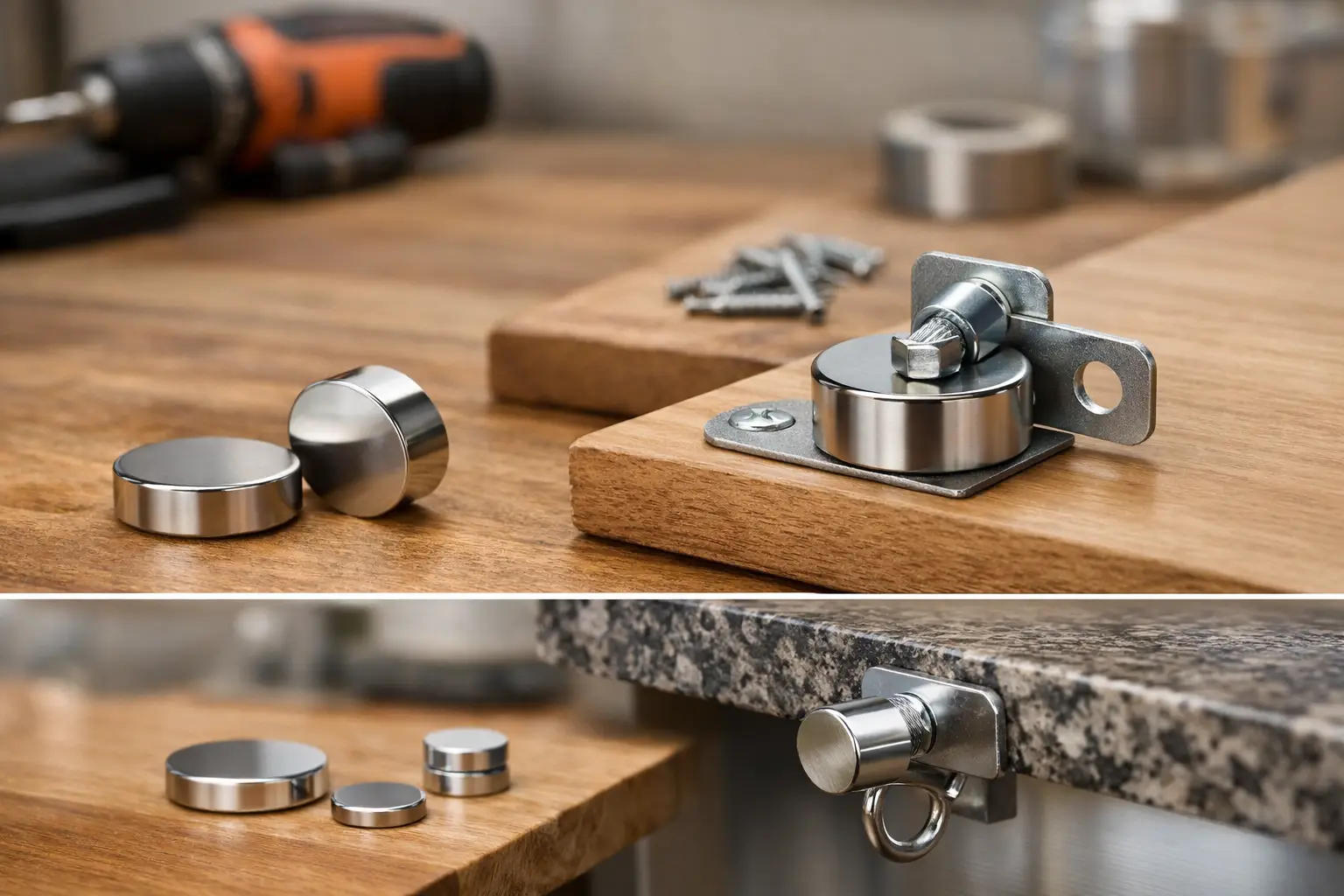
How to Stop Magnet Slipping in Practical Fixings
A magnet that slides down a steel panel, twists out of position or lets a cabinet door creep open is rarely just a case of needing a stronger magnet. Knowing how to stop magnet slipping starts with identifying what is moving: the magnet across the surface, the magnet from its fixing, or the two magnetic faces separating under load. Each problem needs a slightly different fix.
For cabinet makers, fit-out teams and practical DIY users, the reliable answer is usually a combination of correct magnet format, clean contact surfaces and a fixing method that suits the direction of force. A super-strong neodymium magnet can provide exceptional pull strength, but pull strength alone does not prevent sideways movement.
Why magnets slip in the first place
Most quoted magnet pull figures describe direct pull: the force needed to pull a magnet straight away from a thick, clean steel plate. In a real installation, loads often act sideways. This is known as shear force. A hook mounted to a vertical steel surface, for example, is being pulled down rather than directly away from the steel.
Friction is what resists that sideways movement. Smooth nickel-plated neodymium magnets and painted steel can have limited grip against one another, especially where the surface is dusty, oily or glossy. A powerful magnet may stay attached yet still slowly slide under a modest load.
Slipping can also happen because the steel is too thin. Thin sheet metal cannot carry the magnetic field as effectively as thicker mild steel, so the available holding force drops. Stainless steel is another common issue. Many stainless steels are non-magnetic, while others are only weakly magnetic, so even an N52 magnet will not perform as expected.
Finally, do not overlook the mounting itself. If a magnet is bonded into timber, plastic or an aluminium frame and the adhesive fails, the magnet has not slipped on the steel at all. It has come loose from the project.
How to stop magnet slipping on a steel surface
The most effective way to stop a magnet sliding is to improve friction or stop the sideways load reaching the magnet. Start with the contact area. Wipe both the magnet and steel with a clean, dry cloth to remove dust, swarf, grease and polish residue. For workshop or retail fixtures, degreasing the steel with a suitable cleaner can make a noticeable difference.
A larger magnet generally helps because it increases both the magnetic holding force and the contact area. This does not mean choosing the thickest magnet automatically. On a thin steel surface, a wider disc or block often performs better than adding thickness, because it spreads the magnetic field over more material.
Where appearance and the application allow it, add a high-friction layer. A thin rubber or polyurethane pad can reduce sliding dramatically. The trade-off is that any gap between magnet and steel weakens the magnetic pull. The pad must therefore be thin, firm and suited to the load. Soft, thick foam may stop a magnet sliding but can reduce holding force too far.
For a vertical fixing carrying meaningful weight, use a positive mechanical stop rather than relying on friction alone. Rest the item on a rail, ledge, screw head, folded steel edge or bracket, with the magnet holding it in place. The stop takes the downward load; the magnet provides the quick positioning and retention. This is far more dependable than asking a magnet to support the full shear load by itself.
Choose the right magnet shape for the job
Magnet shape affects how easily you can install a secure fixing. Disc magnets are useful where a compact, flush magnetic point is needed, such as a door catch, removable panel or jig. Block magnets offer more surface area and are often a stronger choice for locating panels, holding signs or creating a longer contact line.
Countersunk magnets are particularly useful when the magnet must be fixed permanently to timber, plastic or a non-magnetic metal. A countersunk screw holds the magnet mechanically, removing the uncertainty of an adhesive-only joint. The screw head should sit flush or slightly below flush. A proud screw head creates a gap between the magnet and mating surface, reducing pull performance.
For cabinet doors and access panels, purpose-made magnetic catches can be the better option. They combine a magnet with a housing and strike plate designed to work together, giving more consistent alignment than a loose magnet fitted by eye. They are also easier to adjust during installation.
It depends on the project. A flush magnetic closure may call for small countersunk magnets, while a removable workshop fixture may benefit from a larger block magnet with a rubberised face and a physical support below it. Select for the load direction and mounting arrangement, not simply the highest advertised pull figure.
Make sure the mating material is suitable
Neodymium magnets need ferromagnetic material to work properly. Mild steel is normally the most reliable mating surface. If you are mounting to painted steel, test the actual panel rather than assuming it will hold well. Paint thickness, steel gauge and surface curvature all affect performance.
Aluminium, brass, copper, wood and most plastics are not magnetic. A magnet can be installed in these materials, but it needs a steel target plate or another magnet on the opposite side. If using two magnets face to face, ensure they are correctly orientated before fitting. Reversing one magnet after adhesive has cured is an expensive and frustrating mistake.
Avoid leaving a bare neodymium magnet exposed in wet or corrosive locations unless it is suitably protected. The standard nickel coating is durable for normal indoor use, but chipped coatings and persistent moisture can lead to corrosion. Corrosion can weaken the fixing and make a once-flat magnet sit unevenly.
Check for gaps and uneven surfaces
Magnetic force falls away very quickly as the air gap increases. A tiny gap caused by a screw head, veneer, thick paint, weld spatter or an uneven surface can make a strong magnet feel surprisingly weak. Check that the magnet sits flat and that the steel target is not bowed away from it.
If the installation needs a protective layer, keep it as thin as practical. In some cases, a steel cup or pot-style mounting arrangement can focus the magnetic field and improve performance, but the design still needs to accommodate the load direction.
Secure magnets properly in timber and fabricated work
When a magnet must stay fixed inside a drilled recess, adhesive choice and preparation matter. The recess should be clean, dry and close-fitting. If the hole is oversized, the adhesive must bridge a large gap and the magnet can shift under repeated impact.
For many indoor jobs, a quality two-part epoxy provides a strong bond to timber, plastics and metal when surfaces are prepared correctly. Lightly keying the side of a magnet can improve adhesion, but do not damage the working face or chip the coating. Cyanoacrylate adhesive can be quick for light-duty work, yet it is more brittle and is less forgiving where doors slam or components flex.
Countersunk magnets are the more secure choice where possible. Use an appropriate non-magnetic screw if you do not want the screw itself to become part of the magnetic contact area. Tighten carefully: neodymium magnets are hard but brittle, and excessive screw pressure can crack them.
During fitting, keep magnets apart until they are positioned. N52 magnets can snap together suddenly, chip at the edges or pinch fingers. Wear eye protection when handling larger magnets or working near steel tools, and keep them away from electronics, magnetic storage media and people with medical devices that may be affected by magnets.
Test the finished fixing under real conditions
A bench test is useful, but it is not the final answer. Test the installation in the position and direction it will be used. A cabinet catch should be checked with the door closed at normal speed. A magnetic display fitting should be tested with the intended sign weight, not an empty panel. A removable tool holder should be loaded gradually, allowing for vibration and knocks.
Build in a margin rather than designing to the point where the magnet only just holds. Repeated opening, closing, vibration, warm conditions and imperfect alignment all reduce real-world performance. If failure would damage an item or create a safety risk, add a secondary mechanical restraint.
Magman’s N52 disc, block and countersunk magnets give compact installations superior pull performance, but the best result comes from matching that strength to a well-designed fixing. Give the magnet clean steel, full contact and help with sideways loads, and it will do the job it was chosen for: holding firmly without slipping when it matters.