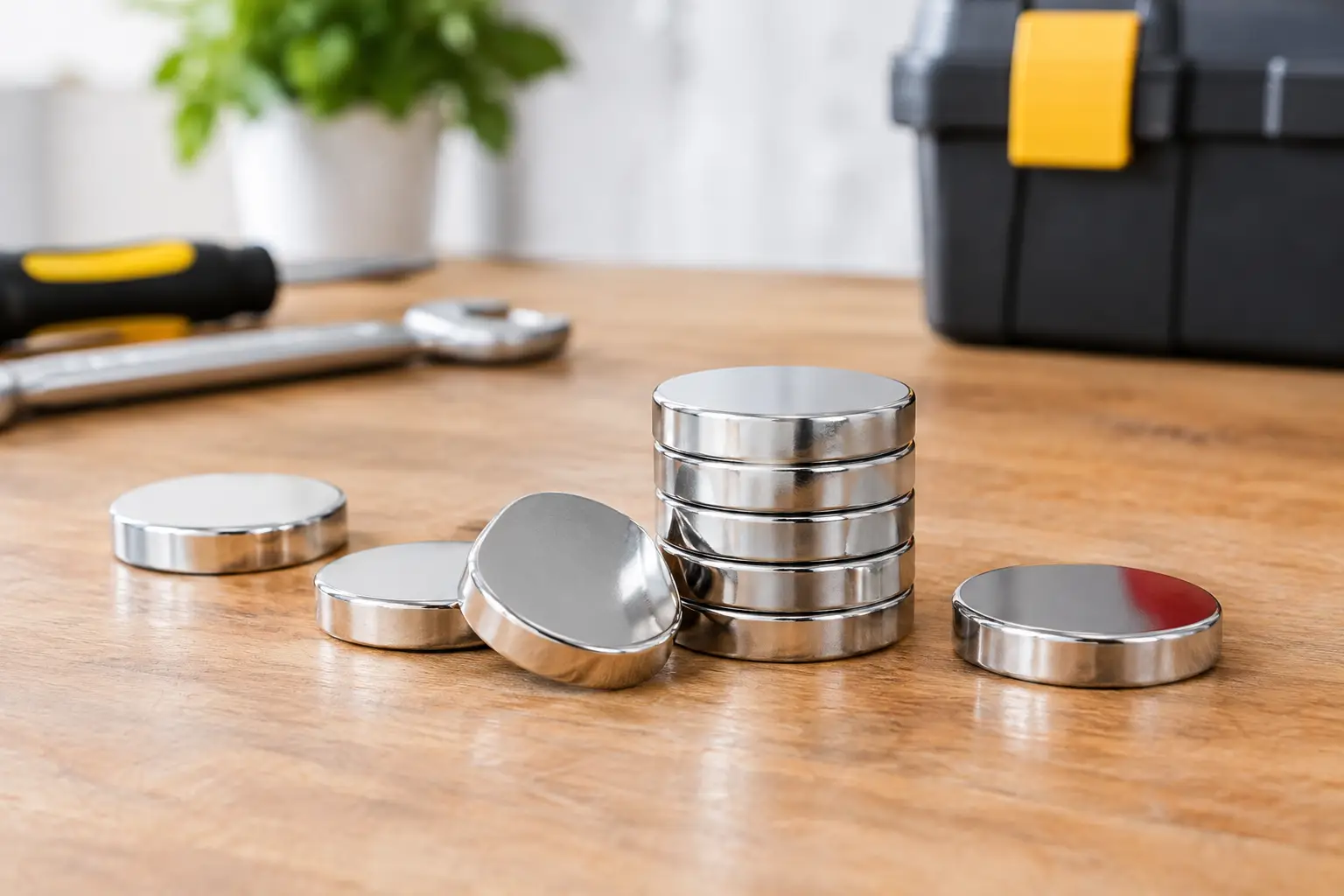
Disc Magnet Review for Stronger Everyday Fixings
A disc magnet can look insignificant beside a hinge, bracket or screw pack. Then it holds a cabinet door shut, secures a removable panel or creates a clean display fixing without a visible latch. This disc magnet review looks at what makes high-strength neodymium discs a practical choice, where they perform best and what must be right before fitting them into a project.
For most jobs, the attraction is simple: a compact magnet provides serious holding power without taking up valuable space. But the strongest option is not automatically the best option. Diameter, thickness, air gap, mounting surface and the way the magnet is fixed all affect the result.
Disc magnet review: what N52 strength delivers
N52 neodymium is among the strongest commonly available magnet grades. In a disc format, it gives you superior pull performance from a small, tidy component. That makes it particularly useful where a traditional mechanical catch would look bulky, need more adjustment or interrupt the finish of a piece.
A quality N52 disc magnet feels noticeably different from an ordinary ferrite magnet. It grips ferrous steel firmly and can attract another magnet with surprising force. For cabinet makers and installers, that strength allows a smaller fixing to do work that would otherwise need a larger catch or additional hardware.
The main benefit is not simply maximum pull. It is controlled strength in a format that can be recessed, bonded, screwed into a holder or paired with a steel strike plate. Used properly, a disc magnet creates a positive closure that is quiet, repeatable and discreet.
That said, pull-force figures should be treated as a useful comparison rather than a guarantee of real-world holding power. Published pull is generally measured with direct contact against a thick, clean steel plate. Put 2 mm of timber, paint, laminate, an uneven surface or a gap between the parts, and performance reduces. This is not a flaw in the magnet. It is the reality of magnetic circuits.
Where disc magnets work best
Disc magnets are powerful and versatile because their flat faces suit a wide range of contact points. They are especially effective for doors, lids and removable parts that need to close neatly and open by hand.
In cabinetry, a recessed disc magnet and a steel counterplate can replace a conventional catch on cupboard doors, access panels and bespoke furniture. The result is clean and unobtrusive, particularly when the magnet is concealed behind a thin timber face. For heavier doors, a larger diameter magnet or more than one contact point may be needed.
For retail fit-outs, discs are useful for removable signage, display panels and product presentation units. They allow components to be changed without visible fixings, which keeps the finished unit looking sharper. Here, repeatability matters as much as raw strength. The panel needs to locate in the same position each time, so a shallow recess, locating pins or an edge stop can be worthwhile.
Workshop and DIY users often fit disc magnets to tool holders, jigs, storage lids and covers. They can hold a light fitting in position while adhesive cures or create a quick-release arrangement for a removable guard. Where vibration is likely, do not rely on magnetism alone if failure could cause damage or injury. Add a mechanical stop, retaining strap or secondary fixing.
Size and thickness matter more than most buyers expect
Choosing a disc magnet starts with the available space, then the holding requirement. Diameter generally has a major effect on the usable contact area, while thickness contributes to the magnetic field and resistance to demagnetisation. A thin, wide disc may be ideal behind a cabinet face; a thicker disc may make more sense where there is depth but limited surface area.
A larger magnet is not always easier to use. Higher attraction makes alignment more critical and can make a light door feel difficult to open. If the user will pull the door using only a small finger gap, an overly powerful catch can become frustrating. For a small jewellery-box lid, moderate holding force is usually preferable. For a tall utility cupboard door that tends to spring open, more holding power is justified.
The material on the opposing side also changes the answer. A magnet paired with a suitable steel plate usually offers a practical, forgiving closure. Two magnets facing each other can produce an even stronger hold, but they need accurate polarity and can snap together during installation. In many fitted applications, magnet-to-steel is the simpler option.
Consider the gap honestly. A magnet buried behind a thick door front may have excellent strength on paper but poor performance once fitted. Test with offcuts before drilling final recesses, especially on painted MDF, hardwood, veneered boards or installations with a soft-close movement.
Coating, fixing and finish quality
Most neodymium disc magnets are supplied with a nickel-based coating that gives a bright metallic finish and helps protect the magnet material. It is suitable for many dry indoor applications, including furniture, displays and workshop storage. However, the coating is not a licence to leave magnets exposed to standing water, salt spray or harsh chemicals.
For kitchens, bathrooms, sheds and other damp locations, protect the magnet from persistent moisture where possible. A recessed installation, sealed edge or enclosed housing can extend service life. If a coating becomes chipped, corrosion can begin beneath it, so avoid striking magnets together or forcing them into a tight recess with metal tools.
Fixing method deserves equal attention. Plain disc magnets are often bonded into a drilled recess. Choose an adhesive suited to both the magnet coating and the substrate, and make sure the recess is clean, dry and deep enough for the magnet to sit flush. A proud magnet can create a visible gap and increase the risk of chipping when the door closes.
Do not assume every adhesive is suitable for every job. Fast-setting glues can be convenient but allow little time for positioning; slower-curing epoxy can provide a more dependable bond when surfaces are prepared correctly. On painted or oily surfaces, adhesion may be the weak point rather than magnetic pull. Mechanical retention is preferable for high-use, high-load or safety-critical work.
Countersunk magnets are often the better choice where a screw fixing is required. A plain disc is cleaner for a concealed bonded installation. Selecting the correct format at the start avoids trying to adapt a magnet beyond what it was designed to do.
Practical trade-offs before ordering
A good disc magnet should make a project simpler, not introduce new problems. Before choosing, check the space behind the fixing face, the weight and leverage of the component, the expected gap, and how often it will be opened. A light panel with a large pull tab behaves very differently from a compact lid with no leverage.
Also consider whether the magnet needs to hold, locate or both. Magnetic force alone is excellent for closing and retaining. It is less suited to resisting sideways movement on a heavy panel. If the part could slide, twist or rattle, build in a rebate, lip, pin or frame that carries those forces. Let the magnet do the job it does best: pulling two faces together.
Safety is part of the specification. Strong neodymium magnets can pinch skin, chip if they collide and interfere with pacemakers or implanted medical devices. Keep them away from children, sensitive electronics and magnetic storage media. When handling larger or stronger discs, separate them carefully rather than letting them jump together.
Is a high-strength disc magnet worth it?
For functional fixing jobs, the answer is usually yes when space is limited and a neat closure matters. A high-strength disc magnet can outperform larger, cheaper alternatives because it provides dependable pull in a compact form. It is a particularly strong choice for furniture makers, fit-out teams and DIY users who want a clean finish without compromising on hold.
The value comes from selecting the right disc rather than simply the strongest available one. Match its size to the gap, use a suitable counterface, protect the coating and give the installation enough support to handle sideways loads. Magman’s focused range of N52 neodymium magnets makes that choice more straightforward for buyers who need practical strength rather than a novelty item.
Measure the space, test the closure on sample material and allow for the real conditions of the finished build. A correctly specified disc magnet disappears into the job while delivering the firm, reliable hold you wanted in the first place.