Magnetic Mounting Solutions That Hold Firm
A fixing that works perfectly in the workshop can fail once a door is slammed, a display is handled repeatedly or two surfaces sit slightly out of line. That is why magnetic mounting solutions need to be chosen for the job, not simply by the biggest pull-strength figure. The right neodymium magnet creates a clean, repeatable hold without visible hardware, awkward catches or unnecessary drilling.
For cabinet makers, shopfitters, DIY users and small manufacturers, magnets offer a practical way to secure removable panels, doors, signs, tools and lightweight components. They can speed up fitting, keep finished surfaces tidy and make access easier when equipment needs servicing. The result depends on matching the magnet format, the mounting method and the real conditions the fitting will face.
Where Magnetic Mounting Solutions Work Best
Magnetic fixing is most useful when an item must stay in position but still be removed quickly. A cupboard door may need a positive close without a traditional latch. A removable access panel may need to sit flush while remaining easy to lift away. A retail display may need to be changed regularly without filling the fixture with worn screw holes.
High-strength neodymium magnets are especially effective where space is limited. N52 magnets deliver powerful pull performance for their size, allowing a compact disc or block magnet to do work that would otherwise require a larger mechanical fitting. That matters in slim cabinet frames, display plinths, timber mouldings and custom enclosures where every millimetre counts.
Magnetic mounting also suits jobs where visual finish matters. A hidden magnet can hold a panel without visible catches on the face. For painted cabinetry, furniture projects and retail units, that cleaner finish is often the main reason to choose magnets. The fixing remains functional while the attention stays on the finished piece.
There are limits. Magnets are not a substitute for a structural fixing where an item carries sustained weight, is subject to shock loading or could cause injury if released. They are best used as a closure, retaining method or light-duty mounting aid alongside sensible mechanical support where required.
Choose the Right Magnet Format for the Job
The shape of the magnet affects how easily it can be fitted and how it performs in use. Selecting the right format early avoids common problems such as a magnet sitting proud, twisting in its recess or failing to meet the opposing surface squarely.
Disc magnets for neat recessed fittings
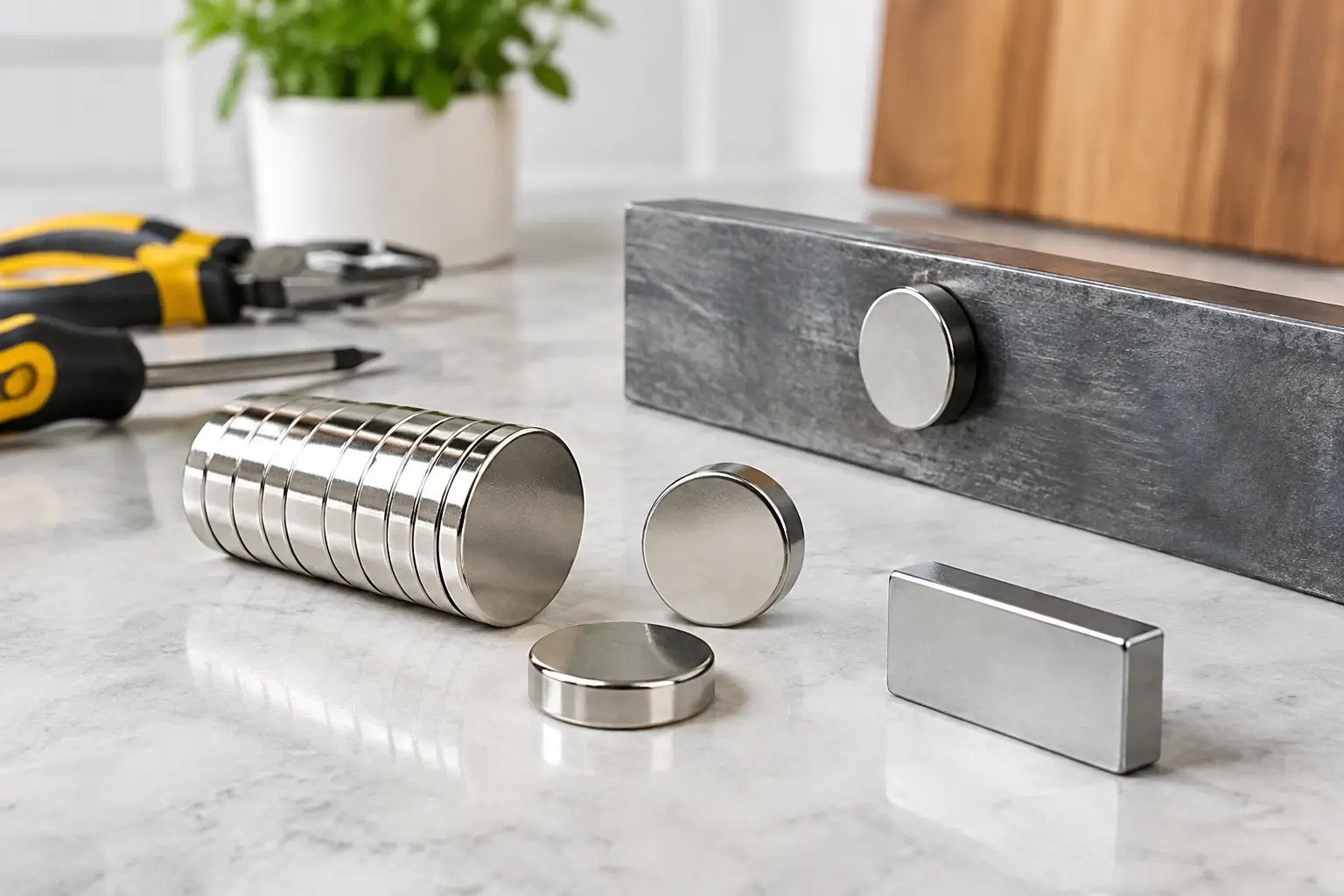
Disc magnets are a strong choice for timber, acrylic, plastic and other materials that can be drilled or routed. Set into a shallow recess, they give a discreet fixing with a broad, flat contact face. They are often used for cabinet doors, removable covers, display boards and box lids.
A flush fit matters. If the magnet is buried too deeply, the air gap between the magnet and its mating surface reduces the available pull. If it sits proud, the panel may rock or refuse to close flat. Measure the material thickness and recess depth before fitting, then test the hold with the final surface finish in place.
Block magnets for directional holding
Block magnets provide a useful flat profile and can be positioned to suit longer edges or narrow frames. They work well inside cabinet rails, beneath signs, within jigs and on custom mounting plates. Their rectangular shape can also help prevent rotation when installed in a matching pocket.
They are particularly useful where a disc magnet would concentrate the hold in one small point. A longer block can spread the holding force across an edge, helping a thin panel sit more evenly. The trade-off is that block magnets need a more accurately sized recess and can be more vulnerable to chipping if forced into place.
Countersunk magnets for screw-fixed strength
Countersunk magnets are designed for direct mechanical fixing. A suitable screw passes through the centre, making them a practical option where adhesive alone is not appropriate. They are widely used for removable covers, gate catches, workshop fixtures and installations that may see frequent use.
The screw holds the magnet in place, but it does not remove the need for care. Use a screw head that sits correctly in the countersink, avoid over-tightening and make sure the fixing material can take the load. A distorted or cracked magnet will not give dependable performance.
Magnetic catches for straightforward closures
For cupboards, wardrobes, display units and utility doors, magnetic catches are often the quickest route to a reliable close. They pair a magnet with a strike plate and are built around the practical needs of door alignment and repeat use. Where the requirement is simply to keep a door shut cleanly, a purpose-made catch can be more convenient than designing a magnet-and-steel arrangement from separate parts.
Pull Strength Is Only Part of the Picture
A quoted pull strength is useful for comparison, but it is not a guarantee of what a magnet will hold in a finished installation. Product pull ratings are generally measured under controlled conditions, with direct contact against a suitable thick steel surface. Real projects rarely match that ideal setup.
Paint, laminate, tape, a timber veneer or even a small mounting gap can reduce the effective hold. So can a thin steel strike plate. If the plate flexes, the magnet cannot develop its full pull. A door that opens by peeling away from one corner also needs less force to release than one pulled straight off face-to-face.
Think about how the load acts. A magnet holding a vertical panel against a wall is dealing with shear force, where the panel wants to slide down. A magnet holding a lid closed is dealing more with direct pull. Friction, surface texture and the number of magnets used all influence the final result.
For a door or panel, it is usually better to use two or more correctly placed magnets than one oversized magnet in the middle. The hold is more balanced, the panel is less likely to flex, and alignment is easier to maintain. Start with a test piece when the project has a heavy door, a long span or an uncertain surface.
Mounting Methods: Adhesive, Screws or Recesses
Adhesive mounting is useful when drilling is not possible or when the magnet needs to sit on the surface. It can work well on clean, flat materials, provided the adhesive is rated for the surface and expected load. The weak point is often not the adhesive itself but poor preparation. Dust, oil, wax, loose paint and uneven surfaces all reduce bond strength.
For an adhesive fit, clean both surfaces thoroughly and allow the adhesive to cure for the full recommended time before loading it. Do not judge the bond after a few minutes. A magnet can feel secure while the adhesive beneath it is still developing strength.
Screw fixing gives greater confidence for repeat-use fittings. Countersunk magnets are the obvious choice, especially on timber, plywood and suitable metalwork. Pre-drill pilot holes in timber to reduce splitting, and check that the screw will not break through the finished face.
Recessing is often the best option where appearance and alignment are priorities. A magnet set flush into wood or plastic is protected from knocks and produces a tidy closing action. Leave enough material around the recess so the edge does not become weak, particularly in narrow cabinet frames.
Common Problems and How to Avoid Them
The most frequent issue is choosing a magnet that is strong enough on paper but too weak once installed. Reduce unnecessary gaps, use a suitable steel target or matching magnet, and test with the actual panel weight. Do not rely on a thin steel washer if the job needs a firm hold.
Polarity catches people out as well. Two magnets can attract or repel depending on their orientation. Before gluing or fixing anything permanently, mark the mating faces and test the opening and closing action. This simple check prevents an avoidable refit.
Another issue is using a magnet in a position where it can strike hard every time a door closes. Neodymium magnets are powerful but brittle. A small buffer, careful spacing or a magnetic catch designed for closure duty can protect the fitting and reduce noise.
Keep magnets away from items that may be affected by magnetic fields, including certain electronic devices, magnetic stripe cards and precision instruments. Handle larger neodymium magnets carefully too. They can snap together unexpectedly and trap fingers, chip on impact or damage nearby surfaces.
Plan for the Finished Installation
The strongest magnetic mount is the one that has been considered as part of the build rather than added at the end. Check the panel weight, opening direction, contact area, gap, material thickness and how often the fitting will be used. Then select a disc, block, countersunk magnet or magnetic catch that suits those conditions.
Magman’s focused range of high-strength N52 magnets gives trade and DIY customers practical options for compact, powerful fixings. With the right format and a properly prepared mounting surface, magnetic fittings can keep doors, panels and displays secure while leaving the finished job clean, accessible and easy to use.
Before committing to the final installation, make a quick test assembly with the real materials. A few minutes spent checking alignment and holding force is the simplest way to achieve a magnetic fixing that feels right every time it is used.