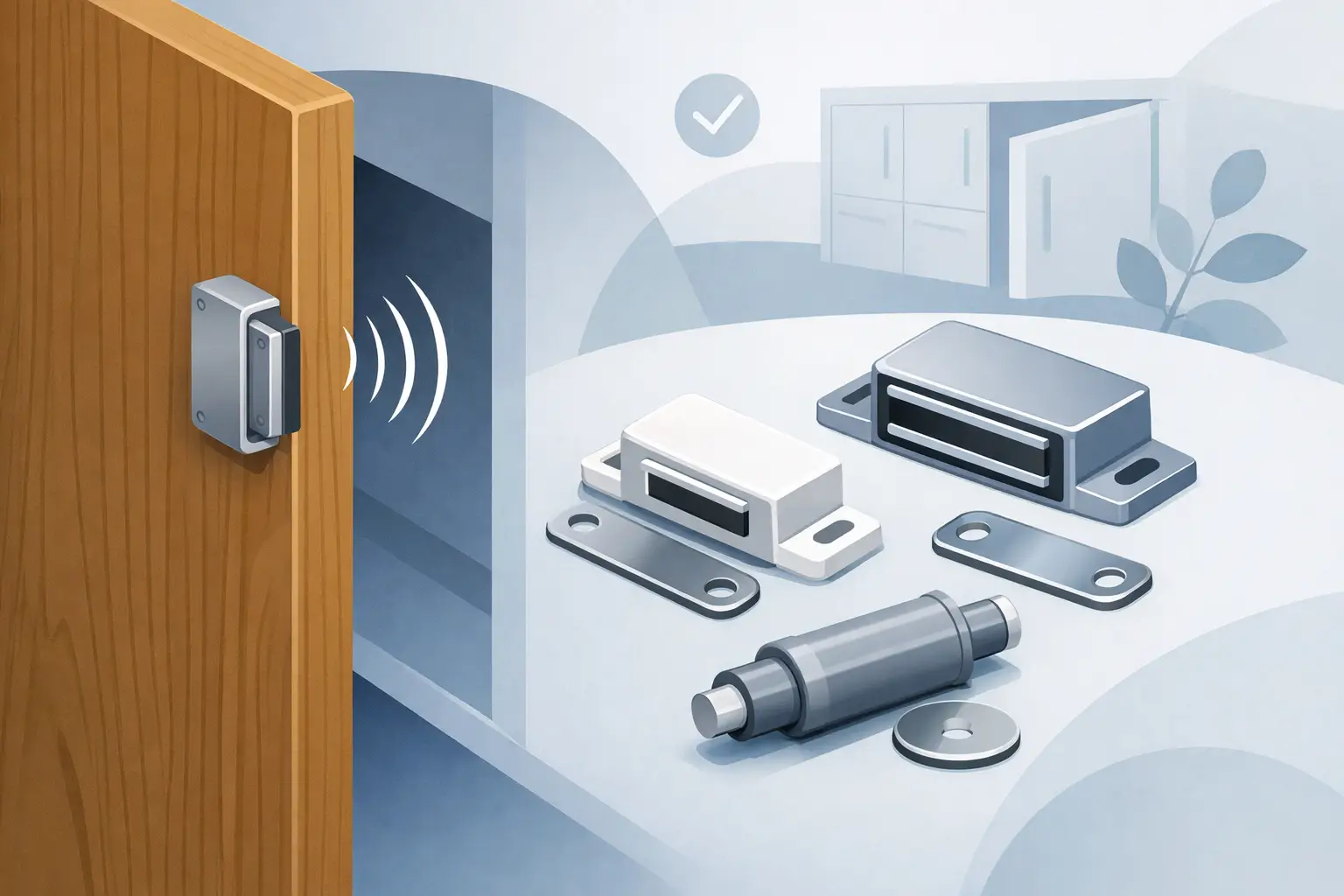
Choosing a Cabinet Door Magnetic Catch
A cabinet door that will not stay shut is a small fault that quickly becomes irritating. In a kitchen, workshop or retail unit, that repeated swing-open problem usually comes down to one thing – the cabinet door magnetic catch is too weak, poorly placed or simply the wrong type for the job.
What a cabinet door magnetic catch actually does
At its simplest, a magnetic catch holds a door closed by pulling a metal strike plate against a magnet fixed inside the cabinet. That sounds straightforward, but real-world performance depends on more than just whether there is a magnet involved. Door weight, hinge tension, the gap between the door and carcass, and the way the catch is mounted all affect the result.
A good catch should close cleanly, hold firmly and release without needing a hard tug. If it is too weak, the door drifts open. If it is too strong for the application, the door can feel awkward to open and repeated force can put unnecessary stress on hinges, fixings or lightweight panels.
That is why choosing by appearance alone rarely works. The right magnetic catch needs to match the job, not just the cabinet.
How to choose the right cabinet door magnetic catch
The first question is not size. It is holding force. A small bathroom cupboard door needs far less pull than a tall wardrobe door or a heavy timber unit in a busy commercial setting. Many buyers make the mistake of choosing the cheapest light-duty option, only to find it struggles once the door settles, the hinges wear slightly or the unit is used day after day.
For lightweight domestic doors, a compact magnetic catch is often enough if the alignment is good. For larger doors, higher traffic areas or cabinets that carry a bit of hinge resistance, a stronger neodymium-based option is usually the better fit. Neodymium magnets offer superior pull performance in a compact format, which matters when you want a cleaner install without bulky hardware.
You also need to look at the mounting style. Some catches are surface-mounted and quick to fit, which suits general repairs, replacements and straightforward cabinet work. Others use countersunk magnets or more integrated hardware where a neater finish or a custom build is the priority. If the cabinet interior is visible, a lower-profile fitting often makes more sense.
Material quality matters as well. A magnetic catch is opened and closed repeatedly, so weak housings, poor plating or inconsistent magnet strength soon show up in use. For trade work or any project where call-backs are a concern, dependable quality is not an extra. It is the whole point.
Match the catch to the door, not the label
Packaging terms such as light-duty or heavy-duty can be useful, but they are not a substitute for thinking about the actual application. A shaker-style kitchen door in MDF behaves differently from a slim melamine office cupboard. A retail display unit may be opened dozens of times a day. A workshop cabinet may have vibration nearby from tools or machinery.
That is where stronger magnetic hardware earns its place. Compact, powerful magnets can hold securely without relying on oversized plastic bodies or awkward double-catch arrangements. If space is tight or the door needs a more positive close, that extra pull strength gives you more margin for error.
Where magnetic catches work best
Magnetic catches are used far beyond kitchen cupboards. They are a practical choice anywhere you need a simple, concealed and reliable closure without adding a visible latch.
In wardrobes and bedroom furniture, they keep doors sitting neatly shut without making the opening action feel mechanical. In utility rooms and workshops, they are a tidy fix for cabinets that need a firmer hold than a basic roller catch can provide. In retail fit-outs, they help maintain a clean front while still allowing quick staff access to storage compartments and display housings.
They are also useful in custom joinery and one-off fabrication work, especially where standard latch hardware does not suit the design. If you are building a cabinet from scratch, magnetic catches give you flexibility. You can position them where they work best for the door weight and opening direction, rather than working around a more rigid latch format.
When a magnetic catch may not be enough on its own
There are limits. If a door is badly warped, significantly misaligned or under constant outward pressure from stored contents, even a strong magnetic catch will only mask the issue for so long. Likewise, for very heavy doors or units subject to frequent impact, you may need a stronger closure setup or a more mechanical latch.
Magnetic catches work best when the cabinet is fundamentally sound and the catch is being used to hold the door closed, not to correct poor construction. Stronger magnets improve performance, but they are not a substitute for square fitting and decent hinges.
Common fitting mistakes that reduce holding power
A surprising number of catch failures come down to installation rather than the product itself. The biggest issue is poor alignment between the magnet and the strike plate. If they do not meet cleanly, the holding force drops fast. Even a small offset can make a catch feel weak.
The air gap matters too. Magnets perform best when the contact distance is minimal. If the catch is mounted too far back, or if the strike plate sits proud at the wrong angle, you lose a lot of effective pull. On lightweight doors you might get away with it. On anything heavier, you usually will not.
Another common problem is mounting into poor material without enough support. Thin chipboard, tired screw holes or loose fixings can all make a strong catch feel unreliable because the hardware itself shifts under use. If the cabinet substrate is weak, it is worth reinforcing the fixing point rather than blaming the magnet.
Finally, some installers place a single catch at the wrong height on a tall door. If the door has a tendency to twist slightly on closing, the hold can feel inconsistent. In those cases, repositioning the catch or using a more suitable format often solves the issue more effectively than simply choosing the next strongest option.
Why neodymium magnetic catches stand out
Not all magnets used in catches are equal. Traditional ferrite-based catches can be serviceable for very light applications, but they are bulkier for the amount of holding force they deliver. Neodymium magnets are far stronger for their size, which gives you more usable pull in a smaller footprint.
For cabinet makers, fit-out teams and DIY users, that translates into practical benefits. You can fit a more compact catch inside tighter cabinet spaces. You can achieve a firmer close without stepping up to oversized hardware. You also get a more confident hold where door weight, usage frequency or slight hinge resistance would overwhelm a lower-grade magnet.
That is why specialist suppliers matter. When you are buying magnetic hardware for real installations rather than occasional hobby use, consistency counts. A focused range built around strong, dependable neodymium products makes selection easier and performance more predictable. At Magman, that specialist approach is exactly the point.
What to look for before you buy
If you want a cabinet catch that performs properly once fitted, focus on four practical checks. First, consider the door size and weight. Second, think about how often it will be used. Third, check how much space you have for mounting. Fourth, look at the fixing method and cabinet material.
Those checks usually tell you more than a product photo ever will. A slim internal cabinet with occasional use can often take a smaller catch. A frequently used retail or workshop unit is better served by a stronger option with superior pull performance and more dependable hardware quality.
It is also worth thinking ahead. If the cabinet will live in a busy setting, if the hinges may loosen slightly over time, or if a positive close matters, choosing a stronger and better-made magnetic catch from the start often saves replacing a weak one later.
A better close starts with the right catch
A cabinet door should shut properly without fuss. When the catch is well chosen and correctly fitted, that is exactly what happens – the door closes neatly, stays put and opens when needed. No rattling, no creeping open, no repeated adjustments.
If you are selecting a cabinet door magnetic catch for a new build, a repair or a trade installation, strength and fit are what make the difference. Choose for the door, the use and the environment, and the result will feel right every time you close it.