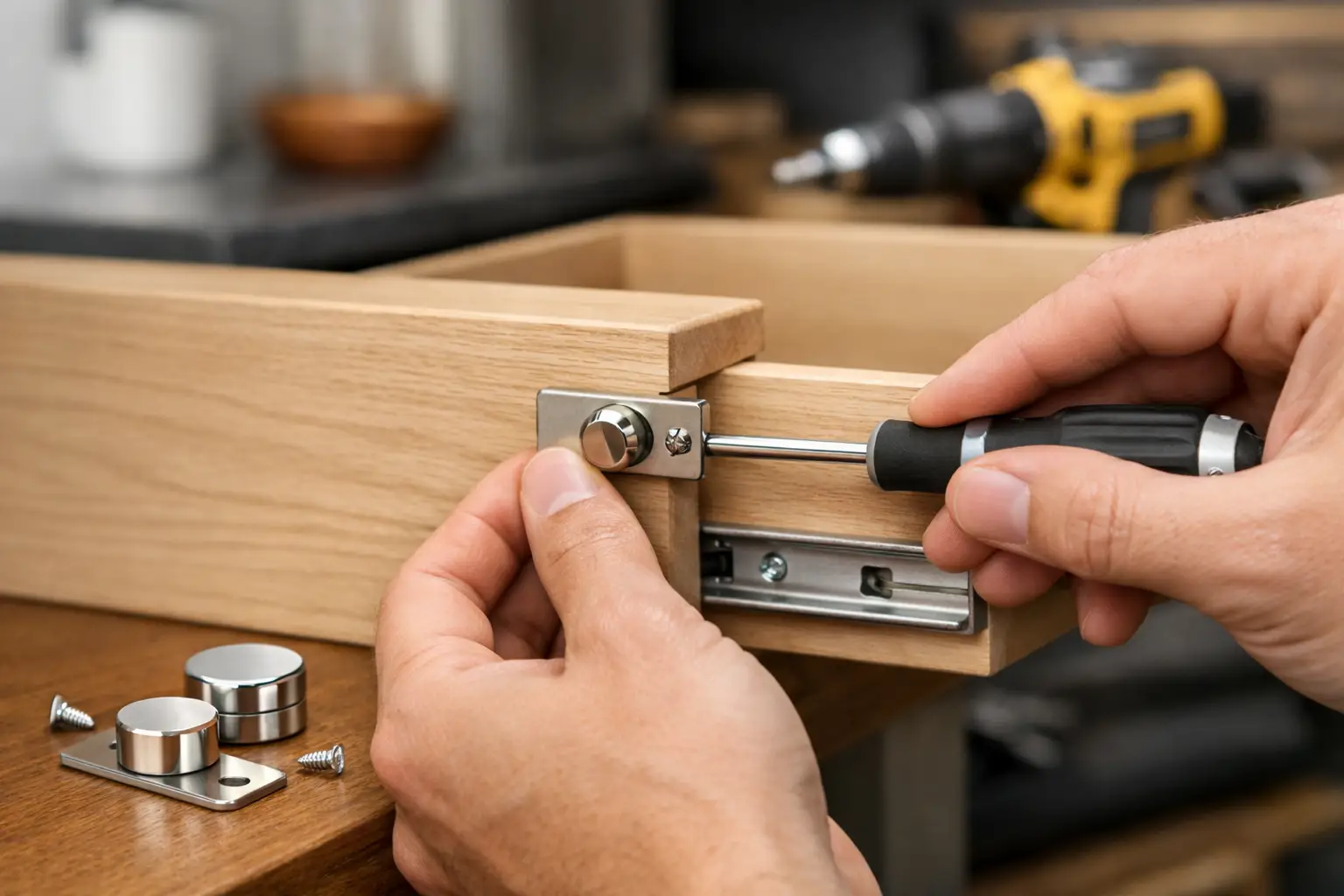
How to Install Drawer Retaining Magnets Properly
A drawer that creeps open is more than an annoyance. In a workshop, retail unit or fitted cabinet, it can catch clothing, expose contents and make a well-made job feel unfinished. To install drawer retaining magnets properly, you need more than a powerful magnet: you need the right catch format, a flat fixing surface and a gap that allows the magnet to pull the drawer home without making it difficult to open.
Magnetic catches offer a clean, compact way to keep light and medium-duty drawers shut. They are particularly useful where a conventional latch would look out of place, where a handle needs a discreet closure, or where a drawer has no lock. A good installation delivers a positive close every time, with enough holding force to resist vibration and everyday movement.
What drawer retaining magnets are designed to do
Drawer retaining magnets are magnetic catches made from two working parts: the magnet housing and a steel strike plate. The magnet is fixed to one surface, usually the cabinet carcass or drawer frame, while the strike plate is fixed opposite it. When the drawer closes, the plate meets the magnet and holds it in position.
The catch is there to retain the drawer at the fully closed point. It is not designed to pull a badly aligned drawer straight, correct a bowed front or overcome runners that bind. If the drawer is already stiff, sort that problem first. Magnets work best when the drawer slides freely and arrives at the catch squarely.
Holding strength also depends on contact. A magnet may have impressive pull performance in a direct test, but its effective grip drops when there is a gap, an uneven plate or an off-centre connection. In practical fitting, accurate positioning matters as much as raw strength.
Choose the right magnetic catch for the drawer
Start with the drawer itself. Small bedside, bathroom or kitchen drawers generally need a neat catch with moderate holding force. Heavier workshop drawers, deep drawers with substantial fronts, or mobile units exposed to vibration may require a stronger magnetic solution or more than one catch.
The catch must be strong enough to hold against the drawer’s tendency to open, but not so aggressive that users have to jerk the front to release it. This balance is especially important on lightweight furniture, where excessive force can loosen screws over time. For broad or heavy fronts, fitting one catch near each side often gives a more even hold than relying on one powerful catch in the centre.
Consider the material you are fixing into as well. Solid timber holds screws reliably, while MDF, chipboard and thin plywood can need pilot holes and suitable fixings to prevent splitting or pull-out. If you are building a cabinet from metal, a screw-on catch may not be the most straightforward option. A countersunk neodymium magnet and matching steel plate can provide a compact alternative, provided the fixing method suits the material and the drawer movement.
Keep the magnet and strike plate arrangement simple. A steel plate gives a predictable target and is usually easier to align than trying to make two magnets meet face to face. It also avoids fitting magnets with the wrong poles facing each other.
Prepare the drawer before fitting
Close the drawer and check the reveal around the front. It should sit evenly against the cabinet, with the runners fully home and no obvious rocking. If the drawer springs back after being pushed shut, inspect the runners, stops and any obstruction behind it before fitting a catch.
Next, decide where the catch can sit without fouling the runner hardware, drawer box or contents. On many cabinets, the most practical position is behind the drawer front, on the inside top rail or underside of a fixed cabinet rail. The strike plate then mounts on the corresponding edge or face of the drawer box.
Before drilling, hold both parts in place and run the drawer through its full travel. Check that there is sufficient clearance when the drawer opens, and that the catch will meet only at the final closed position. Mark a centreline with a pencil rather than relying on an estimated position.
How to install drawer retaining magnets accurately
Fit the magnet housing first
Mount the magnet housing on the fixed cabinet section wherever possible. This keeps the heavier or bulkier component out of the way when the drawer is removed and refitted. Hold it square to the direction of travel, mark the screw holes, then drill small pilot holes to suit the timber and screws.
Do not fully tighten the screws immediately if the housing has slotted holes. Leave just enough movement for a final adjustment. If the catch has round holes only, take extra care to mark it correctly first. A few millimetres of error can reduce the contact area and make the closure feel weak.
Transfer the position to the drawer
The most reliable method is to place a small amount of masking tape on the contact face of the magnet housing, then mark its centre point. Close the drawer carefully until it reaches its normal final position. The corresponding point on the drawer shows where the strike plate should sit.
Alternatively, use a straightedge and measure from a fixed cabinet edge. Whichever method you use, aim to place the strike plate centrally over the magnet face. The plate does not need to be visually perfect from the outside, but it must make broad, flat contact when the drawer is shut.
Fix the strike plate and set the gap
Screw the strike plate into place, again using pilot holes where necessary. Close the drawer slowly. You should feel the catch engage at the last part of the travel, then hold the drawer flush without a visible gap at the front.
If the drawer stops short, the plate may be too proud, the magnet housing may be too far forward, or the catch may be meeting at an angle. Adjust the position in small increments. Do not force the drawer repeatedly in the hope that the parts will bed in. That can mark the timber, bend a thin plate or damage the catch fixing.
Once the catch closes cleanly, tighten all screws firmly. Open and close the drawer at least ten times, including with a realistic load inside it. This is the point at which a catch that seemed acceptable when empty will reveal whether it has enough retention for normal use.
Test the hold in real conditions
A properly fitted magnetic catch should hold the drawer closed when the cabinet is nudged, when a nearby door is shut, and when the unit is moved slightly. It should also release with a controlled pull on the handle or drawer front. If the user needs to pull sharply, reduce the holding force or reposition the catch to avoid full-face contact.
Check the catch after the first few days of use, particularly in new MDF or chipboard furniture. Screws can settle into softer board, and a minor adjustment may restore a firm close. For frequently used commercial displays and workshop furniture, make catch inspection part of routine maintenance.
Common fitting problems and practical fixes
Weak holding force is usually caused by a gap between the magnet and plate, not a defective magnet. Check for a proud screw head, paint build-up, a warped plate or a catch that is slightly off-centre. Even a small spacer or uneven surface can noticeably reduce the grip.
If the drawer rattles but remains shut, move the strike plate a fraction closer to the magnet or pack the magnet housing forward with a thin, firm shim. If the front sits proud after fitting, move the catch back or recess the mounting position where the cabinet construction allows it.
A catch that releases unexpectedly on a deep drawer may simply be undersized for the job. Add a second matching catch rather than overtightening fittings or using an unsuitable adhesive as a shortcut. Two correctly positioned catches spread the retaining load and give a more dependable result.
Use strong magnets with care
Neodymium magnets are compact but powerful. Keep fingers clear when handling loose magnets and steel plates, as they can snap together quickly. Keep magnetic components away from bank cards, sensitive electronics and people with implanted medical devices where relevant.
For a purpose-built cabinet closure, a dedicated magnetic catch is usually the most straightforward route. For custom joinery and specialist fabrication, countersunk neodymium magnets can create a discreet, high-strength fixing when they are selected and installed with the same attention to alignment.
A drawer should close because the cabinet is well built, then stay closed because the magnetic catch is fitted with care. Get that final contact point right, and a small component delivers a reliable, professional finish every day.